 The Union Budget has withdrawn the service tax exemption of senior advocates providing services to other advocates or law firms, effectively increasing the cost of instructing senior counsel by 14 per cent.
The Union Budget has proposed withdrawing the service tax exemption of senior advocates providing services to other advocates or law firms, effectively increasing the cost of instructing senior counsel by 14 per cent.
Service tax is also now chargeable on representations before arbitral tribunals, but legal services provided by “firm of advocates” - presumably meaning litigating lawyers as opposed to transactional lawyers - and individual advocates are still exempt from service tax.
Seniors already charge what some would call exorbitant fees - as Legally India research had revealed in Mint last year, senior counsel in Delhi easily charge more than Rs 15 lakh per appearance to clients.
With an additional service tax rate of 14 per cent, this could work out to more than Rs 17 lakh per appearance, or a Rs 2 lakh increase.
The legal services tax saga now has history.
In 2009 the Union Budget introduced service tax for all lawyers, many of whom were unhappy.
In 2012, the Union Budget exempted litigation and tribunal work from service tax after strikes and protests by advocates and stays by high courts, causing considerable confusion in the process.
The new distinction between senior advocates and advocates appears arbitrary for the purposes of taxation, although perhaps it’s a misguided attempt to encourage the practice of non-senior advocates, whose services are already many times cheaper than those of seniors.
On the other hand, this will put the services of senior advocates - who can be quite effective according to earlier published research - even further beyond the reach of anyone but the richest clients.
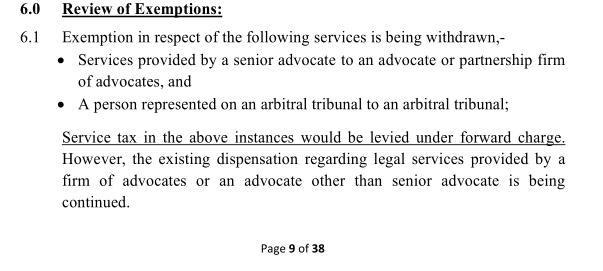
The new provision on page 9 of the finance ministry’s Department of Revenue changes in service tax rules, as first tweeted by @poeticgooner (download PDF here) states:
6.0 Review of Exemptions:
6.1 Exemption in respect of the following services is being withdrawn,-
- Services provided by a senior advocate to an advocate or partnership firmof advocates, and
- A person represented on an arbitral tribunal to an arbitral tribunal;
Service tax in the above instances would be levied under forward charge.
However, the existing dispensation regarding legal services provided by afirm of advocates or an advocate other than senior advocate is beingcontinued.
Hat-tip @sowmyarao_ and @poeticgooner
Comments