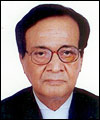
In an e-mailed response to the 32 published comments to Legally India’s interview of 29 June 2009, Sinha (pictured) addressed the commenters and said that he has “high hopes” for the profession.
He wrote: “Brilliant students of law getting degrees from prestigious universities/law schools, instead of enriching [the] bar and bench, prefer to join legal firms [and] corporate sectors to earn handsome amounts from the very beginning of their career.
“If earning money is the only goal of life and you are satisfied with the money you earn then you go ahead with your job.
“You claimed to be expert in drafting, etc. for the client, which a general lawyer [litigator] is not expected [to] do […].
“But remember, drafting, etc. is not only the profession but arguing and assisting the court of justice is one of the primary jobs of a lawyer in [the] dispensation of justice, which you cannot do in your life unless you are a practicing lawyer in court […]. You cannot be a judge of any court […]. Therefore, [against] the aforesaid background I made the said statement […].
“I expect that you will think thrice as to the distinction between you and [a] practicing lawyer in the court of justice, [who is] of course facing hardship in the beginning of a lawyer’s career.
“For a lawyer, all the avenues [are] open, either to be a lawyer, a judge, a politician, president of India, etc.
“But for you there [are] no such avenues if you continue in your job in any law firm or corporate sector.
“For a lawyer, [the] sky is the limit.”
We have republished Sinha’s e-mail in substantially unedited form and length. Click here to read the original interview and comments.
Enter your details below to subscribe for free to our weekly newsletter:
Comments
Oh, by the way for coming to seek an adjurnment from the court, can I also charge you Rs.100000 (you see I need to pay my junior 2500 every month - overheads I say!)
secondly,regarding a lawyer being a judge, its always a personal choice to join the bench, even when one is in litigation.
lastly, does he mean that the lawerys at the bar/litigating are not bright and from good law colleges/schools?
That said, the fact that many young lawyers from top law schools are not joining the bar is a cause for concern at a macro level. At the same time it is also true that a large number of top law students want to join the bar but avoid doing so, not because (in the words of Mr. Sinha) they are afraid of facing any hardship or working hard, but because the bar is not supportive of junior lawyers and the pay is often too low for basic sustainence in a metro.
Instead of telling corporate lawyers that they are not upto the mark, Mr. Sinha should for a change actually put in some effort in punishing corrupt lawyers and overhauling the system. Positive changes in the system will attract talent and until then lack of talented lawyers not joining the bar should not be an excuse to not bring in much needed reforms.
The unfortunate answer is, we did.
As usual we people are also too busy in our life and work to bring any change or for at least trying to bring some change, till then Mr Sinha & company will have their say.
If the Bar Council fails to recognise this, how can it regulate law firms. The rules applicable to litigators are not apt to deal with corporate lawyers. It is not healthy for a profession where the law firms cap their liability to the fees received on that particular transaction, the rules of conflict are unclear at best and non-existent at worst and the regulators consider in-house counsels as "non practicing lawyers" and therefore effectively not lawyers. We need a regulator who understands the sophistication of corporate law firms and their work.
Regulators such as SEBI are in sync with the sophistication. The Institute of Chartered Accountants, which albeit needs more improvement, has at least started moving in the right direction. However, the Bar Council is far from the reality and needs of today’s legal profession.
There is, however, the argument that, given how the Bar Council functions, perhaps it is in the best interest of corporate lawyers and their clients that the Bar Council remains as it is and does not intrude into the workings of a corporate law firm. Is ignorance bliss – I am not sure?
@ 307
I think you've nailed the argument but you've also answered your own question.
Why would law firms want the BCI to do anything else other than what it is does right now?
1. It opposes the entry of foreign law firms.
2. And as you mentioned, since it couldn't care less about the lawyers working at law firms, it doesn't formulate any policy which might remotely concern them. While that is a bad thing, it is at the same time a very good thing as there is no code to regulate law firms.
3. 305 pointed out that we should have a body along the lines of SRA. Would any law firm really want a minimum level of remuneration to be stipulated by anyone?
Which is why, to put 299's comments in perspective, the partners must've elected this 'clown'.
Mr. Sinha obviously doesn't know enough about the law firms to regulate them and to be truthful, he most probably does not even care. Why would he facilitate the enhancement of law firms as a place to work when that would alienate the litigation lawyers, which all things said, are his primary constitutency and arguable worse off than the lawyers in law firms? And since the biggies at the law firm are doing better with him staying away, they couldn't care less.
It's lawyers like Mr. Sinha who are symptomatic of the malaise in the Indian 'system' and as 307's inadvertent yet cheeky remark pointed out, "he has indeed brought a good issue into light (i.e. the dearth of lawyers from top law schools choosing litigation)". Agreed. Mr. Sinha is livng proof that the Indian legal education system is not yet in place.
Legal Dodo
If Mr. Sinha wants to attract talent into litigation, perhaps the first question to ask is why should senior litigators minting money from the profession be unwilling to pay juniors who put in 12 - 14 hour days for them, a meaningful salary. Perhaps if litigators would be willing to pay an honest salary to their juniors, young graduating lawyers would genuinely be in a position to consider litigating and law firm opportunities on an equal footing.
Mr. Sinha - question for you. How much do you pay your juniors who work for you full time? What does that salary constitute as a percentage of your income from this profession.
The views expressed by the Chairman BCI are correct but one difficulty is there. Once one join with the advocate the senior advocate did not pay any thing to him/her. Even for a misc. expenses which may include petrol/bus fare/tea expenses. I think there should be some strategy vide which every advocate may obtain work once in a quarter. (A new advocate who has spent a lot in college,degree and then for license did not receive even a single penny in a year, what he will do then? It is my own experience that how the staff of state Bar council create hurdles in granting the license.) In the larger public interest in the fitness of things if by rotation, from bottom the local bar association may help in providing work to each advocate. First of all every new case be routed/registered with the local bar association and then local bar may provide work to each and every advocate. Unless the work is not provided how one may commence to work hard on his own. Like 138 N.I.Act cases, Land Acqusition cases, MACT cases, 13 B H.M.Act cases,small offences cases and on idential lines at High court level like Bail Matter under the 438cr.P.C., First appeals of Land Acqusition cases, MACT cases, writ cases can be offered rotation wise. The nominal fee be also fixed and general people will also satisfied upto certain extent. In cases if any client at subsequent stage intends to engage specialist such facility may also be made. With these introduction the appetite of new advocate to go else will be mitigated and he/she will learn to work hard with more laborious way and will adhere with the bar association more vigorously.
G.S. Bhatia
Advocate, Patiala
5th Aug,2012