Did you know (or suspect) postgraduate law students hoping to study at an Indian national law university (NLU) nearly all prefer going to NLSIU Bangalore? Probably. But did you know NLIU Bhopal is by some readings more popular than NUJS Kolkata? And that a lot of high-ranking post-grads are going to Lucknow.
Following on from our annually-conducted analysis of undergraduate Common Law Admission Test (CLAT) takers’ preferences for national law schools a few days ago, we have this year, for the first time, also analysed postgraduate preferences for national law schools.
This is far from a completely scientific analysis, and doesn’t necessarily take into account reserved seats, locational factors and quality of postgraduate education offered, but it is rather interesting since there has been very little transparency or reporting done on the LLM scene (with the exception of a few articles below, please let us know if we’ve missed any):
- LLM recruitments: Shunned by law firms top NLU LLM grads go in-house, teach
- The Worth of an Indian LL.M.: A Critique of the LL.M. Programme in India
- And a bit on US LLMs here
In any case, we have published a table below of the top 20 ranks and top 10 ranks who opted for each college for a postgraduate, according to the first indicative seat preference list published by the CLAT.
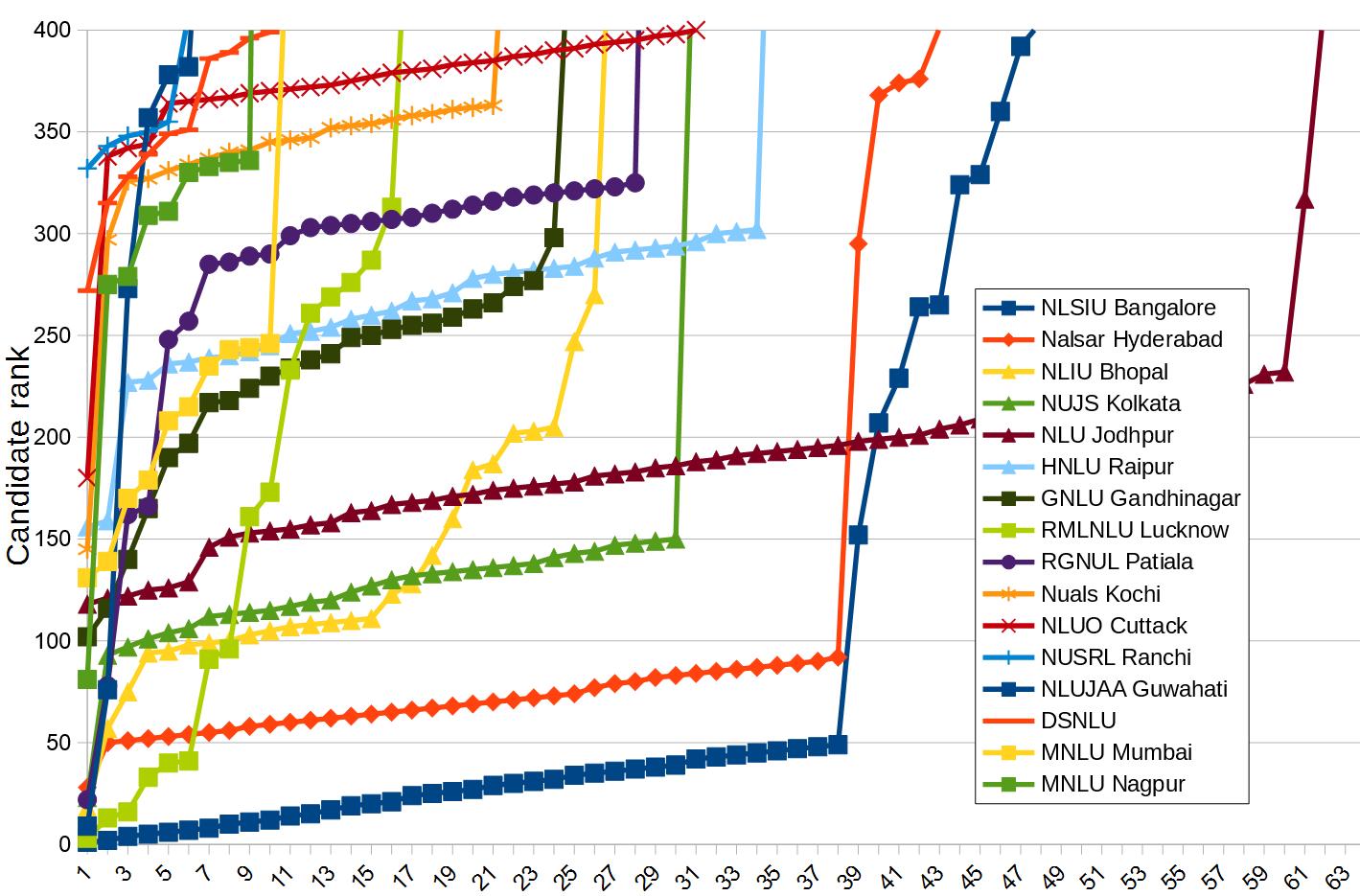
In addition, there’s a slightly confusing graph above plotting candidate ranks against each law college, which is enlightening once you get your head around it (click here for an interactive version of the graph, which may be easier to follow, as well as the source data).
The findings, in short
In short, much like in the undergraduate preferences, nearly everyone ranking in the top 50 wants to go to NLSIU Bangalore.
Nalsar Hyderabad is in firm second place in CLAT post-graduate preferences, both according to the Super 10, Super 20 and the graph.
It gets interesting around NLIU Bhopal and NUJS Kolkata though - NLIU Bhopal, which is the older college but has long been lower-ranked in undergraduate preferences to NUJS - has a clear edge over NUJS both in Super 20 and Super 10 scores.
According to the graph, NLIU reservations likely kick after around 15 candidates, however, while NUJS has a fairly consistent curve up to 30 candidates.
The largest post-graduate NLU, with 80 seats, is NLU Jodhpur, and it is firmly ensconced in CLAT takers’ preferences behind NLIU and NUJS, for all 60-odd non-reserved seats.
Also interesting is RMLNLU Lucknow, which has quite a low Super 20 rank though actually is nearly as popular as Nalsar Hyderabad among its 10th best candidates. That could be a locational preference or a statistical aberration, due to 10 candidates being a small sample size.
Update: The RMLNLU mystery is perhaps solved. Othla tweeted:
@LegallyIndia reason for Lucknow preference is: lot of candidates who score high in CLAT-PG are from UP preparing for UPSC & Judiciary.
— Othla (@othlaw) Fri, 09 Jun 2017, 19:56
Finally, post-graduate candidates marginally preferred GNLU Gandhinagar over HNLU Raipur, which is followed by RGNUL Patiala and Nuals Kochi.
After that, there is a bit of a numerical separating line between NLUO Cuttack, with comparable Super 20 and Super 10 scores in the mid-300s, and the rest.
The remaining four and youngest CLAT colleges, which generally have smaller batch sizes of around 20, are lowest on the list of preferences with Super 20 scores of around 1,000, due in part to reservations kicking in.
However, some Super 10 scores stand out - MNLU Mumbai’s top 10 candidates have a comparable rank to those at HNLU Raipur, GNLU Gandhinagar, and RGNUL Patiala. One would wager that it’s Mumbai’s locational advantage coming into play, yet again.
Conclusion
In any case, this is the first time we’ve done this but we’d be interested in your views: how do you choose post-graduate national law schools? Is there a difference in post-graduate course quality at each of these places, or is it mostly a matter of brand names?
And why is NLIU more popular than NUJS?
Answers and thoughts in comments below please.
Postgraduate NLU Super 20 & 10 preferences
| Super 20 (avg ranks) | Super 10 (avg ranks) | Total PG seats | |
|---|---|---|---|
| NLSIU Bangalore | 14 | 7 | 50 |
| Nalsar Hyderabad | 58 | 52 | 60 |
| NLIU Bhopal | 106 | 84 | 40 |
| NUJS Kolkata | 112 | 98 | 40 |
| NLU Jodhpur | 149 | 135 | 80 |
| GNLU Gandhinagar | 215 | 180 | 52 |
| HNLU Raipur | 242 | 221 | 45 |
| RGNUL Patiala | 258 | 208 | 38 |
| Nuals Kochi | 334 | 312 | 37 |
| RMLNLU Lucknow | 349 | 67 | 20 |
| NLUO Cuttack | 359 | 341 | 44 |
| NLUJAA Guwahati | 827 | 827 | 10 |
| NUSRL Ranchi | 983 | 383 | 20 |
| MNLU Mumbai | 1091 | 201 | 18 |
| DSNLU | 1229 | 352 | 21 |
| MNLU Nagpur | 1515 | 378 | 17 |
Comments
https://barandbench.com/rectracker-nujs-2017-100-placements/
Few issues to flag here:
1. Most National Law schools barely focus on master's students.
2. While specializations are listed, websites of law schools barely provide description of the various electives on offer. More often than not student end up repeating undergrad courses.
3. UGC controls and specifies certain mandatory courses for LLM courses. This limits the number of electives that can be opted by Master's students.
4. Quality of teaching, assessment standards are rather poor as faculty members barely teach. In some instances faculty is asked to focus on Undergrad students.
5. All in all, master's students are forced to learn on their own. Some emerge with better understanding due to their interactions with various undergrad students or due to their own efforts.
Also, I don't understand why there is always a comment on an LLM news berating lack of placements, LLM is not for placements, it is an entry degree for Academics - I think students are misguided if a course is meant for something and you want something else you will be disappointed.
You see, without an US LLM followed by clearing a US State level Bar Exam, it is very unlikely that an Indian law grduate will get a job in a law firm in the US. Also, without getting into detailed niceties, most State level Bar Exams require that candidates study at an American law school. Further, studying LLM at a top Ivy League opens doors to placements, just like studying LLB at top NLUs do.
The situation is different for the UK. London firms do not care that much about LLM. They even hire law students directly from Indian law schools as "Trainee Solicitors" (because English law requires that all law graduates undergo a training period before their enrolment, although the position has changed slightly/technically since 2010 with the replacement of QLTT scheme/exam with QLTS). Indian law students who cannot get a Training Contract during their undergrad days try the LLM route subsequently in the belief that the LLM will improve their chances of getting a Training Contract. Some try the LLM route entry to associate positions directly, after a couple of years at Indian law firms - most of them were earlier registered as "foreign lawyers" but now they can qualify as English lawyers without doing a "Training Contract" if they take the QLTS. Firms, however, may not list them as "Associates" and continue their "foreign lawyer" designation.
https://www.lawctopus.com/clat-colleges-preference-list-the-rankings/