Published:
To some extent it’s understandable: for years, the Indian legal profession – particularly litigation – has been dominated by men, and most of the new law firms that rose in the nineties and noughties were headed by men. The (generally) male managing partners would often be busy trying to capture market share and executing the work; worrying about whether female lawyers were given the same opportunities as the men was for many an afterthought, if that.
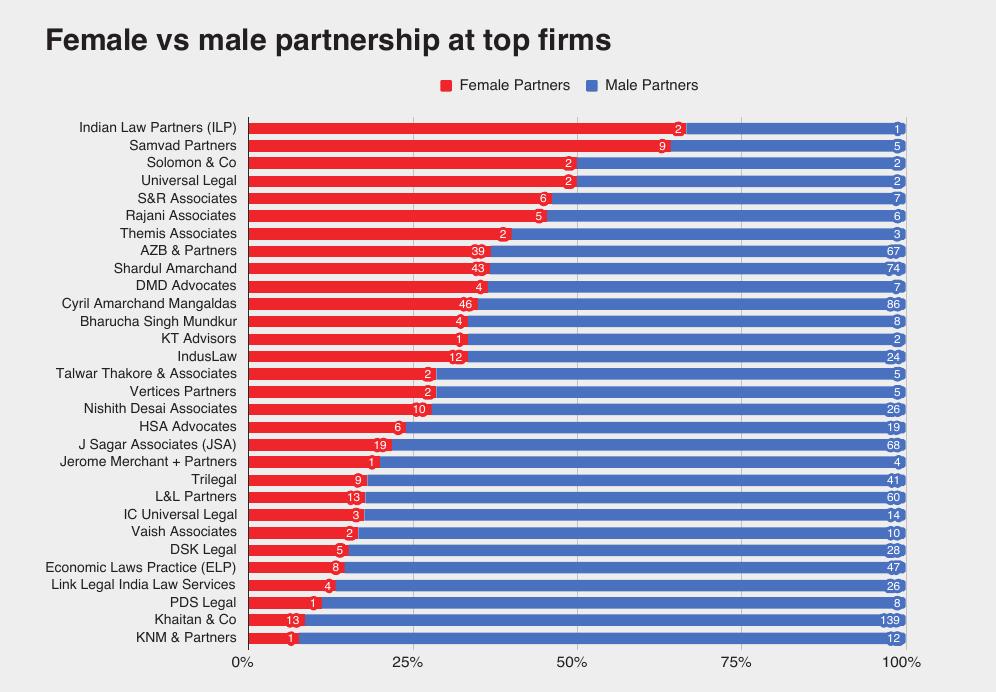
The average percentage of women making up the partnership at 30 top Indian law firms, for which data was available, currently stands at 30%. At only 23% out of those 30 firms is that senior gender ratio above 40%; at a third of firms it’s below 20%. And amongst our Top 100 Corporate Dealmakers, only around 25% are women.
Samvad Partners stands out amongst all the larger firms with a gender balance of 64% in favour of women in its partnership of 14. “It just worked out that way, it was not planned that we had more women becoming partners,” explains partner Vineetha MG. “It is completely based on performance,” she adds, but agrees that it does help that the firm’s senior leadership has women in it. “It brings some sort of sensitivity to certain issues.”
Other larger firms with more balanced gender ratios include S&R Associates (46% are women out of 13 partners) and Rajani Associates (45% out of 13). And AZB & Partners, Shardul Amarchand Mangaldas and Cyril Amarchand Mangaldas are also above the average, with between 35% and 37%, out of more than 100 partners being women.
MG says that at most firms the gender imbalance is not necessarily intentional: “It depends on policies within the firm itself, how they look at development. I don’t see any firm in the market today actively trying to make some sort of discrimination. It has just resulted in that way, but it is also dependent on the environment: if you provide more opportunities, then women come out in a good way in those opportunities.”
Some of the firms that have struggled the most to increase diversity at the top, have also been making strides recently to address the deeper issues. At Khaitan & Co, only 9% of its partnership are women, but in its most recent promotion round in April 2019, more than half of the 11 new partners were women.
At IndusLaw, all four of its new partners made in April 2019 were women - in probably a first in the industry - increasing its ratio to 33%. At Cyril Amarchand Mangaldas and AZB & Partners this year, respectively 42% and 40% of new partners were women.
While a charge may occasionally be whispered by male colleagues that women are getting unfairly advantaged these days by firms trying to be more diverse, it is highly unlikely that firms which primarily value profitability and quality above most other factors would dilute their quality at the top. The fact is that many law firms have actively worked at improving their internal systems, which allows high performers, many of whom happen to be women, to shine and be recognised.
“The firm actively encourages diversity in all its avatars, especially gender,” explains Khaitan & Co executive director for HR, Amar Sinhji. “Towards making our firm more inclusive and supportive of women, a host of policies, including flexi time, work from home and truncated hours for returning mothers have recently been introduced. The firm is also introducing a structured mentoring programme beginning with our principal associates.”
With 50% of incoming campus recruits being women (“selected based strictly on merit”), Sinhji says that this would, “over the next couple of years positively skew the gender balance in the firm”.
Other firms at the lower-end in terms of gender balance, such as J Sagar Associates (JSA), which stands at 22% of its women being partners (dropping to 14% at the equity partner level), are also doing more. Joint managing partners Vivek Chandy and Amit Kapur explain in a statement that the firm now offered six months of maternity leave, in accordance with statutory requirements, had introduced creche facilities for working mothers, and has a flexible timings system to allow lawyers to “balance both work and needs of a young family”. And the leadership at JSA has historically also included two female joint-managing partners as well as female partners represented in “important decision-making committees” at the firm.
But, not everything is about getting systems in place either. A large part may simply be a new-found awareness, sensitivity and practical attitudes of some issues by male senior partners, of which they may have previously been (blissfully) ignorant.
“I think policies don’t always work,” says AZB Mumbai managing partner Zia Mody. “I’m a big believer in bespoke solutions, and that’s still possible for Indian law firms because of their size.”
“Not all our women get married and get pregnant at the same time,” she notes. “It’s possible for management to have bespoke conversations to understand the need of every woman separately. [When women ask for maternity leave or flexible working] there will be common concerns about time, ability, ‘will I lose out in the race?’, ‘will my career be affected?’
“At this time it’s very easy for partners or the team, to basically get irritated, etc, and that negativity feeds down to the woman in question, which then becomes a circle of diffidence and lack of confidence, and then she just quietly leaves. If you dive into that, it’s a problem, it’s a reality: there will be some disruption and unexpected availability, and therefore you need a backup that you bring in the beginning. You understand that a client won’t pay for an extra hand, but as an organisation you’re allowing the gap to be filled in and providing for limited redundancy for the period.”
“It’s an outlook change as well that’s required,” agrees Samvad’s MG about how the profession can increase participation of women at senior levels. But she adds: “As compared to other Asian countries, India is ahead.”
That is likely true: countries such as Japan, for instance, are well known for their dearth of women in corporate leadership positions, and the female partnerships at some of India’s largest firms are far more gender diverse than nearly all international firms.
So, as India’s top firms become more secure in their market position, with the most rapid growth behind them, many of are taking promising steps in the right direction.
However, it’s clear that no change will come without deliberate efforts.
{module 544}
Comments
Please tell me this not euphemism for telling women colleagues when they can or cannot have a baby and any 'happy news' before or after such timelines will be met with appropriate consequences.
p.s. Let's see if LI has it in them to print this comment.
It's alarming to think law firms don't follow the law themselves. And Zia seems to imply that a woman who is not at her desk is useless to her client. It's time to call out the sexism in the legal industry. For the longest time it has been a wonder as to why #metoo in law firms did not come out. Considering partners are predators in a suit in some of the firms mentioned in the article. And women MPs or bosses there don't even blink a billable hour. Navel gazing and watching the sky are quite accepted as hazards of the work place after all.
Start by giving compulsory month long (if not) paternity leaves - instead of a pittance like 5 days. Allen and Overy has something like that. Let childcare disrupt the career progression of both men and women alike. It'll make men equal parents at home and women equal lawyers in office.
the bias is so high and work at law firms so stressful that women often leave their high paying jobs despite being more talented than male counterparts when planning family as its an open secret that no comfort or support in such crucial time will be extended or entertained ...and our male colleagues are no different, they use this opportunity to pull down their female colleagues....thats how its is ....most of women become try to become independent or take up concessionary jobs who want to give time to their motherhood alongwith their career
sad but this is the truth....