Against the backdrop of Brexit and vaccine diplomacy the United Kingdom and India yesterday agreed to a deal to increase investments by $1.39bn and to work on a longer-term bilateral free trade deal between the countries (dubbed an “Enhanced Trade Partnership”), as widely reported.
The already announced deal includes agreements on migration and cooperation on climate change, technology and in the pharma sectors, as well as the commitment to soon begin full trade talks to hammer out the Enhanced Trade Partnership (ETP).
However, not widely covered and right at the bottom of the UK government’s press release of the deal, as pointed out to us by an eagle-eyed reader, there is something that will be of interest to regular readers and followers of the ancient and never-ending story of Indian legal market liberalisation - ‘will they or won’t they?
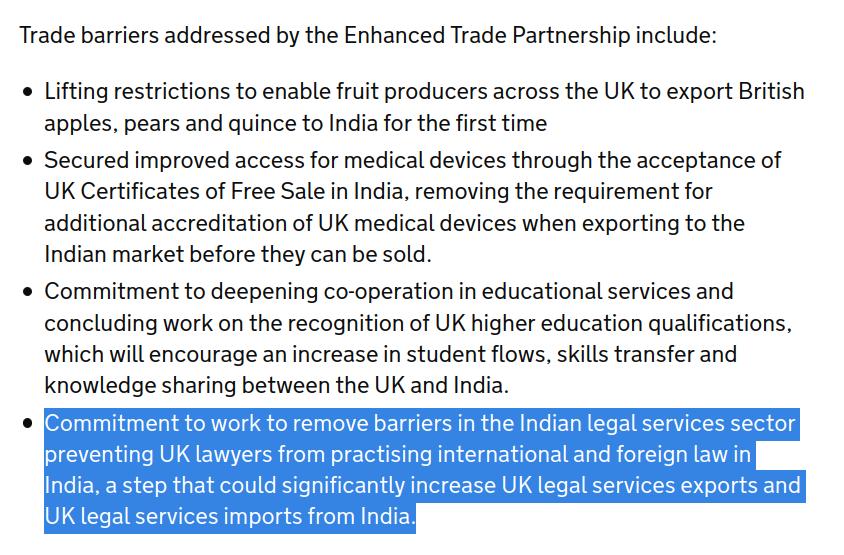
In the press release, the UK government wrote that “Trade barriers addressed by the Enhanced Trade Partnership include”:
Commitment to work to remove barriers in the Indian legal services sector preventing UK lawyers from practising international and foreign law in India, a step that could significantly increase UK legal services exports and UK legal services imports from India.
That language is, of course, a textbook example of being non-binding.
What does it mean? Same as always
But for those hoping for the entry of foreign law firms to India, the above is a sign that at least the UK still has its eyes set on pitching for its law firms to be able to do more business in India.
And post-Brexit that may not be surprising: the legal sector and its London-headquartered giant international law firms are some of the few remaining trump cards in the UK economy that could remain relevant even without Europe.
For opponents of liberalisation, there is solace that this is neither the first time that India has considered the subject, nor the first time that the UK (such as in 2016;; and 2011) or other countries’ delegations have brought it up (and dropped, such as by Obama).
Nor is it therefore likely to be the last.
The Indian government’s press release from yesterday about the ETP makes no explicit mention of services, let alone legal ones, for instance.
And domestic pressure might make this a tough point to press for the UK: lobby groups such as Society of Indian Law Firms (Silf) and Bar Council of India (BCI) have furiously and (apparently) successfully lobbied against attempts to open up the sector in the past.
That is albeit corporate general counsel (GCs) having expressed a preference for foreign lawyers’ entry, while the Indian National Bar Association (INBA) and some senior lawyers, such as senior L&L partner Mohit Saraf and senior counsel Harish Salve and Gopal Jain had also spoken in favour.
In short, the situation is much the same as it has been for decades with plenty of positive intentions and statements for liberalisations made from both governments without a pudding of proof ever getting baked.
As such this story will no doubt continue though even without an end.
Comments
- RSS and Swadeshi Jagran Manch
- Bihar/trial court advocates lobby (led by the law minister and BCI chairman)
- Indian family law firm lobby (led by a person linked to Modi's favourite industrialist)
Do try to score a copy of the declaration if you can! Will make for an interesting read.
Cheers
7.2 Remove barriers to trade through a balanced and beneficial market access package under the ETP including on agriculture, healthcare, education, legal services, seafarers, marine, healthcare and social security.
No ambiguity there.