NLSIU Bangalore earns annual revenues of over Rs 1 crore as fees paid by students admitted under its foreign national quota even though more than 80 per cent of those students were not even schooled outside India, revealed a study by Chirayu Jain published in Economic & Political Weekly (EPW) in December 2017.
NLSIU uses a mere 2.37 per cent of this revenue to subsidise the fees of scheduled category students, even though the average annual family income of reserved category students was lower by Rs 11 lakhs than that of foreign national quota students, wrote Jain, who is a 2017 graduate of NLSIU currently practising in the Delhi high court as an advocate.
The academic performance of the foreign national quota students at NLSIU on an average was lower by one full cumulative grade point average (CGPA) than that of its general category students.
Jain’s study examined the constitutionality of foreign national (FN) and NRI quotas in national law universities (NLU).
Lucrative seats
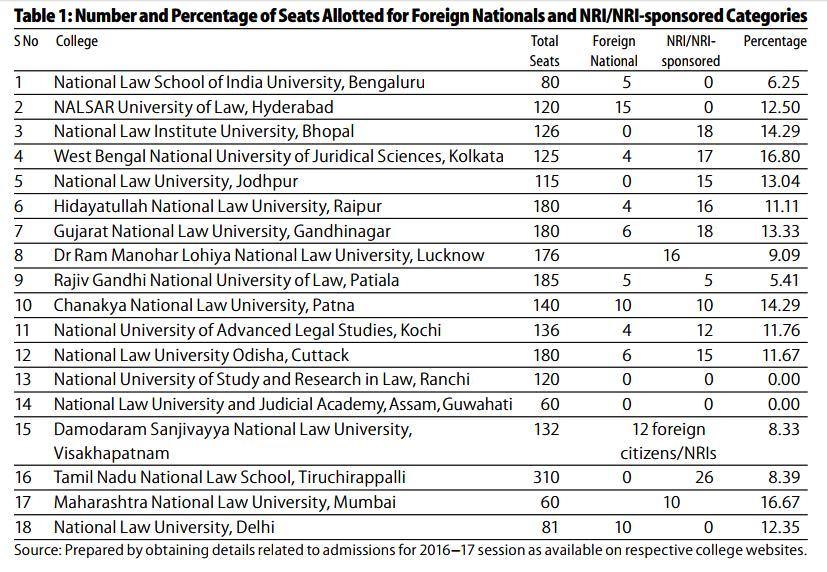
The study revealed that through admissions conducted on the basis of vague, undefined and inconsistent parameters for selection and admission of NRI and FN quota students, 15 NLUs are able to add from anywhere between Rs 2.77 lakh (NLUO Cuttack) to Rs 11.75 lakh (MNLU Mumbai) per student, to their coffers every year.
GNLU Gandhinagar makes the highest annual revenue per batch, more than Rs 2.2 crore having reserved 24 seats for FN/NRI students. It is followed by NUJS Kolkata (Rs 1.48 crore, 21 seats), NLIU Bhopal (Rs 1.43 crore, 18 seats) and MNLU Mumbai (Rs 1.1 crore, 10 seats).
“It is evident that the said foreign national/NRI/NRI-sponsored quota is unconstitutional. At the very least, the Bar Council of India, which has the mandate to regulate the legal education imparted in the country, ought to ensure that a uniform definition of these categories is adopted and there is uniformity in the merit sought by the individual NLUs,” Jain noted in the study.
| Total NRI seats / year / batch | Fees (lakh Rs) | Annual revenues (assuming 5 batches / year, Rs crores) | |
|---|---|---|---|
| NLSIU | 5 | 4.9 | 1.23 |
| Nalsar | 15 | 5.3 | 4.00 |
| NLIU | 18 | 8.0 | 7.19 |
| NUJS | 21 | 7.1 | 7.41 |
| NLUJ | 15 | 5.5 | 4.13 |
| HNLU | 20 | 4.2 | 4.15 |
| GNLU | 24 | 9.3 | 11.16 |
| RMLNLU | 16 | 6.2 | 4.99 |
| RGNUL | 10 | 3.0 | 1.49 |
| CNLU | 20 | 3.5 | 3.55 |
| NUALS | 16 | 4.6 | 3.67 |
| NLUO | 21 | 3.4 | 3.57 |
| DSNLU | 12 | 2.8 | 1.66 |
| TNNLS | 26 | 3.9 | 5.08 |
| MNLU Mumbai | 10 | 11.8 | 5.88 |
| Total: 249 | Avg: 5.6 | Total: 69.14 |
Source: Jain, EPW, Legally India calculation
++Unregulated quota
There is a gap in regulation on foreign quotas in NLUs, said the study.
The Supreme Court had laid down in 2005 in the case of PA Inamdar vs State of Maharashtra that only “bona fide” NRIs and their children or wards should utilise foreign quotas in universities, and that even in selection of these bona fide NRIs, merit should also be taken into consideration.
But this still doesn’t answer questions such as whether “a foreign national is a foreigner residing/visiting/studying/employed within India? Or, is a ward of a NRI also a foreign national even if they hold an Indian passport, but have a permanent address abroad and have been studying in India?” according to the study.
NLUs take advantage of the absence of specific regulation in the area and:
- NLSIU applies the quota on only the production of a foreign passport, asking for no proof of residence or proof of having completed schooling from outside India. As a consequence, 17 out of 21 foreign national students (from the 2016–20 batches) were found to have completed their schooling within India.
- _Nalsar Hyderabad_ and NUJS Kolkata do not define who a foreign national is.
- RMLNLU Lucknow and MNLU Mumbai do not make a distinction between an NRI and a foreign national.
- NLIU Bhopal considers any Overseas Citizen of India (OCI)/ Person of Indian Origin (PIO) cardholder to be eligible for the NRI/NRI-sponsored category as well.
- MNLU Mumbai does not require the sponsor to be related to the a NRI-sponsored category candidate, unlike NLUs such as NLIU which requires candidates to be sponsored either by fi rst degree or second degree NRIs or OCI/PIO cardholders.
- At RGNUL Patiala the definition of NRI itself is broader; it includes the spouse/ progeny (natural or adopted) of an NRI.
- TNNLS Tiruchirapalli creates a hierarchy within the NRI-sponsored category: those with NRI parents are to be preferred over those with NRI guardians, and both are to be preferred over those with NRI sponsors. Even though the regulations stipulate that only merit is to be given consideration within these categories.
Other observations of the SC
In PA Inamdar, the Supreme Court had also ordered a cap of 15% on NRI quotas in universities. NUJS Kolkata and MNLU Mumbai are in violation of this rule, while NUSRL Ranchi and NLUJA Assam do not provide any foreign national or NRI quotas.
The court also asked the NLUs, through a non-binding suggestion, to subsidise the fee of economically weaker or other backward students using the surplus from foreign quota fee.
The average annual fee of Rs 6.2 lakh that 15 NLUs charge under the foreign quotas is three times that of the fee they charge annually on an average to the general category, but 10 of these NLUs do not pass over any benefits from the surplus revenue so earned to scheduled category students.
The remaining 5 NLUs use between 1.98% (Nalsar) to 7.55% (MNLU Mumbai) of the surplus to subsidise scheduled category student fee.
Death of exclusivity
Scheduled category reservations are often blamed for the “death of meritocracy”, says the study, but at NLSIU, for instance, the CGPA of both foreign quota students and scheduled category students on average is at par with each other and lower by 1 CGPA than that of general category students on an average.
Foreign quota students perform better than scheduled category students in being selected on student run committees. The former have a rejection rate of 13.6% while the latter have it between 16-26%. But this is in context of family backgrounds, foreign quota students being better off with an average annual family income of almost Rs 27 lakh, whereas scheduled category students have it at Rs 16.3 lakh.
Only one foreign national part of the study assessed themselves to be not fluent in English, while 11.9% of SC and 19.4% of ST students assessed themselves as being poor in English language.
“Do SCs/STs face the ire because they cause the death of meritocracy, or is it because they cause the death of exclusivity?” Jain asks.
As a student at NLSIU Jain also explored diversity at NLSIU through his study in 2015 which revealed that although elite private-schooled third generation college goers make up a majority of the law school’s population, this trend is reversing with each successive batch. In his first year of law school in 2013 he had sued Hindustan Pencils for a racist crayon colour categorisation.
Comments
[b]Facts:[/b]
[b]1. Context: [/b]Indian law schools run cash-strapped. Everyone sees these categories as means to supplement earnings & not as a conspiracy to further exclusivity. Funding for our universities is a joke.
[b]2. Academic Performance: [/b]In my class at a national law school covered in the report, some of the class [b]TOPPERS[/b] were (and [b]Rank #1[/b] in most years was) from the NRI category. Beyond the first few weeks, we didn't think of students in terms of which seats they entered the community. It was simply on merit - many who scored very high in the entrance did horribly in courses or even failed. How successful one became was simply in their own hands.
[b]3. Misinterpretation of Data - FN Data Cited for NRI categories:[/b] Right from the headline, the story seems critical of the academic capabilities of the NRI category/ sponsored students. BUT - your CGPA data is ONLY for Foreign Nationals? They are totally different categories & this is gross misreporting.
[b]4. Where's the Info on Cut Offs?:[/b] The entrance exam cut-offs for NRI categories back then were comparable to the General category. What is it under CLAT? This should've been covered in the study since the HEADLINE starts with a bias AGAINST the academic rigor of such students. Again, this should be separately evaluated for Foreign Nationals, if at all.
[b]5. CGPA - Be All, End All?[/b] Law school is NOT only about CGPA. World over, there is focus on interaction with diverse students, inclusivity, co/extra curricular activities.
[b]6. Absurd Comment on Student Orgs:[/b] That comment contextualising family background & income to selection to student committees is absurd! I support reservation for SC/ST students for lack of earlier opportunities, but to credit family income for selection to a student organisation is discrimination too. Abilities to speak, write, lead & organise are valuable skills. If one set of students is edging-out others in one area and it is the other way around in another, it would mean it is a healthy competition for both to do well.
Headline - "NLUs make $$ from [b]NRI[/b] quotas, who have lower GPAs..."
Report - "[b]Foreign quota[/b] students ... ... lower by 1 CGPA"
Fact - "[b]Foreign Quota[/b]" and "[b]NRI/ NRI Sponsored Quota[/b]" are not the same
E.g. NRI quota students clear the entrance exam, FN students don't.
Sad to see LI join the #FakeNews bandwagon.
You're basically slinging mud at hard working kids & jeopardising their careers by not fixing that misleading headline.
Either do a study of the NRI/ NRI Sponsored students' grades & report actual facts, or fix the error.
Idealism is beautiful like a fake diamond.
I think prachi you should do seperat story on this.
I request Legally India to please expose this scandal and ban this sham quota.
There are NRI students in the 2014- 2019 batch with CLAT rank of 11,000+ in GNLU. And yes, they aren't NRIs even if you stretch the prescribed conditions by a mile.
Most of them hail from big cities (where certain coaching institutes urge these people to apply through the NRI quota) and some of them are sons and daughters of high and mid-level apparatchiks (let the reader have brains to figure how they fund the admission) in the government.
Legally India should do a story on this. Shri Shri BP and Pingu needs to act on this.
These students are undeserving. Better that these students study in Jindal/Symbi/Amity/other dumbshit pvt colleges.
The issue of constitutionality of this quota, not just in the above-discussed case of NLUs, but across educational institutions needs to be settled at the earliest by the Supreme Court.
and then they merge both without thinking.
Here my PIO child had more preference for indian citizenship.. i dont understand that country like US dont allow H1B worker to stay beyond authorised limit but give citizenship right by birth to those parent's child. India govt mark PIO / OCI and now poor people like me have to either bear 5 times high cost education under that category or educate the child with what they can afford and they all will represent future india out of india if they go.....
we are here in india since 2003 and paying high fee as child born out of india in USA.. waited 11 year on PIO but all of sudden it was merged with OCI . so applied OCI and now again have to wait for 5 year on OCI to apply for Citizenship as PIO was surrender.... its ok if PIO/OCI come from outside pay 5 times fee but why those who live here so long .. looks like its mistake we citizen make to choose our leader but we dont have any choice all are at same level. our policy are complicated not straight forward. ,,, Its advice to all who go out for company work have a child birth plan out of india only if you can afford then to india otherwise dont plan child or dont come back...
1. First off - you need to differentiate between NRIs/NRI-sponsored and FNs. While the former have the option of writing the entrance, the latter do not. If an FN wishes to study in a premier law school, his/her only option is to shell out the exhorbitant fees. That's the rule. It's not a conscious choice we make.
2. On that note, I'd like to do away with the FN quota too. A good part of my schooling was done in India. My parents do not earn in USD. Barring us from writing the entrance and demanding the high fees from us is unjust, in my opinion. You could allow us to write CLAT/AILET. Food for thought?
3. You can't take an example of a [i]single batch[/i] in a [i]single NLU[/i], and generalise it to make a comment on the overall merit of FNs in law schools [i]across India[/i]. I know a lot of my "meritorious" batchmates who had borderline pass marks only because some of their FN friends were gracious enough to lend their class notes.
4. Once you're in law school, you're in law school. You can't keep reminiscing about your excellence in CLAT/AILET and expect to do well here. Law school has no place for you.
I do agree with your point NLUs minting money from FN/NRI students and yet not subsidising the fees of EWS/SC/ST and other reserved category students. Be that as it may, it doesn't give you any grounds for launching an attack on the merit and worth of FNs.
This article is an academically unsound, bitter piece, highlighting your grudges against a set of sincere, hardworking students. I, for one, despise you almost as much as you despise me.