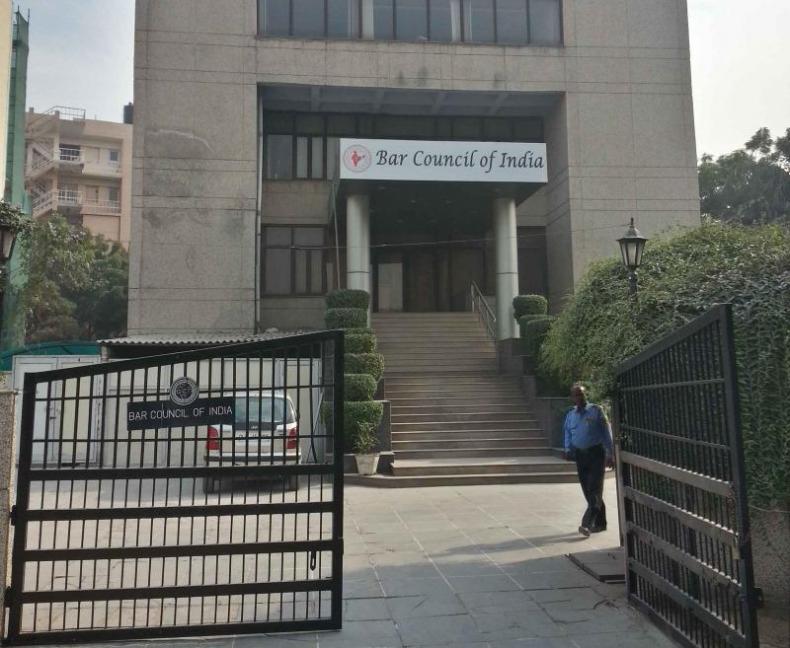
The Bar Council of India (BCI) has proposed to override law schools’ autonomy by inducting its own members into their faculty selection committee, as an “expert member”, in its draft first amendment to the Legal Education Rules 2008.
One of several law school heads we spoke to said that the proposed amendment was generally opposed and there was not likely to be unanimity within the Legal Education Committee for it to be passed.
The draft legal education rules amendment follows the BCI’s hefty draft amendment of the Advocates Act 1961, in which also the BCI attempted to tighten its control over the profession by assuming many new powers and functions.
VCs slam rule 56 on BCI ‘expert member’
Rule 56 of the BCI’s draft, as first reported by Live Law, reads as follows:
[Rule 56] Composition of the Selection Committee: The Selection Committee for faculty positions in law in each University and its centres for legal studies (affiliated institutions) shall comprise one expert member nominated by the Bar Council of India. The Bar Council of India may nominate one or more expert members, one of whom shall be invited by the University to attend to such selection committee meetings.
NLU Delhi VC Prof Ranbir Singh commented: “They are not qualified [to be in the faculty selection committee]. For anyone to be in the selection committee, they have to be a professor (including an assistant professor or associate professor) as per the UGC rules. The UGC also sees whether [the selection committee member] can teach and the kind of research they have done.
“BCI members may be knowledgeable but have no idea about research in law. It will create additional problems.”
“It is an absolutely unwise move. universities are autonomous,” added Singh.
RGNUL Patiala VC Prof Paramjit Jaswal noted: “The UGC is the regulatory body which is looking after [faculty] appointments. Why should there be duplicacy [because of the BCI also now regulating appointments]?
“If the selection committee does not fulfill the UGC’s criteria then the UGC will not recognise it. Who is supreme? The BCI or the UGC? You cannot have two sets of procedures for appointment.”
Indian nationals holding foreign law degrees
The draft amendment, which was circulated to the heads of all Indian law schools, departments and universities by a letter dated 2 January inviting suggestions, also proposes to replace the Qualifying Examination for Indian National Holding Foreign Law Degree with a “bridge course”.
On enrolling for and passing this course Indians holding the LLB degree from foreign universities can directly appear for the bar exam.
The amendment also proposes conditions on the fulfilment of which undergraduate and post graduate law degree obtained from foreign universities will be equivalent to the same degrees obtained from Indian universities. The conditions take into consideration factors such as time, subjects, history of the university and the status of reciprocal arrangements with India.
Jaswal commented: “[The move is] atrocious. BCI cannot have any control on LLM. The [Association of Indian Universities] is [regulating] it. The role of the BCI is to see the maintenance of professional standards in professional education. LLM is not a professional degree. It is an academic degree and in [the regulation of] academic degrees the BCI has no role.”
Doubled law school faculty ratios
The draft amendment also proposes to double the faculty strength at law schools by bringing down the mandatory faculty-student ratio from the current 1:40 to 1:20, failing which after three years of default law schools will face a penalty imposed by the BCI.
The proposal calls for a core faculty of full-time teachers, of a certain strength, in each law school. Only one subject can be assigned to each law faculty. One full time faculty to teach English, three arts subjects and nine law subjects each is mandatory as per the proposal.
The proposal also prescribes minimum qualifications for law school faculty but does away with an LLM degree as such minimum qualification, although qualifying the NET is a mandatory minimum for the designation of an assistant professor. However if a law school is faced with lack of suitable assistant professors, the proposal retains the flexibility to allow a lecturer or a teacher’s assistant with three years’ experience to fill the assistant professor’s post.
Although it is not necessary for a lawyer to hold an LLM in order to be appointed as an assistant professor, according to the proposed amendment, it is mandatory for a lecturer or teacher’s assistant who has been appointed as assistant professors, to finish their PhD thesis within three years from appointment, the amendment draft adds.
Associate Professors must have eight years’ experience teaching as an Assistant Professor, five papers published in peer reviewed national or international journals and a minimum score in the Academic Performance Indicator (API) of the UGC, adds the draft. Professors must have 15 years’ teaching experience, eight publications, and must have guided at least two PhD theses.
Comments
Also, Prof Singh is being too kind when he describes BCI members as "knowledgeable". While Gopal Subramanian no doubt was very eminent, his successors are completely mediocre .
I urge Legally India to look into this issue.