Analysis of data submitted by 29 law schools to the government’s National Institutional Ranking Framework (NIRF), of which 19 were ranked in the top 20 of NIRF, has revealed that nearly all face significant disparities in undergraduate female to male gender ratios, which are considerably below the national average for the age group of law school aspirants.
According to 2011 census data, 47% of 15 to 19-year-olds are women.
However, only three colleges - AIL Mohali, SLS Pune and KIIT Bhubaneswar - have undergraduate populations of women above that level, with national law schools generally performing the worst (with the exception of NLIU Bhopal, see below).
On the postgraduate front, the results were perhaps surprising: all but four of the colleges’ one and two-year postgraduate LLM degrees were dominated by women candidates and scored higher than the national average of 48% for 20-25-year-olds.
Undergraduate gender ratios
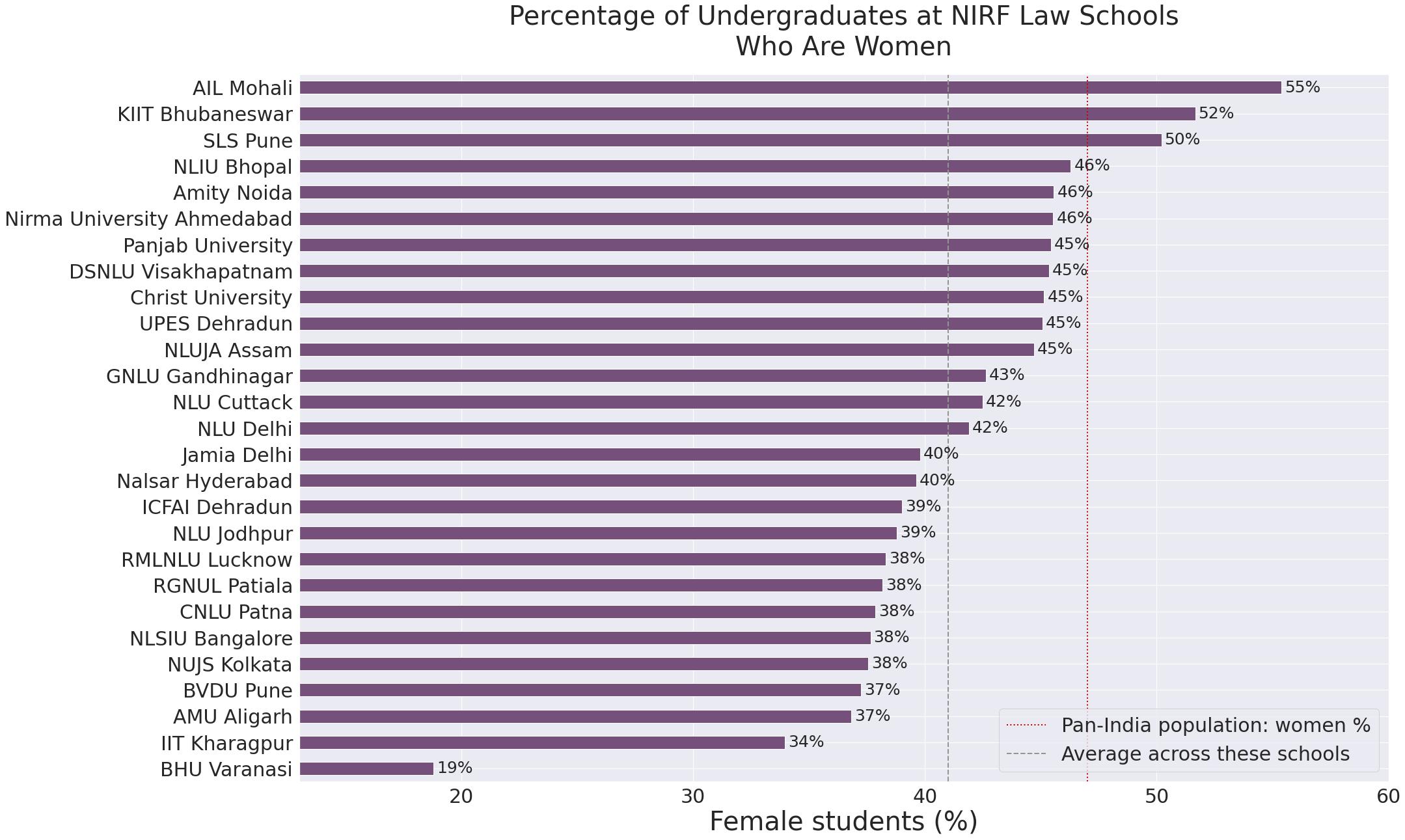
Out of the national law universities (NLUs) only NLIU Bhopal had somewhat healthier ratio of 46% women to men but nearly all others came in at below the 40% mark: NLU Delhi, Nalsar Hyderabad, NLU Jodhpur, RMLNLU Lucknow, RGNUL Patiala, CNLU Patna, NLSIU Bangalore and NUJS Kolkata only had, respectively, between 40% and 38% women in their LLB programmes.
By far the worst performer on this metric was BHU Varanasi, where only 19% of undergraduate law students are women and IIT Kharagpur - perhaps much in line with the gender disparity at most IITs, only had 34%.
The blame for the low entry of women into NLUs, where entry is solely via the Common Law Admission Test (CLAT), or the All India Law Entrance Test (AILET) in the case of NLU Delhi, must lie there.
Indeed, the generally disastrous 2015 CLAT had showed a drop in the percentage of women in the top 500 ranks from 45.7% the year before to 36.6%, despite 45.4% of candidates having been women.
But that is only half the story.
Could more LLB reservations be the answer?
Alongside NLIU Bhopal, also DSNLU Visakhapatnam and NLUJA Assam have higher ratios of women in their LLBs of 45%, while GNLU Gandhinagar and NLU Cuttack had 43% and 42% respectively.
The likely reason for NLIU’s stronger performance lies in reservations: according to its 2020 CLAT prospectus, NLIU has reserved 30 horizontal seats for women candidates out of a total of 122 it will admit.
Likewise:
- DSNLU has a 33.33% horizontal reservation for women from Andhra Pradesh,
- GNLU has a 30% horizontal all-India-seats reservation for women.
This does not alone explain NLUJA Assam and NLU Cuttack’s healthier ratios, which do not appear to have horizontal reservations for female students (if you are aware of any other NLUs that have horizontal reservations for women, please let us know in the comments).
Update: Nalsar Hyderabad also has a 30% horizontal reservation of 36 seats at undergraduate level. RMLNLU Lucknow has 20%. Out of those that have not submitted to NIRF, HNLU Raipur and MNLU Mumbai both have 30%.
Update 18 June 2020: NLU Delhi also has a 30% horizontal reservation for women. Thanks for @NLU Alumn in the comments for pointing out.
That said, the data is strong evidence that if national law schools and by extension the legal profession is to become more diverse in terms of gender, the only thing that seems to work in practice is to reserve more seats for female candidates.
LLMs: Much more female-friendly
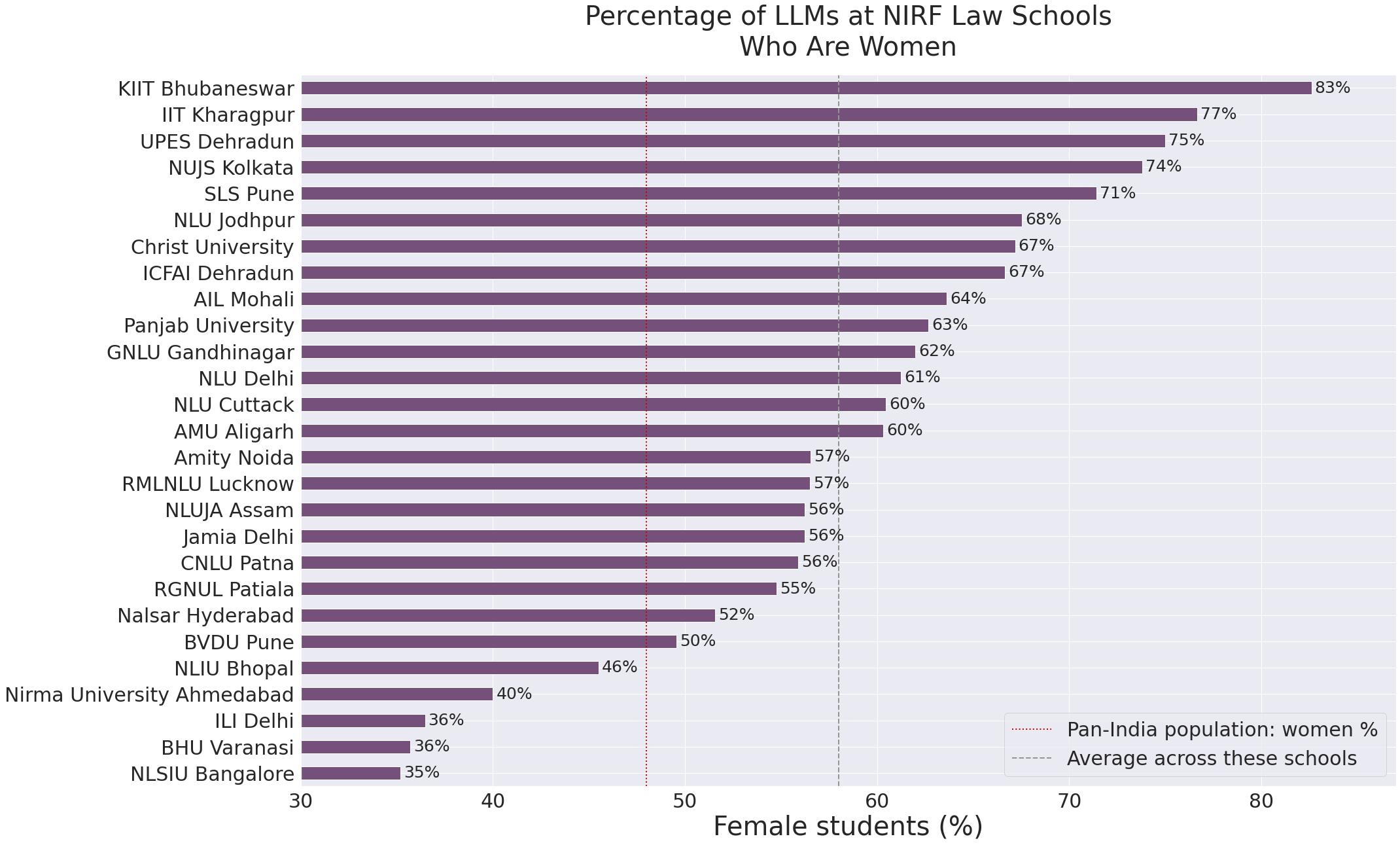
Nearly all institutions have more than 50% women admitted into their LLM programmes, with KIIT Bhubaneswar and IIT Kharagpur having a massive 83% and 77% women on these courses, respectively.
UPES Dehradun stands at 75% while NUJS Kolkata has the most female-friendly LLM at an NLU, with a ratio of 74%.
However, the worst performer out of all, coming in even lower than BHU Varanasi that in the LLMs is similarly unpopular with women at a ratio of 36%, is NLSIU Bangalore.
At NLS, just over a third of its 54 LLM candidates are currently women.
And the LLM-and-PhD-only ILI Delhi, ranked 18th in the NIRF, fared similarly badly: only 36% of its 340 one-year-LLM candidates were women (for PhD candidates, no gender figures are submitted to NIRF).
Digging the NIRF: Next steps
Please read our mission statement for analysing the NIRF data and let us know suggestions there.
Comments
Most criminals are men anyway.
If anything, there had been an increase in the number of people coming in from smaller cities, a disproportionate number of whom were male.
My theory has been that people hearing about big firm money is the worst thing to happen to diversity in law schools (albeit only in terms of gender parity, not geographic distribution). We now have CLAT mills that are almost as bad as the JEE stuff, and in a race to become as toxic.
A general observation is that the larger the male majority in the coaching place, the lesser the number of parents willing to let their girls go there (Indians parents having irrational reactions, go figure). And there is DEFINITELY a majority of male students in a lot of coaching centres. This wasn't the case when I was in one.
This is again something that I've noticed personally. Please visit the coaching center you may have gone to or visited before 2012, you might find the contrast shocking.
I joined my NLU is 2013 and we had quite a fair mix of people from all over India (including the North-East), albeit with a few more people from Delhi. Now, that trend has actually reversed and there aren't as many folks from the big cities (especially cities like Bangalore and Mumbai, where the coaching culture is not as competitive like it is up north) or for that matter, other States except the BIMARU ones (which are socially and culturally backward in terms of gender equality). Now this is not necessarily a bad thing but it has adversely affected the gender diversity in law schools, no doubt.
This is also why I think domicile reservation could be a positive in some ways (and a negative in others). This whole argument of an absolute meritocracy is not quite going to get you quality students since a good law student need not necessarily be a good competitive exam taker. These are State universities which are largely funded by the State governments after all. And States like MP and UP don't have good law schools which means their students are attracted to the ones in the other states.