Explained: What is & who might take India’s first BA in “legal studies” for 3 years at JGLS?

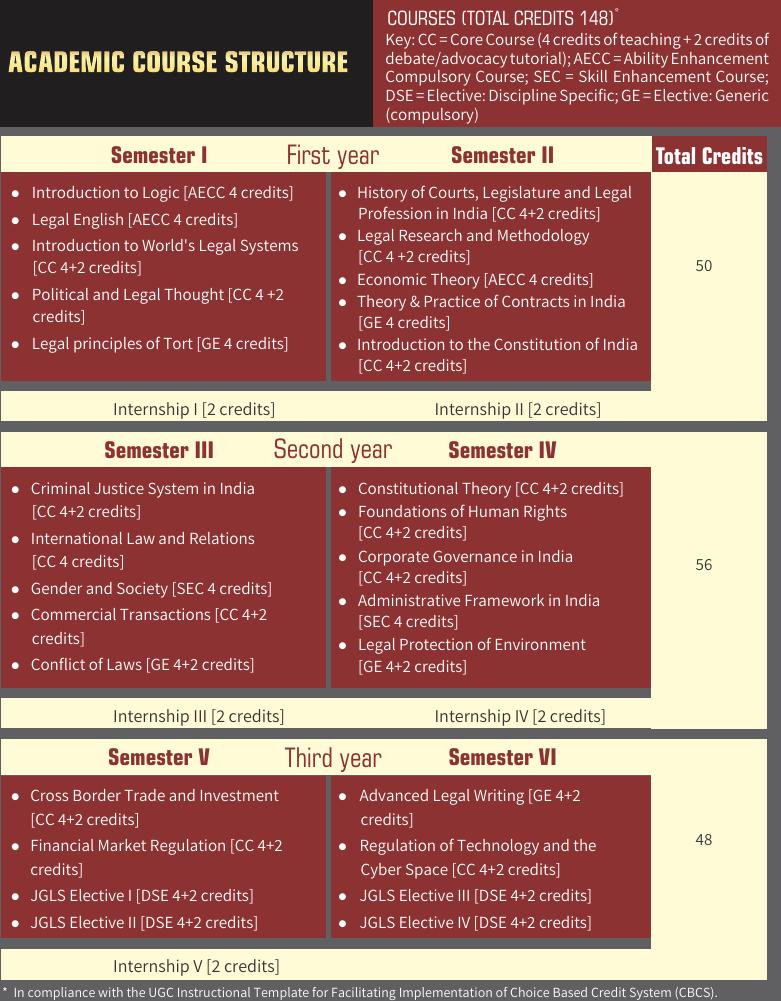
The course structure for Jindal’s new legal studies BA Hons

JGLS Sonepat has launched a three-year “BA Honours Programme in Legal Studies” (LS), a course concept borrowed from the United States and the first-of-its-kind in India.

However, the bachelors degree, despite covering many subjects also found in undergraduate LLB degrees, is not recognised by the Bar Council of India (BCI) and will not provide graduates with eligibility to practice law (or take the All India Bar Exam).

So, the obvious question is, who is this course for? We asked JGLS founding dean and Jindal Global University (JGU) vice chancellor Prof Raj Kumar, and he offered the thoughts behind it.

Who is it for?

The BA Hons LS, as its catchy short-hand goes, would see admission for up to 150 students, said Kumar, and “fees are much cheaper than LLB”, around “half of it” (the course prospectus lists annual fees as Rs 3.5 lakh for tuition, and Rs 2.4 lakh for food, accommodation and laundry).

The legal studies programmes are common at many US universities, he noted, as a combination of social sciences and humanities subjects, often housed in non-law departments. As a first in India, it also dovetails with the CBSE schools introduced in the last decade to teach “legal studies” as a subject in the 11th and 12th standard.

One target audience for the undergraduate LS degree could be students curious about law but perhaps not yet sure that they want to join the lawyers’ profession, with its robes, law firm desks, bar councils and other trappings.

“There’s a lot of attrition rate amongst law students, they realise it’s not what they want to do,” said Kumar. “This is to enable people to take an informed decision to become a lawyer or not.”

Expounding further on the philosophy, Kumar added: “My big theme is, law is the new liberal arts. In my speeches I talk about it, the exponential rise in students seeking to study law, a new-found understanding that law is the new liberal arts.

“If you look at economics or sociology or engineering, you’re seeing it, as how these disciplines are impacting law today.”

Kumar argued that engineers were now interested in law, due to emerging areas around machine learning, robotics and driverless cars, while governance and policy people were increasingly called on to be conversant in legal language and landscapes.

One of the options available for them, would be to join the legal profession (and complete another three-year LLB, which is helpfully also offered by JGLS and would be an aggregate undergraduate legal education of just a year longer than the five-year LLB Hons).

“If you decide you don’t want to be a lawyer,” considered Kumar, “say [do an] MBA or other disciplines, the study can be beneficial for them for the future, or they can be using this degree to undertake a range of non-law careers… [such as working for] human rights organisations [in non-legal roles].

“But knowledge of law, ability to articulate effectively, all those things are valuable.”

Overall, Kumar said, extrapolating from the three-year LLB programme, that around half of anticipated legal studies graduates would be expected go on to do law, while the other half would pursue other fields (in the three-year LLB of 150 students at JGLS, a third of students apparently hailed from JGU’s own business, international affairs, public policy and liberal arts schools).

Why not just do a 3-year LLB?

Besides not being able to practice law with a legal studies degree, there is also a difference in substance, though it can appear subtle.

“The main thing is that pedagogy is key for this,” Kumar said. “In LLB, the focus is on case study methods. In [legal studies] it’s about the social, political and the economic context.”

While some of those things are also included in LLBs and the LS programme also includes some “black letter law”, the latter was “not based upon focus on courts, case studies and decisions, but more on social context, economic context and political context”, according to Kumar.

“The pendulum has swung in the other way”, claimed Kumar. “The idea is to elevate the LLB programme and emphasis to [US-American Juris Doctor] JD-type programmes, where graduate legal studies becomes a choice for all kinds of students.”

Good arguments aside, there is still the question of whether it will prove popular with students, whose parents have only recently come around to the idea that a law degree is perhaps even just on par in respectability with engineering or medicine.

But even if the legal studies degree doesn’t stick, it’s arguably worth trying for its own sake, particularly in light of one of Jindal’s more recent achievements.

“We are now mandated to look at innovative, inter-disciplinary programmes,” said Kumar. “Now that we have Institution of Eminence status, we are constantly innovating.”

Comments

Guest 21 Oct 2019, 16:07
+4 -6
Actually, NLSIU should start this for tier 1 NLU rejects to make money. A BA from NLSIU + LLB from DU will be preferred by most people to a BALLB degree from tier 2/tier 3 NLUs.
Guest 21 Oct 2019, 16:10
+9 -4
Instead of a separate course, why not replace the useless socio, history, economics etc courses on the 5 year LLB with these subjects? It will be better for the students.
Guest 21 Oct 2019, 16:29
+24 -5
Speak for yourself (and your law school maybe). I've learnt as much from those courses you so cavalierly dub 'useless' as from the standard law papers at least, as I'm sure many others did too. Of course, you might have had the misfortune of having bad teachers offer those papers, in which case the fault lies with them, not with the papers or the concept.
Guest 21 Oct 2019, 16:19
+9 -1
Makes no sense. No one will take this programme after class 12 in India. Better to offer a 1 year MA in legal studies for arts/commerce graduates. Or a 2 year MA in law and economics, law and sociology, law and journalism etc.
Guest 21 Oct 2019, 16:35
+7 -0
[quote]“fees are much cheaper than LLB”, around “half of it” (the course prospectus lists annual fees as Rs 3.5 lakh for tuition, and Rs 2.4 lakh for food, accommodation and laundry).[/quote]

This means the LLB costs 10 lakhs a year??? You're paying more than an MBA !!
JINDAL snob 21 Oct 2019, 21:19
+4 -0
Not really. Some pay 6L, Some pay 7, some pay 8L etc. It all depends on how much scholarship you get.
Guest 21 Oct 2019, 19:21
+5 -1
Won't work as JGLS does not have the brand value to attract students for such a course.
A500 22 Oct 2019, 02:30
+6 -17
Time to remove social science/humanities subjects from law schools and sack the freeriding leftist profs who teach them. Hire proper law profs instead.
Guest 22 Oct 2019, 05:25
+13 -1
Tu so jaa na Mamu!
Guest 22 Oct 2019, 08:20
+3 -0
Why does LI not publish JGLS placement figures and compare with NLUs? Then we can judge how good or bad the college really is.
Guest 22 Oct 2019, 08:24
+13 -0
Students who can pay 50 lakhs for their law degree don't need placements. They are probably the recruiters. ;)
Ranker 22 Oct 2019, 09:05
+5 -11
Objectively, JGLS placements would rank 5th when compared with NLUs:

1. NLSIU
2. NALSAR
3 NUJS
4. NLUD
5. JGLS
6. NLUJ
7. GNLU
8. NLIU
9. HNLU
10. RGNUL

On an overall basis, the ranking is 4th as we have to consider parameters like faculty publications, infrastructure etc:

1. NLSIU
2. NALSAR
3. NLUD
4. JGLS
5. NUJS
6 to 10 as above.
Guest 22 Oct 2019, 09:33
+8 -4
Arrant nonsense. By any parameter, JGLS is way behind in placement. NLUJ, NLIU and GNLU all have better placements. Even the Legally India pieces are enough to get that stats. If you are considering faculty and infra, you may as well keep JGLS as rank one. No other NLU can match it at present on those parameters. But those don't get converted into better graduate outcome necessarily, as has been seen. However, simply parading faculty publications isn't enough. As JGLS insiders have revealed earlier, half of those people don't actually teach. In any NLU, that is unthinkable at present. So the models are quite different and shouldn't be compared. If you are only looking at placements actually, NUJS is marginally ahead of the others, but it lacks in infra etc. Faculty-wise there isn't actually much of a difference between the NLSIU, NALSAR and NUJS. All have some really good people, some decent, some very bad ones. However, admin wise NALSAR would be ahead of the other two. NLSIU may change that with Sudhir there now, remains to be seen. NLUD had got an edge faculty wise among the NLUs, owing to their focus on research. Remains to be seen if they can continue holding it under the new VC and the ongoing and soon to come faculty exodus.
Guest 22 Oct 2019, 10:01
+7 -0
This is a pretty accurate analysis overall. Why people ignorantly go about these random rankings every couple of days is anybody's guess. Probably have some sort of OCD.
Guest 22 Oct 2019, 10:05
+1 -7
Do not give misinformation. LI has ranked JGLS higher than GNLU, NLIU and NLUJ in placement data. Regarding the allegation that 50% professors at JGLS do not teach, who gave you that fake news? No college hires professors solely to publish. Some professors may go on research leave, but they return to teach.
Guest 22 Oct 2019, 11:56
+3 -1
There is no misinformation. Quit trolling. LI has never ranked any university based on placement. And what the earlier guy said about many senior faculty at JGLS not teaching or only teaching a small group of students is absolutely correct. You seem to have no real idea about JGLS as an institute. So go away.
Guest 22 Oct 2019, 18:58
+3 -3
One area where all the faculty brilliance at JGLS falls flat is policy research. I mean impactful policy research. Yes, sure, some of their faculty members have been cited by the Supreme Court - but really look at the citations. These are not for path-breaking or even important points. Most of these are reference padding kind of citations.. But the jindal faculty is strangely absent from government policy making. Amongst NLUs, clearly NLUD has cornered this space - you can't go into policy meetings in delhi without stumbling over some NLUD prof there. DU faculty are sometimes present. Also ILS faculty strangely (but this might be because many bureaucrats have studied in ILS). And a smattering of people from other NLUs. Vidhi is now taking over the space in a big way and edging academics out. But even so, one hardly sees any jindal faculty. And I say this as someone who does a lot of work in the public policy and regulatory affairs space. Is it because they are so busy teaching and publishing that they don't have time/incentives for policy engagements? Or some other reason?
Guest 22 Oct 2019, 19:35
+3 -1
You mean to say we have NLUD faculty to blame for the atrocious policies we get see all around us these days? Wow! That's a revelation for me!
Guest 22 Oct 2019, 19:55
+3 -1
Wow, so funny! I know this is trolling, but I'll bite - external experts provide inputs that may or may not be accepted by the governmental authorities or may not be accepted in full. But at least you have a seat at the table and the ability to shape or nudge law reform in a particular direction. I was only wondering (without any snark involved) about why jindal faculty are absent from such policy spaces especially since they clearly have faculty members who are good thoughtful people. Is it because of institutional policies at jindal (which I have been told is focused exclusively on rankings)? Or because of any other reason. That NLUD is over-represented in these spaces might just be because of locational advantage, and not because its faculty are necessarily better - but jindal has the same advantage.
Hmm 26 Oct 2019, 02:28
+2 -0
Don't know about overall numbers and all that. But I've heard anecdotally that save for the toppers who make it to firms, the middle rung is often recruited by Jindal group companies.
DD 22 Oct 2019, 10:01
+3 -1
You mean their parents are. Very true. The who's who of India's elite send their kids to Jindal (used to be Amity and Symbi before Jindal existed).
FACT 26 Oct 2019, 02:27
+2 -0
Preach. This is true.
Guest 22 Oct 2019, 10:17
+3 -4
Sandeep Parekh, founder of Finsec Law Advisors, has blasted JGLS and suggested it is like IIPM:

https://twitter.com/SandeepParekh/status/1169947641469227008
Guest 22 Oct 2019, 12:00
+3 -1
This is classic misrepresentation. Sandeep's tweets don't say anything of the sort. His main issue is with JGLS being for profit and academics choosing it despite that.
Guest 22 Oct 2019, 20:03
+9 -1
JGLS is, surprisingly, non-profit. It is run under the trust funds, which presumably, is audited fairly as a non-profit. Profits generated are reinvested into JGU, so the entire premise of Sandeep Parekh's argument falls down.

http://www.jgls.edu.in/jgu-glance/

TL;DR: Sandeep did not read JGLS was a non-profit institution.
jackal 22 Oct 2019, 11:51
+7 -0
On right hand you have spending close to 18 lakhs at an uni at Sonepat for a BA degree that is not recognized as a professional qualification; on left hand you have spending about 5k for any BA degree that is not recognized as a professional qualification. Both will enable pursuing a 3 year LLB post graduation. What's that left hand? Right hand sucks? Damn right!
Guest 22 Oct 2019, 12:22
+5 -0
You are forgetting the quality teaching bit and the infra. Like it or not, that's where the fees usually go to. And there seems to be a market for it. You don't see current JGLS students doing their LLBs from the government law colleges, right?
Guest 22 Oct 2019, 14:32
+1 -7
Kian, please make a policy that only comments with NIRF rankings will be published on LI and comments with any other rankings by random users will be banned. The government has given an official law school ranking, so nobody should be allowed to give other rankings and confuse people. You must accept that the heirarchy is NLSIU>NALSAR>NLUD>NUJS>NLUJ>GNLU>RGNUL>NLIU>RMLNLU.
Guest 22 Oct 2019, 15:05
+4 -1
Did you use to play general with your toy soldiers? Who died and made you policy maker, judge, jury etc., eh? NIRF is just one other ranking. Nothing else. Not even a good one, since they don't actually verify authenticity of any data submitted anyway. Anybody who doesn't believe in that ranking is allowed to do so. Such peremptory directions, shiver me timbers!
Guest 22 Oct 2019, 15:23
+4 -1
Do you get paid a stipend by the MHRD to rush to defend NIRF's honour every time it is in jeopardy?
Guest 22 Oct 2019, 17:35
+4 -0
I won't accept it. What do you plan to do, sue me? I consider the government and most of its wings to be incompetent and inefficient, so I find no reason to put faith in any ranking that they come up with. The same government has created the UGC which has some of the stupidest guidelines available globally. Doubtless their new higher education council is also gonna do similar stuff. Why should we care then about any ranking that they come up with?
Guest 22 Oct 2019, 20:48
+1 -2
Those rejecting NIRF, do so at your own risk as it is the official ranking and all law aspirants follow it. Also, govt will soon award grants/National Importance status on the basis of NIRF rank.
Guest 23 Oct 2019, 05:18
+2 -0
Do all the law aspirants leave their teeth out for the tooth fairy too?
Guest 22 Oct 2019, 20:49
+1 -3
What rubbish comments from NLUD students. Your profs are the only ones involves in policymaking and not JGLS? LMAO. Give me one example of a policy drafted by NLUD profs.
Guest 23 Oct 2019, 05:21
+5 -1
Frankly, being a part of those vaunted 'policy meetings' is less about your ability or scholarship, and more about whom you know.
Guest 23 Oct 2019, 06:27
+3 -0
Might be. Does that mean JGLS faculty are not as well connected as faculty from NLUs? And @12, I am not from NLUD or from JGLS and I was not trying to make this a pissing contest between the two. I was making a comment based on my observation. In my organization I work on the public law and judicial reforms verticals. In these spaces, NLUD profs (but also, as I said originally, people from DU, ILS and other NLUs) are commonly found. I am sure the NLUD wesbite will give you details, but off the top of my head, I would say the death penalty report by Anup Surendranath, Mrinal Satish and the Verma Committee report, Aparna Chandra and the various law commission reports, Chinmayi Arun and intermediary liability policies, and G S Bajpayee and criminal justice reform especially around policing in bprnd, doj etc. I don't know whether faculty who work in other areas are as clued in to the policy scene. Again, to emphasize, JGLS has some very good faculty overall, hands down better than any of the institutions mentioned above. Which is why it is a puzzle why they are not present or more present on the policy scene.
Guest 23 Oct 2019, 06:50
+5 -0
It's an interesting point. JGLS faculty have impressive publications, but not many senior Indian academics having reputation for policy research. I think Ranbir Singh also played an important role in connecting the faculty with the right set of people using his contacts. Rajkumar is very dynamic, but maybe not yet focusing that much on the Indian policy sector? He's more geared towards international collaborations to increase exposure for the university. Not that those two are mutually exclusive.
Guest 23 Oct 2019, 09:25
+5 -0
Not necessarily connected with this discussion, but one thing that has always struck me as unusual is that unlike the good teachers at NLUs, about whom you can at least read in these forums or at least get to know their names, teaching ability etc. from (I'm assuming) mostly students and alum they have taught, very little is actually found about the individual JGLS faculty. Neither the Indian ones and definitely not the foreign ones. Wonder why that is. It's unlikely that JGLS students or alum don't visit these forums at all, on the contrary I've seen comments ostensibly made by them regarding the university as a whole. But never about specific teachers. Come to think of it, this is true for most NLUs barring NLSIU, NALSAR, NUJS and NLUD. But JGLS is supposed to have much, much better faculty than all these places, at least qualification wise. Why isn't their work being discussed then?
Guest 22 Oct 2019, 21:10
+3 -1
QS India rankings are out! JGLS is there at #60, but research output is classified as LOW by QS. It makes it mainly because of faculty:student ratio (1:10), international faculty (rated 99.9/100 in India by QS) and infrastructure (rated 5 stars in India by QS).

[b]IITs dominate QS India rankings, Calcutta University tops among state-run varsities
[/b]
https://www.indiatoday.in/education-today/news/story/qs-india-rankings-2020-iit-bombay-calcutta-university-1611877-2019-10-22

https://www.topuniversities.com/universities/op-jindal-global-university#922525
Guest 24 Oct 2019, 06:35
+0 -0
Jindal has many faculty members who have good credentials and but don't really publish much. That is why their "research intensity" - overall publications per faculty is so low. Quite sad!
Guest 24 Oct 2019, 07:32
+1 -0
What's JGLS' faculty student ratio at present? Can anybody in the know actually shed some light on this? Because if it's around 1:15, then there is no reason why the faculty who actually are capable of publishing won't get time to do so. Their admin workload is actually lesser compared to all NLUs, because JGLS has a very efficient set of staff for admin duties specifically from what I know.
Guest 22 Oct 2019, 21:16
+0 -0
Here are the top 20 universities in India by QS. Just the other day Sudhir Krishnaswamy was boasting that quota makes no difference to NLSIU as Bengaluru is the hub of education. These rankings show only 1 college from Karnataka in the top 20. Highest is Maharashtra and Bengal jointly.

1. Indian Institute of Technology Bombay (IITB)
2. Indian Institute of Science (IISc) Bangalore
3. Indian Institute of Technology Delhi (IITD)
4. Indian Institute of Technology Madras (IITM)
5. Indian Institute of Technology Kharagpur (IIT-KGP)
6. Indian Institute of Technology Kanpur (IITK)
7. University of Delhi
8. University of Hyderabad
9. Indian Institute of Technology Roorkee (IITR)
10. Indian Institute of Technology Guwahati (IITG)
11. University of Calcutta
12. Jadavpur University
13. Indian Institute of Technology Indore
14. Savitribai Phule Pune University
15. Indian Institute of Technology Hyderabad
16. Anna University
17. University of Mumbai
18. Birla Institute of Technology and Science, Pilani
19. Banaras Hindu University
20. Indian Institute of Technology Bhubaneswar

https://www.ndtv.com/education/qs-india-university-rankings-2020-iits-dominate-iisc-delhi-university-university-of-hyderabad-in-top-2120999
Guest 23 Oct 2019, 03:57
+2 -0
JGLS is not non-profit. It is very much for profit. IT has huge batch sizes to make more money,
Guest 23 Oct 2019, 10:09
+8 -5
The problem with JGLS is that it is filled with too many human rights/legal theory leftist profs. They need to be replaced with good profs who teach commercially relevant subjects
JINDAL snob 23 Oct 2019, 19:28
+0 -3
Jindal also has some amazing profs like Saumya Dey, Karan Latayan, Sayan.
Guest 24 Oct 2019, 04:44
+4 -1
Who?
Guest 24 Oct 2019, 05:22
+4 -1
Snobbery really doesn't work if nobody has heard the names you are trying to drop. Just saying.
Guest 24 Oct 2019, 07:36
+2 -0
LOL. One prof named is not with JGLS and one is among the least well regarded. The real star profs are a core group of 8-10 people, most of whom teach electives to small classes and often take long research leaves.
Guest 24 Oct 2019, 09:12
+3 -0
Then how are they star profs? As in what benefit do the bulk of the students get from having them around?
Guest 25 Oct 2019, 07:37
+2 -0
Who are these 8-10 people? Could you name them, so that we can follow their work?
On a separate note, how come Rajkumar hasn't been able to hire more "star profs" at the mid-level who can also teach mandatory courses? The big four who joined recently are too senior and won't be teaching regular courses I imagine.
Guest 25 Oct 2019, 10:49
+1 -2
At least three of the four don't have any teaching responsibility at all as part of their understanding with the university.
Guest 24 Oct 2019, 07:44
+2 -0
Jindal will get a huge boost if Congress comes to power in Haryana. Jindal's are old Congress wallas (Naveen Jindal is a former MP and his parents were both ministers) and the Congress helped set up the university originally, with speedy clearances.
Sponsored 25 Oct 2019, 19:15
+3 -0
Kian, is this not sponsored? Can't see the sponsored tag!