 Jindal takes full advantage of IoE status but some NLUs might also manage
JGLS Sonepat has launched an online asynchronous LLM programme - the first in India, with nine full-time permanent faculty members looking for at least 100 candidates to join up, though the programme could be scaleable beyond that.
It is well-timed, considering a continuing and potentially longer-lasting Covid-19 shutdown. However, preparations for the programme had been underway for more than six months, said JGLS dean and Jindal Global University vice chancellor Prof Raj Kumar.
The government has last month given permission for India’s top 100 universities to offer online courses (presumably decided according to the National Institutional Ranking Framework (NIRF) / National Assessment and Accreditation Council (NAAC) yardstick). Until now, that had required specific University Grants Permission (UGC) approval, so long as the universities were in the top 100 with an NAAC grade of 3.26 or more, according to the Financial Express; according to NAAC, those are grades A+ or A++).
However, JGU - which has not participated in NIRF to date, though it procured an A grade with a score of 3.26, which was the highest around five years ago when it was inspected - finds itself in the enviable position of being outside that system due to the grant of Institution of Eminence (IOE) status to it last year, which came with significant freedom from existing regulations.
Correction: JGU has in fact participated in NAAC contrary to what had been stated in the original story (though not in NIRF).
“IOE has enabled us to do something like this because it offers curriculum and course delivery flexibility on the one hand, and even empowers [the] IOE and even allows [the] IOE to be [leaders in] innovation,” explained Kumar.
Prof Vishwas Devaiah, the director of the university’s centre for postgraduate legal education since April, which is a UGC-mandated position, noted that this exemption was part regulation 19 of the IOE-UGC norms (see excerpt below, or full notification (PDF)).

LLMs galore
JGLS already runs two other LLM programmes. Its flagship physical LLM, that is a one-year residential programme in Sonepat, takes around 75 candidates every year, though Kumar said that the number would be increased to “not less than 120” in the coming academic year.
They can choose from a basket of around 120 electives every semester (some of which are prescribed by the UGC), thereby indirectly having access to Jindal’s more than 320 faculty members (though only around 100 or so were actively involved in teaching physical LLM students, said Devaiah).
The cost for this programme was Rs 3 lakh in tuition fees, plus Rs 2.4 lakh for on campus residence and related charges.
Then there is also a much smaller LLM for around six to seven students last year, that takes place at the World Wildlife Fund (WWF) offices in Delhi and is in partnership with the organisation, about energy, environment and climate change.
Parallel LLM
The new online LLM, however, is going to run parallel to these programmes, being primarily targeted at practising lawyers, “or even a judge for that matter”, according to Devaiah. “Non-availability is what sometimes keeps working professionals from going for” further education, he added.
Seven of the nine course modules are squarely aimed at that target audience, and primarily consist of corporate topics such as competition, company, M&A and private equity, commercial contracts, banking and finance and insolvency law.
The cost is identical to the physical LLM, at Rs 3 lakh tuition (though students won’t have to pay the residential surcharge, so despite higher internet bills, that should work out cheaper).
It also has completely separate faculty to the other two LLM programmes.
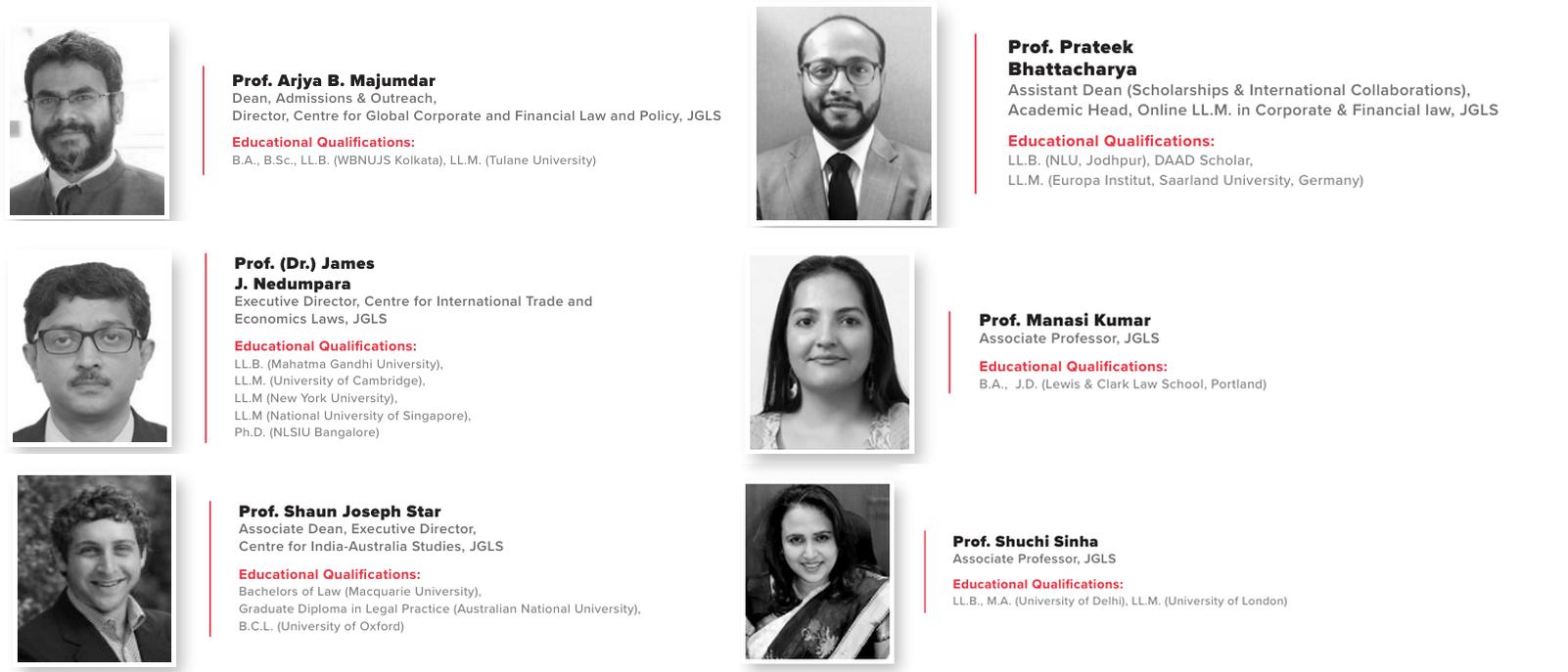
Currently, there are nine faculty members on the books, administered by programme head and NLU Jodhpur 2012 graduate Prof Prateek Bhattacharya, who had been at JGLS since 2018 after leaving Shardul Amarchand Mangaldas as a senior associate.
Other faculty members, according to the online LLM’s brochure, are Prof Arjya B Majumdar, Prof James J Nedumpara, Prof Shaun Joseph Star; as well as associate professors Prof Manasi Kumar, Prof Shuchi Sinha; and assistant professors Prof Anindita Jaiswal Jaishiv, Prof Karan Latayan and Prof Ishana Tripathi.
All had been with JGLS before the launch of the programme, said Kumar.
Befitting an online LLM, tuition will happen entirely online and in pre-recorded lectures, delivered via the Upgrad platform, set up by former media mogul Ronnie Screwvala after he sold UTV to Disney for $454m in 2011.
The advantage is that if “you are busy in the day, you should be able to see anything” at any time that is available, to make this “viable” for working lawyers, Devaiah said.
The physical LLM, by contrast, had only “live” tuition, with a lot of debate and learning happening during such interactive teaching sessions, which the online LLM was aiming to emulate with “live sessions” every week, where faculty members would “spend a couple of hours” with students online.
Numbers
Kumar said that in the online LLM they were targeting “at least 100” candidates, who would have to pass the JSAT LLM entrance test.
However, the nice thing about online teaching, at least for a university, is that in theory they are more scaleable than offline programmes, though faculty numbers would also have to increase (each of the nine faculty members also has assistants, however, to help them with the workload, according to Devaiah).
“The key thing is quality,” added Kumar about potentially scaling up.
If it does scale up, and considering that Covid restrictions could be around for a while (Cambridge University has announced it would hold all its lectures online due to the pandemic, for instance), might the online course not cannibalise the offline one?
“Not really,” said Devaiah. “Usually the ones who tend to come for a residential programme, they have a slightly different requirement in that sense.”
“They might want to be in campuses and be engaged in that campus-imparted education,” he added. “They might choose a JGLS, NUJS [Kolkata] or Nalsar [Hyderabad] for that matter.”
NLUs in the wings?
JGLS is the first law school to offer an online LLM, but several national law schools are offering significant online offerings already, though none a full-fledged degree, and at least one is also looking at making a significant push into further online courses soon.
Some NLUs might even have the NAAC scores to pull off a full degree offering (though there might still be some UGC red tape if they don’t fall into the new automatic exemptions for India’s top 100 universities, and if the UGC criteria is a score of 3.26).
From a sampling of scores of NLUs, via the NAAC website, Nalsar Hyderabad currently has an NAAC score of 3.6, NLU Delhi of 3.59, and NLU Cuttack on 3.32. (CNLU is on 3.15 while NLSIU and GNLU are both on 3.1, albeit all still with an ‘A’ grade).
However, NLSIU Bangalore VC Prof Sudhir Krishnaswamy had recently said - coincidentally in a virtual round-table of VCs hosted by JGLS, that the difference ‘between off-campus and on-campus learning experiences will slowly disintegrate’.
“Even after we open and things look alright, there is going to be a degree of off-campus learning, including in our core programmes,” he said. “We have to really think about the scale in which we teach. Anything on campus is a premium programme, anything on campus we can scale up.”
NLS had already educated 10,000 people a year off-campus (primarily via its flagship Masters in Business Laws (MBL)), Krishnaswamy had said in the webinar. “We can scale that up 10 times,” he added. “And do it well.”
“We will offer education across the spectrum, on campus and off campus - this is going to become standard,” he noted. “Currently we have on campus programmes, which are our premium programmes. But I think all programmes are going to be partly on campus and off campus going forward.”
Due disclosure: JGLS is an advertiser on Legally India.
Comments
https://www.ugc.ac.in/pdfnews/5628873_UGC-Public-Notice---treating-all-degrees.pdf
For instance, see this: https://www.bbc.com/news/education-52732814
[Note: Accuracy disputed.]
Also, because of UGC rules certain non-corporate subjects are being taught, such as globalisation, trade and constitutional law. If Upendra Baxi and BS Chimni are with JGLS, then one of them should have been included.
[Note: Accuracy disputed]
I don't mean to pry, but it seems like the only reason one would write a comment like this is because, perhaps, they're still dealing with the sadness of not having gotten good grades with Ms. Kumar or Ms. Majumdar, due to the extremely high standard set by them in their courses, which mind you, is brilliant.
The perspective on research that you adopt is rather problematic. While you may be able to defend quantity as an identifier of good researcher, I, as well as my mentors and inspirations, belong to the school of thought that would rather stick to quality as the deciding factor. I'd be happy to direct you to their profiles on pre-print repositories and leave you at your will to read their work first, and then form your opinion on their dedication and contribution to research as both Prof. Majumdar and Prof. Manasi have published in some of the most reputed journals in their field, including SCOPUS (https://www.scopus.com/sources.uri GO FIGURE!).
With respect to your concern about Prof. Baxi and Prof. Chimni not being involved to teach a core course in the Online LLM in Corporate and Financial Laws programme, JGLS is home to some 329 faculty members, all of which have been hired owing to their professional merit. With all due respect to the doyens, the subjects that you mentioned have to be taught to some 5-7 odd sections across the specialisation spectrum, have been assigned to several faculty members, each of whom promises a unique learning experience in the classroom.
http://www.jgls.edu.in/arjya-b-majumdar/
http://www.jgls.edu.in/manasi-kumar/
https://papers.ssrn.com/sol3/papers.cfm?abstract_id=3387887
https://papers.ssrn.com/sol3/papers.cfm?abstract_id=2804427
https://papers.ssrn.com/sol3/papers.cfm?abstract_id=2553025
Then let me know if Prof Majumdar should be teaching corporate law
Both these professors do not fit conventional moulds in the industry and I think any of their potential students will the better for it. They set extremely high standards for their students, but give you the tools and encouragement to meet those standards. I have personally observed their commitment to maintaining the quality of the courses they offer and their interest in their students' careers, despite their administrative duties. The idea that faculty has to be one-dimensional to be "better" is at best laughable.
I remember, when he was to allotted as our Corporate Law Prof, there was so much lobbying among sections to get him as the assigned faculty. Arjya has several years of law firm experience under his belt before he started teaching. Not that many corp law practitioners out there teaching law students but that's not just about it.
Arjya is an artist, and I think at some point he dabbled in theatre and literature because his classes were a real piece of art. They were not lectures; they were a performance. You just felt great listening to him. He would bring in Shakespeare to describe boardroom politics, draw in from his experience of working on actual transactions to make it more practical and make Company Law 101 something to look forward to.
Arjya was allotted to us for the first time, but I took his elective the second time willingly because that is how good he was. His class on Advanced Corporate law helped me launch my own legal tech startup. He went above and beyond in helping me and would come to campus to discuss progress even on a Sunday.
And last but not least, he is an academic at heart. Last time I had met him was at the Alumni meet. Once the usual chitchat got over, all he wanted to discuss was his latest paper on the unenforceability of various clauses put in SHA in PE/VC transactions. I found it fascinating because we had recently negotiated a term sheet some time back, and if we had access to that paper beforehand, it would have helped.
I hope your assessment of him is not based on some bitter experience of interacting with him on the admin side. I have had my share of trouble over there as well. When I came back from the exchange, I had to sit with him on multiple occasions to discuss the conversion of grades. It was a frustrating experience, and eventually, he didn't budge. He had his reasons, and while I couldn't agree with them, they had a rationale behind them which I respected. The entire experience, however, did not change my opinion of him as a person, or as a faculty.
If you are a student at Jindal, you should audit one of his courses and find it out for yourself. He is a great Prof, and your opinion will change. Don't expect an easy A, though!
2. Was there a point to that statement? Who had claimed otherwise? They have more faculty than at least 7-8 NLUs combined to begin with! In any case, being from an NLU does not make one a good faculty or even a good researcher alone. Most of those NLU alumni are junior people who have joined the profession recently and are yet to prove themselves. A few are sub-par at most. Although there are certainly good people too. Jindal's recruitment policy about NLU grads so far has been that if you have an NLU degree and a foreign one too, then you are in unless you have trouble putting two words together. That brings in good people as well as bad ones. They also do marquee hires like these three from time to time, of course.
3. Exemption to offer such courses without UGC permission, yes. I am still skeptical about whether online LL.M.s would be treated at par as a qualifying course like offline ones are, but if UGC allows that, it would be an interesting development. Sadly, it might end up getting misused, since even offline Indian LLMs these days barely have enough rigour and quality to prepare students for academics and research-based careers. Online ones are likely to be worse probably.
As a matter of curiosity, does anyone know why the Indian legal academic sector does not mention the foreign faculty who teach at JGLS? I mean, their official profiles look good, but we rarely get to hear of any quality research done by them. I am not saying they don't do good research or similar work, just wondering at the lack of coverage.
1) MPS, Baxi and Chimni very much teach at JGLS
2) the number of NLU alumni faculty at JGLS is more than that in all other NLUs combined
3) IOE status gives full exemption to online courses
I've had the pleasure of being taught by both Arjya and Mansi at Jindal. Arjya and Mansi's lecture preparation, credentials and work ethic scream professionalism and do not require any over-compensation at their end make their work heard, read or felt. Let's get into specifics, since I've known both for over 7 years now.
[i]On Mansi[/i]: Mansi taught me contract drafting from an American perspective. This had the right mix of theory and practical drafting exercises. This paved the way for better legal writing and drafting. The sub-conscious effect of this course bled into my professional and academic world, where I was easily able to integrate into the world of American legal writing. She was always available to answer queries, and her engagement with students went beyond the classroom.
[i]On Arjya[/i]: Arjya offers courses on M&A (which I TA'ed for )and securities regulation (where I was a student). The structuring, quality, assessments rigor, lectures and sheer rigor, all prepare you for the corporate law firm life. In M&A, we drafted due diligence reports, negotiated and drafted SPAs, SHAs, and understood fundamentals of fundraising. In securities regulation, we drafted a DRHP! Yes, an entire DRHP - with no exemptions on deadlines! Most of us that have taken Arjya's courses agree on one thing - These courses prepared us for the formative years of our lives as associates at large law firms. Even those that didn't join transactional practice, walked away with a new set of skills.
Once we entered practice, there was no panicking, no frantic phone calls, and definitely no lack of understanding, compared to our non-JGLS counterparts . We knew the documentation, we knew the diligence process, how to make our way around the MCA website. As part of the classes, we also learnt how to navigate corporate culture, work with difficult people and learn to build professional relationships. We also got tit-bits of business development skills. In my second year, I walked into his office and told him that I was interested in pursuing a career in transactional law, to which he unflinchingly pushed me toward by setting my basics right. On a personal front, I'm grateful to Arjya because he helped me land two jobs at day zero, make it to New York City, a chance to collaborate on academic articles. And this is Arjya's true nature - he's not an just an academic, he forges strong relationships, invests in mentoring, and is paving his way to become a kingmaker.
Of the several faculty and academics that have taught me at Jindal, I owe a large chunk of it to Arjya and Mansi because of their personal interest in making us succeed. My words are echoed by a lot of JGLS grads; just look around you at law firms in India and the UK - almost all of them are beneficiaries of Arjya and Mansi's classes.