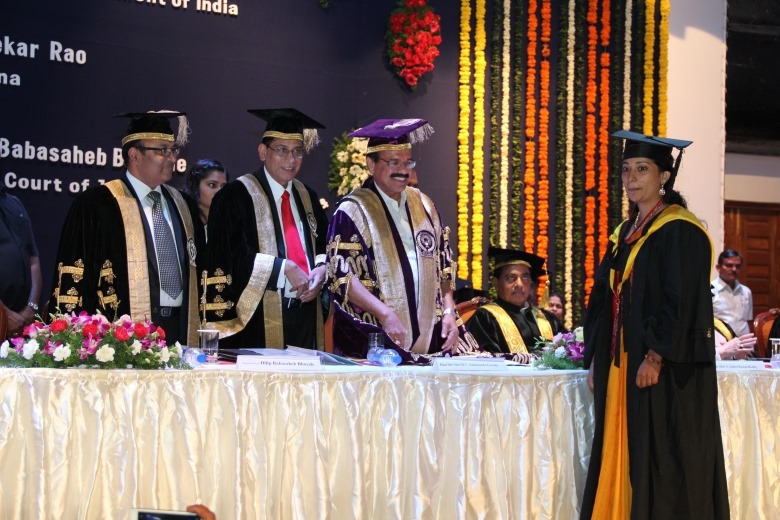
Legally India asked the vice chancellors of all 17 national law universities some questions about their law school and why law aspirants should come there.
Here’s the first in our series of national law schools, in their own words, with Nalsar Hyderabad vice chancellor (VC) Faizan Mustafa giving his candid view about what he thinks makes Nalsar special.
Nalsar at a glance
| Total number of teachers | 39 |
|---|---|
| Of whom: | Law Professors: 8 Management Professors: 3 Associate Professors (Law): 1 Associate Professors (Management): 2 Assistant Professors (Law): 17 Assistant Professors (Arts): 5 (1 for each subject) Assistant Professors (Management): 3 |
| Of 17 Assistant Professors (Law) | 2 at Stage 3 (10 + years service at current institution) 3 at Stage 2 (5 + years service at current institution) 6 at Stage 1 (<5 years service at current institution) 6 in contractual positions (0-3 years of service) |
| Academic research by teachers | Each teacher expected to publish in prestigious peer-reviewed journals and devote vacation period to independent research and writing. Some teachers are working on longitudinal research projects and some are taking correspondence courses from specialised centres. |
| Teaching hours | 10-12 hours of class per week per teacher. One mandatory course, one elective course and one research-based seminar to be taught per teacher per semester |
| USP | Course design flexibity. BCI’s mandatory courses taught by third year. Fourth and fifth year students are allowed to choose from elective courses, research-based seminars and shorter courses. LLM students build a custom specialisation. |
Which jobs that students secured in the past three years, do you think most exemplify why your law school is a great place for students to join?
Our recent graduates have chosen jobs spread across different sectors:
- training contracts with English law firms such as Linklaters, Herbert Smith Freehills and Allen & Overy
- a substantial majority has started at leading Indian law firms such as Shardul Amarchand Mangaldas, Cyril Amarchand Mangaldas, AZB, Trilegal, Khaitan, Luthra & Luthra and J Sagar Associates (JSA) to name a few.
- Quite a few have joined the chambers of leading advocates in the various high courts
- some have pursued judicial clerkships under sitting Supreme Court judges.
- On the other end of the spectrum, some graduates have joined voluntary sector organisations such as the Centre for Social Justice, Ahmedabad and the Alternative Law Forum, Bangalore.
LI note: Click here to see the 2015 batch’s final recruitment tally, and 2014’s figures here.
Which co-curricular and extra-curricular achievements of students in the last five years are you most proud of? Which student body activities are you most proud of?
- In 2012, teams from NALSAR won the international rounds of the Willem C. Vis Commercial Arbitration Moot held in Vienna as well as the Monroe E. Price Media Law Moot held in Oxford.
- In April 2015, the NALSAR team broke first in the Philip C. Jessup Moot and progressed to the quarter-finals. A few weeks later, another team from our institution won the Asia-Pacific rounds of the Manfred Lachs Space Law Moot.
- Just a few days ago, one of our teams reached the semi-finals of the Vis East Moot held in Hong Kong.
- Apart from mooting, our students have done very well in essay-writing competitions.
- Our student body has several active discussion groups such as the Constitutional Law Society, the Gender and Sexuality Forum, the Technology Law Forum and the Debating Society which keeps them engaged after class hours.
- In the current academic year, the Policy Lecture series organised by our students has been very well attended.
Can you provide a break-down of monetary funds provided for the use of student bodies’ activities?
In the present academic year (2015-2016), the University has allocated approximately Rs 40 Lakhs to the Student Bar Council (SBC).
Out of this amount, nearly half is allocated to cover the travel and registration costs for moot court competitions, client counselling, negotiation and mediation competitions.
The remaining amount is allocated to the various elected committees that are part of the Student Bar Council (SBC), namely the Academic Committee, the Literary and Debating Committee, the Cultural Committee, the Sports Committee and the Student Welfare Committee among others.
The students have considerable autonomy in the inter-se allocation of funds and the University can only provide an exact breakdown of how funds were utilised at the end of the academic year.
| Total Student Bar Council Budget (2015-2016) | Rs 40 lakhs |
|---|---|
| travel and registration costs for: - moot court competitions - client counselling - negotiation and mediation competitions | Almost Rs 20 lakhs |
| - Academic Committee - Literary and Debating Committee - Cultural Committee - Sports Committee - Student Welfare Committee - Other elected SBC sub-committees | Remaining amount |
Have you worked on developing any systems in your law school to better manage, incentivise and / or improve effectiveness of teaching and non-teaching staff?
The most important intervention in this regard has been the introduction of a comprehensive course evaluation system since 2012.
Towards the end of each semester, students are asked to fill in anonymous feedback on the performance of their respective teachers. The feedback is collected through a structured questionnaire that also generates a rating of the concerned teacher’s performance on several aspects such as knowledge of the subject, communication skills, availability for students and transparency in assessment of exams.
The ratings generated through this process are communicated to the teachers and are given weightage in decisions related to regularisation and promotion.
Regular faculty seminars are held in order to advance academic discussions on topic of contemporary relevance.
How many professors and assistant professors have you hired in the last 12 months? How many have left? Can you give a breakdown of names who have joined and / or left?
Since March 2015, we have hired five new faculty members (Two Professors for Management Studies, Two Assistant Professors for Law and One Assistant Professor for English).
In the past one year, two faculty members (both Assistant Professors) have left, one to pursue doctoral studies and another on account of health-related difficulties.
Names have been withheld at the request of the interested parties.
| Faculty members hired since March 2015 | 5 |
|---|---|
| Faculty members who left since March 2015 | 2 Assistant Professors |
| Hired Management Professors | 2 |
| Hired Law Assistant Professors | 2 |
| Hired English Assistant Professor | 1 |
What do you look for when hiring faculty?
The first and foremost thing is that a prospective faculty member must demonstrate a commitment to learning and open-minded inquiry. We require all applicants for teaching positions (whether for contractual or regular positions) to give demonstration classes before our students.
This is important since a teacher should be an effective communicator and be able to handle the students’ questions with confidence. Applicants are then required to face interviews before Selection Committees (as mandated by UGC regulations) where they are tested for their subject knowledge and analytical skills.
We are doing our best to identify and attract capable teachers, but in the legal education sector it is quite difficult since the remuneration in other branches of the legal profession is a lot more.
What kind of emphasis does the college place on faculty to publish in journals or to do academic research? How much time would you expect professors and/or others to spend on research?
We expect each one of our faculty members to publish their independent research in peer-reviewed journals. Instead of setting a numerical target, we encourage them to aim for publications that carry a certain degree of prestige and are known for their quality.
Some of our faculty members are engaged with longitudinal research projects (for example there is an ongoing study on Knowledge-Based Interventions in order to realise Socio-Economic Rights such as work, education and housing) as well as specialised centres that offer correspondence programmes in areas such as Patent Law and Aviation Law to name a few.
While our faculty members are busy with teaching responsibilities for nearly nine months in an academic year, we expect them to devote the vacation period (May, November and December) towards their independent research and writing.
We also host symposiums and workshops from time-to-time that are substantially based on the research interests of our faculty members.
How many hours are teaching faculty expected to teach per week?
As per the UGC regulations, the prescribed teaching load ranges between 14 hours to 16 hours per week. However, this prescription was made with traditional university-systems in mind.
In the NLUs, an instructor has to devote considerable time for consultation hours, presentations of term papers, internal evaluation of examinations and written assignments as well as providing support for student activities (e.g. moot courts, legal writing exercises, guest lectures etc.) in addition to one’s own independent research.
Keeping this in mind, we usually require our faculty members to engage 10-12 hours of class per week.
Each instructor is hence required to engage one mandatory course, one elective course and one research-based seminar course in a semester. We do recognise that such a teaching load is higher than what is prescribed in the leading Western Universities (6-8 hours per week), but we hope to rationalise this with more faculty hiring in the foreseeable future.
It is our policy to give a semester off after three semesters. In last one year two assistant professors were given a no teaching semester to help them complete their Ph.D. University had also given sabbatical to 75 per cent of its eligible faculty members.
What do you think your NLU offers that is unique and sets you apart from the other 17 NLUs?
The most distinctive feature about the curriculum at NALSAR is the substantial flexibility that it allows.
- Most of the subjects required by the Bar Council of India (BCI) are completed by the end of the third year;
- while the fourth and fifth year students can more or less design their own coursework by choosing from a basket of elective courses, research-based seminars and shorter courses taught by visiting faculty members.
- Some of these optional courses are also made available in the second and third year, based on suitability.
- In total, students can earn nearly 40% of their total credits from optional courses.
In the last four years, we have hosted more than 50 short courses taught by visiting faculty which includes sitting High Court judges, senior lawyers, bureaucrats, academics, film-makers, activists and NALSAR alumni who are engaged in different sectors.
None of the other NLUs have enabled academic flexibility to such an extent.
Our elective courses are consciously designed to emphasize interdisciplinary scholarship and ways of thinking.
Our LL.M. programme is unique among Indian universities since it does not lock students into specialisations at the beginning of the academic year. Instead, our LL.M. students can customise their own coursework and build a specialisation of their own choice.
Other highlights:
- Currently (January to April) we are having more than 60 elective courses in law and MBA. On an average we have approximately 50 such courses on offer.
- Reasonable accommodation as a concept is frequently used to help students in passing exam/promotion.
- Restorative justice is used to resolve conflicts
- Nalsar has appointed an Ombudsman as per UGC regulations
- NALSAR has broken hierarchies – the same course is opted by students across batches and across degrees: MBA students can take law courses and vice versa- LLM students can take LLB courses and LLM students can opt LLB courses- 2nd year students can take final year courses.
- Students are allowed to pace their learning - may take more courses in one semester and less in another semester.
- Clinics have been integrated with courses- ie Family Law clinic, criminal law, ADR etc
- 3 credits for Teaching Assistantship
- On line project bidding is another innovation, in addition to a real credit system
- E-student system
What piece of legal education reform, either at the statutory or regulatory level, would you most like to see during your tenure, and why?
At the moment, the most worrying aspect about the NLUs is their uncertain financial health.
While all of them have been created by State-level legislations, the financial support for building infrastructure and meeting recurring expenditure has been quite uneven. While some of the NLUs have received generous support from their respective State governments, others have struggled on this count.
Limited support from the State leads to escalating costs in administration which further result in the continuous increase of fees collected from students. Increasing the fees has several debilitating effects such as discouraging applicants from disadvantaged backgrounds and compelling current students to prioritize lucrative earning opportunities over their personal interests and motivations.
It is important to preserve the public character of the NLUs and the same can only be done with consistent financial support from the respective State governments.
Residential institutions such as the NLUs are far more expensive to run in comparison to traditional universities, so we have to find a way to make a special case for their funding on a recurring basis.
At the statutory level, the governance structures of the NLUs need to be made accountable to a broader range of stakeholders. At NALSAR, we are exploring the possibility of having the formal representation of alumni (chosen from the pool of graduates who have more than 10 years of work experience) in our governing bodies.
This practice is followed by the best universities in the world since the alumni will have a strong interest in enhancing the reputation of the institution in the long run.
We hope you found the above useful and that it helps shed some more light on what Nalsar is like and how it’s run. We have sent the same questions to all other NLU VCs and are awaiting their responses, which will be published unedited. If your VC has not yet responded, please remind them – it’s a great opportunity for colleges to put their best foot forward around CLAT time.
Comments will be moderated, so please only share constructive thoughts below. Suggestions for us always welcome.
Comments
And having alumni being part of the governing bodies is very progressive. Hope this works. Nalsar surely has alumni in various sectiors. This will definitely help the law school.
But let's not go there. how about we cross check the vice chancellors claim about the research and writing his faculty has done - let's try and find out how many book chapters and articles and opinion pieces the professors at NALSAR have put out in the last two years - this isn't hard to find out. And as someone who is an alumnus I'll bet money that the vice chancellors claims won't check out. Some of these people are ancient and they haven't said a new thing or done any new research in years !
But I suppose you didn't have the resources for any of those stories. Pity.
Please consider it an information gathering exercise, a bid at a baseline of transparency, and a work in progress.
But one one inaccuracy in your article. One assistant prof (Manav Kaour) left to teach at Jindal and is an assistant prof there.
In the case if faculty you must examine why BALLB alumni of NLSIU, NALSAR etc are not joining the teaching profession (very few). Only useless LLM alumni whith BALLBs from rubbish schools are joining
In the case of infra our useless finance minsiter, who is supposed to be a lawyer, must be hauled up and asked why IITs and IIMs (even NIFT) get national funding but NLUs get state funding. His children studied law at Amity, so he does not care about NLUs. Very sad.
You should really ask for the opinion of the students of the universities that he left mid-water. Maybe then we all can have a rational discussion on any university's merits/demerits.
The juicy info is missing from this article. It seems Legally India has bowled underhand deliveries instead of bouncers!