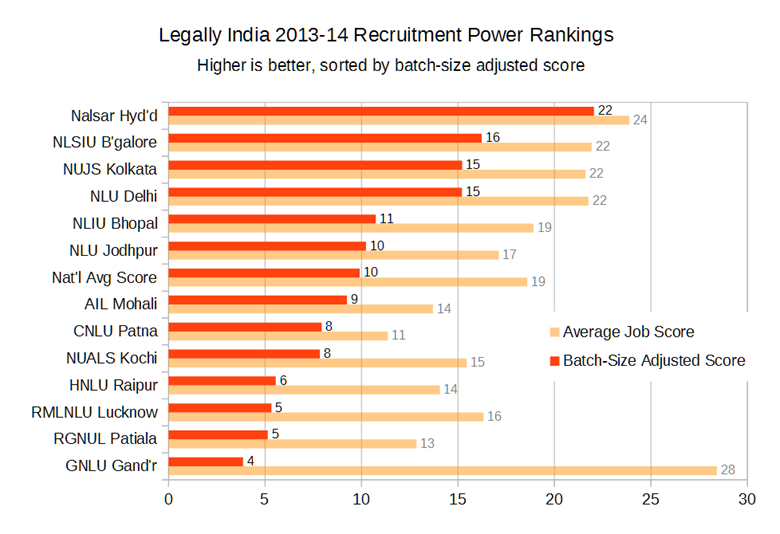
Nalsar Hyderabad performed better than all national law schools, including NLSIU Bangalore, in finding placements for its 2013-14 graduates of its class of 2014, according to Legally India’s new rating of law schools recruitment results.
Nalsar’s “average job score” of 22, in India’s first ever transparent system of ranking the recruitment performance of law schools, is 5 points higher than NLSIU’s average of 16, which was marginally ahead of NUJS Kolkata and NLU Delhi, which were both at 15 points.
What this means is that the average Nalsar student was offered higher-paying or more competitive jobs than the average student at any other college in India (see full methodology below).
NLIU Bhopal and NLU Jodhpur followed, respectively, with 11 and 10.
According to the recruitment statistics reported by Legally India this year, AIL Mohali has done better than the remaining national law schools with a score of 9.
CNLU Patna and Nuals Kochi performed similarly, with a score of 8, while HNLU Raipur scored 6, with RMLNLU Lucknow and RGNUL Patiala both scoring 5.
GNLU Gandhinagar, which did not transparently disclose its recruitment data this year, was the worst performer this season according to Legally India’s metrics, with a batch-size adjusted score of only 4.
Legally India had published the recruitment data of the graduating batches of 12 national law schools and AIL Mohali this year.
| Average Job Score | Batch-Size Adjusted Score | |
|---|---|---|
| Nalsar Hyd’d | 24 | 22 |
| NLSIU B’galore | 22 | 16 |
| NUJS Kolkata | 22 | 15 |
| NLU Delhi | 22 | 15 |
| NLIU Bhopal | 19 | 11 |
| NLU Jodhpur | 17 | 10 |
| Nat’l Avg Score | 19 | 10 |
| AIL Mohali | 14 | 9 |
| CNLU Patna | 11 | 8 |
| NUALS Kochi | 15 | 8 |
| HNLU Raipur | 14 | 6 |
| RMLNLU Lucknow | 16 | 5 |
| RGNUL Patiala | 13 | 5 |
| GNLU Gand’r | 28 | 4 |
Methodology
The scores take into account:
- the recruitment results disclosed by each college this year and reported on Legally India,
- the salaries and relative competitiveness of career options, divided into 4 tiers (see below), arrived at after discussions with a number of RCC members from different colleges, and
- the total batch strength and the number of students accounted for in our reports.
- To compute the average job score, each job was allocated between 10 and 40 points according to the 4 tiers (as in the table below).
The final batch-size adjusted score comes from multiplying the average job score by the percentage of students out of the total batch with accounted-for jobs.
NB- Before commenting, please note that:
- This ranking is a work-in-progress, which will improve, be tweaked and adjusted in future years as colleges will hopefully become increasingly transparent in their data.
- The tiers make no judgment on the relative desirability of each career choice or the quality of the employer, they are only a very rough classifications based on competitiveness.
- This year’s ranking did not distinguish LLM degrees from each other, due to lack of bifurcated information on LLMs in the recruitment data of some law schools. All LLMs are therefore counted as Tier 4 this year. However, future Legally India rankings will group foreign ivy league and top UK law school LLMs in tier 2, national law school and other foreign law school LLMs in tier 3, and other law schools’ LLM and other higher studies in tier 4. However, this year all higher studies have been put into tier 4, and from next year lack of such data from any law school will imply a tier 4 LLM admission.
- Similarly, we have treated named senior advocate employers as tier 3, while other named advocates were tier 4, and unnamed advocates or jobs in litigation were classified as tier 4. This will be tweaked in future years, so that unnamed advocate jobs will not be counted in this table.
- We are open to feedback and fine-tuning the methodology to arrive at a fair and transparent method to evaluate the recruitment strength of law schools going forward.
More analysis to follow.
| Tier 1 (40 points per job) | Tier 2 (30 points each) | Tier 3 (20 points each) | Tier 4 (10 points each) |
|---|---|---|---|
| Foreign law firms | Big 6 Indian law firms | Law firms (Starting salary approx Rs 5 lakh – Rs 10 lakh pa) | Low ranking Indian law firms (Starting salary less than Rs 5 lakh pa) |
| Top Indian law firms (starting salary approx Rs 10 lakh+ pa) | In house roles | LPOs other than Pangea3 and OSC | |
| SC and HC judicial clerkships | Legal Process Outsourcing (LPO) – Pangea3 and OSC | Non legal jobs, non-legal entrepreneurial ventures, etc | |
| Named senior advocates | NGOs, thinktanks, etc. | ||
| PRS Legislative and CIS | LLM and other higher studies** |
**See NB above re LLM
Full data by tier (and source file)
Full source data download: Excel spreadsheet
| Category | Tier | All Totals | Nat’l Score | NLSIU | Score | Nalsar | Score | NUJS | Score | NLUD | Score | NLUJ | Score | NLIU | Score | GNLU | Score | HNLU | Score | RMLNLU | Score | RGNUL | Score | CNLU | Score | NUALS | Score | AIL Mohali | Score |
|---|---|---|---|---|---|---|---|---|---|---|---|---|---|---|---|---|---|---|---|---|---|---|---|---|---|---|---|---|---|
| Foreign Firms | 1 | 14 | 560 | 4 | 160 | 4 | 160 | 3 | 120 | 3 | 120 | 0 | 0 | 0 | 0 | 0 | 0 | 0 | 0 | 0 | 0 | 0 | 0 | 0 | 0 | 0 | 0 | 0 | 0 |
| Indian firms (T2) | 2 | 135 | 4050 | 22 | 660 | 26 | 780 | 28 | 840 | 18 | 540 | 12 | 360 | 10 | 300 | 13 | 390 | 3 | 90 | 2 | 60 | 1 | 30 | 0 | 0 | 0 | 0 | 0 | 0 |
| Judicial clerkships | 2 | 17 | 510 | 0 | 0 | 2 | 60 | 2 | 60 | 2 | 60 | 2 | 60 | 3 | 90 | 3 | 90 | 0 | 0 | 0 | 0 | 1 | 30 | 2 | 60 | 0 | 0 | 0 | 0 |
| Named senior counsel | 3 | 8 | 160 | 0 | 0 | 1 | 20 | 0 | 0 | 3 | 60 | 0 | 0 | 4 | 80 | 0 | 0 | 0 | 0 | 0 | 0 | 0 | 0 | 0 | 0 | 0 | 0 | 0 | 0 |
| Indian firms (T3) | 3 | 51 | 1020 | 0 | 0 | 5 | 100 | 11 | 220 | 5 | 100 | 4 | 80 | 4 | 80 | 3 | 60 | 6 | 120 | 6 | 120 | 0 | 0 | 1 | 20 | 4 | 80 | 2 | 40 |
| In-house (T3) | 3 | 94 | 1880 | 11 | 220 | 26 | 520 | 8 | 160 | 3 | 60 | 5 | 100 | 5 | 100 | 0 | 0 | 0 | 0 | 12 | 240 | 3 | 60 | 1 | 20 | 9 | 180 | 11 | 220 |
| Lower Judiciary | 3 | 1 | 20 | 0 | 0 | 0 | 0 | 0 | 0 | 0 | 0 | 0 | 0 | 0 | 0 | 0 | 0 | 0 | 0 | 0 | 0 | 1 | 20 | 0 | 0 | 0 | 0 | 0 | 0 |
| LPOs (T3) | 3 | 27 | 540 | 0 | 0 | 0 | 0 | 5 | 100 | 0 | 0 | 0 | 0 | 2 | 40 | 0 | 0 | 1 | 20 | 8 | 160 | 0 | 0 | 0 | 0 | 4 | 80 | 7 | 140 |
| NGOs (T3) | 3 | 4 | 80 | 1 | 20 | 0 | 0 | 1 | 20 | 0 | 0 | 0 | 0 | 0 | 0 | 0 | 0 | 0 | 0 | 1 | 20 | 0 | 0 | 0 | 0 | 1 | 20 | 0 | 0 |
| Named advocates | 4 | 10 | 100 | 0 | 0 | 5 | 50 | 0 | 0 | 0 | 0 | 0 | 0 | 3 | 30 | 0 | 0 | 0 | 0 | 0 | 0 | 1 | 10 | 0 | 0 | 1 | 10 | 0 | 0 |
| Indian firms (T4) | 4 | 65 | 650 | 2 | 20 | 1 | 10 | 11 | 110 | 6 | 60 | 10 | 100 | 5 | 50 | 0 | 0 | 2 | 20 | 7 | 70 | 3 | 30 | 14 | 140 | 2 | 20 | 2 | 20 |
| LLM/Further studies | 4 | 78 | 780 | 6 | 60 | 0 | 0 | 9 | 90 | 7 | 70 | 1 | 10 | 8 | 80 | 0 | 0 | 2 | 20 | 5 | 50 | 13 | 130 | 12 | 120 | 10 | 100 | 5 | 50 |
| LPOs (T4) | 4 | 25 | 250 | 0 | 0 | 2 | 20 | 0 | 0 | 0 | 0 | 0 | 0 | 0 | 0 | 0 | 0 | 3 | 30 | 3 | 30 | 2 | 20 | 5 | 50 | 1 | 10 | 9 | 90 |
| NGOs (T4) | 4 | 7 | 70 | 0 | 0 | 0 | 0 | 3 | 30 | 0 | 0 | 1 | 10 | 2 | 20 | 0 | 0 | 0 | 0 | 0 | 0 | 0 | 0 | 0 | 0 | 1 | 10 | 0 | 0 |
| Other (T4) | 4 | 48 | 480 | 2 | 20 | 0 | 0 | 0 | 0 | 4 | 40 | 6 | 60 | 0 | 0 | 0 | 0 | 15 | 150 | 5 | 50 | 3 | 30 | 2 | 20 | 0 | 0 | 11 | 110 |
| Other litigation (unspecified) | 4 | 34 | 340 | 9 | 90 | 0 | 0 | 0 | 0 | 0 | 0 | 11 | 110 | 0 | 0 | 0 | 0 | 0 | 0 | 0 | 0 | 0 | 0 | 7 | 70 | 0 | 0 | 7 | 70 |
| All Totals | Nat’l Score | NLSIU | Score | Nalsar | Score | NUJS | Score | NLUD | Score | NLUJ | Score | NLIU | Score | GNLU | Score | HNLU | Score | RMLNLU | Score | RGNUL | Score | CNLU | Score | NUALS | Score | AIL Mohali | Score | ||
| Total jobs / score | 618 | 11490 | 57 | 1250 | 72 | 1720 | 81 | 1750 | 51 | 1110 | 52 | 890 | 46 | 870 | 19 | 540 | 32 | 450 | 49 | 800 | 28 | 360 | 44 | 500 | 33 | 510 | 54 | 740 | |
| AVG JOB SCORE | 18.6 | 21.9 | 23.9 | 21.6 | 21.8 | 17.1 | 18.9 | 28.4 | 14.1 | 16.3 | 12.9 | 11.4 | 15.5 | 13.7 | |||||||||||||||
| Total batch size | 1160 | 77 | 78 | 115 | 73 | 87 | 81 | 140 | 81 | 150 | 70 | 63 | 65 | 80 | |||||||||||||||
| Batch Adjusted Score | 9.9 | 16.2 | 22.1 | 15.2 | 15.2 | 10.2 | 10.7 | 3.9 | 5.6 | 5.3 | 5.1 | 7.9 | 7.8 | 9.3 |
Comments
1. If students get placed after the term is over, it's fair to assume that the placements are weaker at a college where everyone's been placed by term end.
2. Please elaborate - why can we not compare a job at AMSS with a job at HSA? A job at AMSS in our system would score 30 points, while a job at HSA would be 20 points. A PSU is also generally 20 points.
The full list of each employer per tier can be downloaded in the Excel file linked to above (or is viewable here in simpler form, with the number next to each organisation denoting the tier)
http://pastebin.com/h3PE6AN4
Feedback would be appreciated.
This ranking therefore doesn't say anything about the quality of a college or it's recruitment prospects.
[quote]This year’s ranking did not distinguish LLM degrees from each other, due to lack of bifurcated information on LLMs in the recruitment data of some law schools. All LLMs are therefore counted as Tier 4 this year. However, future Legally India rankings will group foreign ivy league and top UK law school LLMs in tier 2, national law school and other foreign law school LLMs in tier 3, and other law schools’ LLM and other higher studies in tier 4. However, this year all higher studies have been put into tier 4, and from next year lack of such data from any law school will imply a tier 4 LLM admission. [/quote]
This is a really commendable survey and am sure it took a lot of time and effort and running around.
However, think over it, is it really worth it? I think your intentions are just to make sure that all law schools come out with complete recruitment datas so that you have extra/better 'news-pieces' which will give your website more hits, more advertisers etc.
The BIG criteria here for deciding tiers here is 'salary' I guess.
There are lots of people who choose NGOs/Think Tanks other than PRS/CIS over and above Amarchand/AZB etc. There are lots of lawyers who choose to start-up with district court lawyers and not renowned senior lawyers at the SC.
Counting LLM is the biggest source of discrepancy in this table and should not be counted at all. Maybe you can have a higher studies table separately?
This has now gone beyond merely listing out the number of jobs that a particular university bagged, which is still fair reporting.
I have lost all respect for Legally India.
http://www.legallyindia.com/201410315253/Law-schools/law-schools-recruitment-power-rankings-2013-14#comment-58675
In short, I think you miss the point of a ranking such as this in your anger: this isn't judging your or any individuals' career choice, but only the career opportunities available to students of an institution, all other things being equal.
Also, how do you intend to deal with people who have a foreign law firm job but also do a clerkship or NGO placement for 6-12 months before the law firm job?
Second there are some easy alternatives - why not calculate the average salary of graduating students who got jobs and the percentage of the class who got jobs (Lawyer mag and ABA follow this method);
third some criticism of your method - I would not go into the classifications (which others have pointed out and of course can be refined over time) but into Batch-Size Adjusted Score (which if I understand your explanation is the total points allocated to a uni divided by the number of students in that batch) the problem with this is the unis with larger batches get penalised and RCCs do not provide information on each and every student, they would generally only be able to provide information on the jobs which are garnered through them.
but again congrats on making the indian law schools more transparent, and unlike a certain magazine you at least publish your raw data and methods.
For average salary there isn't enough transparency on the litigation side at the moment, and even many of the smaller law firms and employers, are still outside of our salary table:
http://www.legallyindia.com/wiki/Salary_table
Do you think it would be possible for RCCs to provide full breakdowns of everyone in a batch, even those outside the RCC, in future? Nalsar seems to have been able to do so this year, for instance.
I always found the distinction between RCC jobs and outside RCC jobs a bit artificial... What do you think?
Though if we just use money as a determinant, that would undervalue LLMs, litigation, the judiciary, etc...
Quick answer to one question: agree that some careers are undervalued on this table. However, every metric will have some intrinsic gaps.
If you go purely by salary, this would undervalue lit, judicial clerkships, and NGOs.
'Social utility' as a metric or boosting litigation would undervalue what most law students seem to prefer most.
Ultimately you can't argue that, rightly or wrongly, the high paying jobs tend to be hardest to get and are aspirational to the vast majority of law students, and that corresponded to our research and conversations with RCCs.
If we get full breakdowns on JCs, litigation and LLMs for instance in future from all colleges, then our ranking will become even more representative.
Right now, colleges like GNLU are an aberration, however, taking the supplied GNLU figures alone gives them a score that is better than NLS and Nalsar even and is an unrealistic representation.
Anyway, we thoroughly accept that this is not perfect but we want to keep making it better and more helpful going forward.
Best wishes
Kian
Nevertheless, even unadjusted for batch size, Nalsar scored higher than any other top college.
It's definitely a somewhat surprising result.
Also, given that a majority of people who do judicial clerkships do them to improve their CV for an llm app, it's really strange that LLMs get a third of the points that clerkships do.
For batch sizes, you may want to run a super 30 type analysis like you did for entrance exams. That may, of course, not increase the incentive to provide more recruitment data
At least people will now have something more meaningful than "look at our MPL" rank when fighting about their college being better than some other college
Also tried to fill up the rest of NLS' and others' batches with '10 point' tier 4 jobs, as an experiment, and while theirs scores increased, the overall order and ballpark figures did not change significantly.
Thought about super 30 type but don't think it'd work so well. Though I accept schools with larger batches will have a harder time placing everyone and scoring highly, just because of the nature of campus recruitment and RCCs?
firstly, on the placements front, i think the appropriate time of coming out with these figures for a batch is about five years after they graduate. i understand collecting data then would be cumbersome, but it would be more appropriate to measure their actual contribution and the manner of it to the society, economy and profession. for instance, many take up trainee roles in foreign firms only to never convert and return to India to find themselves behind the ladder to their peers who had joined such firms in the first place. secondly, many, deliberately, plan their career paths in non conventional ways. for instance, if one decides to join a big four firm for the brand name and exposure to financials and then revert back to a career in corporate law, s/he would be on a strong ground to the clients subsequently because of the diversity factor and the range of experience, thereby adding more value to his/her organization than someone who had joined a law firm right out of college. thirdly, what about those who actually clear the civils within a couple of years time of graduating? certainly they would be better positioned for a more meaningful contribution to the society than others, won't they?
while the above are just few examples of how the tables may be turned with the passage of time, the more important issue is to not jump to conclusions.
http://www.legallyindia.com/201310044020/Law-firms/nls-glc-du-ils-rule-law-firm-partnerships-law-firms-don-rsquo-t-play-favourites
Again, as mentioned above, we're not ranking on the basis of who will contribute most to society or who will have made the best career choice in the long run - this is simply about, coming out of the college gate, who gets the jobs that are generally perceived as 'most desirable' by the average law student / RCC.
http://www.legallyindia.com/201310044020/Law-firms/nls-glc-du-ils-rule-law-firm-partnerships-law-firms-don-rsquo-t-play-favourites
Again, as mentioned above, we're not ranking on the basis of who will contribute most to society or who will have made the best career choice in the long run - this is simply about, coming out of the college gate, who gets the jobs that are generally perceived as 'most desirable' by the average law student / RCC.[/quote]
Why don't you do this survey every year? We can have an idea on the stats yearly.
Your intention may be good (or may be not!), but you clearly messed up this post by comparing different things. For instance, you intended to compare 'water' with 'soil' (which, from a reasonable point of view, cannot be compared). Different things have different nature and there is no 'objective' criteria of defining competitiveness among such things (which you have done here).
Take for instance, litigation. In the office of Gopal Subramanium, most of the juniors have previously worked at some place (he hardly takes freshers). Some had even worked at Foreign Law Firms, Indian Law firms (e.g., AZB) for a substantial period of time (e.g., some worked even for 4-5 years). Some have done LLM from Harvard, Oxford etc. You see, how competitive then getting a juniorship becomes.
I am not saying one is good, another is bad. It is just that you compared different things which is not a correct way of analysis.
See how Bar and Bench has done it:
http://barandbench.com/content/212/law-school-recruitments-2014-33-opt-law-firms-less-10
However, before criticising:
1. If you accept that a ranking is valuable.
2. You must accept that every metric will have things that it misses, because quantifying something always requires reducing the complexity of the system and losing some nuance.
We experimented with a lot of different approaches and ideas to get something that is the least imperfect option.
However, we hope to fine tune this as we go on to arrive at a methodology that more and more closely starts approximating the real world.
Three simple points:
1. Recruitment is generally understood as the job secured by a person. Hence, competitiveness of recruitment would mean how many persons are striving to get the same nature of job. So, a person, who is striving to get a job at AMSS, would not be looking for a job/juniorship in a lawyer's chambers. So, there cannot be any 'competitiveness' between these two persons. With respect to AMSS, competitiveness would include only those who strive to get law firm jobs and not anyone else. By clubbing them, you have made a cricketer compete with a basketball player.
2. By classifying them in tiers, you have made an assumption that people first 'compete' to get a Foreign Law Firm job. And only when they are not able to get it, they then 'compete' to get law firm job/JC. While in practice, people may not compete in that order. They may opt to compete for a single nature of job. So, when you calculated the competitiveness for NLSIU students, you assumed that those who opted for litigation must have first competed for previous tiers of jobs (A background on check whether they did would have substantiated your point). Some of them might have 'refused' job offers from tier 2 classification? Can be a probable situation. And even if you did not assume that, you then assumed that they were not 'competitive enough' to 'compete' for previous tiers. If I am wrong this concluding this, then please explain the basis for classification?
3. People opting for different nature of jobs actually indicate a good trend. It reflects diversity in the career options. Assume a situation where every alumnus of NLSIU sits at Foreign Law Firm Job. In such a situation, it would score immensely in your rankings. But, if it deviates and students reflect diversity in their choice, they would score less in rankings. So, here I ask again, What purpose does this ranking serve?
I have many more points which I can make here. But above points would reflect the inherent fallacy in the methodology of this ranking.
However, indeed, as you ask, I think you and others miss the purpose of these rankings slightly.
These rankings are [b]NOT AT ALL[/b] about individuals' choices or the validity thereof - i.e., to the ranking it is completely irrelevant whether A at law school X competes with B at law school Y for job F, or B ultimately decides to go for job G.
It is about a larger ecosystem and supply and demand.
This recruitment ranking is simply supposed to demonstrate, all other things being equal, [b]whether one college will offer better career opportunities to the average graduate than another[/b]. The sample size in each of these is intended to be large enough that individual choices cease mattering and we end up with statistically meaningful figures on actual recruitment infrastructure, support and the 'free market' demand for the college's brandname and its graduates.
A few examples:
[b]Big Six and Foreign Firms[/b]
1. Ask 1000 law students in India, and I'm fairly sure more than 50% would love to get a job at a foreign firm, and perhaps a similar figure applies for the Big Six or our Tier 2 firms in this ranking (we should do a survey some time).
2. However, foreign firms and the Big Six are in a position of oversupply - many more apply to them than they have places, so they can afford to be very picky, so they try to pick the strongest candidates (and, importantly for this ranking, usually those from a very small number of law schools).
3. [b]A graduate at a law school in the list of 'preferred' recruiting grounds for Big Six and foreign firms, will therefore have greater 'career opportunities'[/b], even if only purely with respect to those employers, than a graduate elsewhere. For students at less preferred colleges, that one career opportunity with a foreign firm or Big Six will shrink near zero.
[b]Rhodes / LLMs[/b]: These and other scholarships have had a bias for certain colleges. Again, this is not to say it's impossible for a topper from a Tier 5 university to get accepted to an LLM from Harvard, but it's probably harder for them than a medium GPA student from NLS.
[b]RCC / Alumni[/b]: Some colleges are simply better than others at helping (or pushing) their grads into high-paying jobs. If your RCC organises campus interviews or mobilises alumni networks, or helps you in CV preparation, interview practice, and so on and so on, you as a student will likely be in the position when you graduate of having the choice between a handful of job offers.
If you are in a Tier 5 college, you wouldn't even have the opportunity to consider whether you want half the jobs that are available to national law schoolites (and for them, the default is usually litigation).
The reality is that if you go to an NLS, Nalsar, NUJS, and, perhaps now NLU Delhi too, to some extent, legal career wise the world is your oyster (compared to a college lower in the rankings). Sure, we can't account for individual choice, and as we've noted earlier this year, there is some evidence that litigation (and maybe NGOs) are becoming trendy and a conscious choice of top graduates ( http://www.legallyindia.com/201408224988/Law-schools/42-jobs-for-77-nlsiu-2014-grads ).
Nevertheless, speak to a student at some of the lower rated or newer colleges (as I have, many times) and the thing many complain about most is that they do NOT EVEN HAVE THE OPPORTUNITY to try out for the corporate jobs.
Thus, a student who voluntarily opts for litigation/NLS/NGO work despite having the option of sitting for a law firm job WILL skew these results for that college - and this effect will be magnified if more than one student from the institution makes the same choice.
I personally (and maybe I'm biased) find it hard to stomach a ranking which concludes that NALSAR offers students better recruitment opportunities than NLS. I don't think this is true. NLS students are (and always have been) quite willing to try alternative career paths. I also know that some indian law firm recruiters prefer NALSAR/NUJS over NLS because NLS students have a tendency to get bored with the mundanity of law firm life in India and leave after a few years (if they choose to come at all in the first place).
I take your point on the lack of opportunities available to those attending the so-called "lower ranked" colleges.
There's no point in doing a ranking if we just pull a figure out of our, umm, hats, so we're keen to have something that is at least understood and can hopefully become somewhat accepted as a metric.
You make interesting points.
1. Sample size: I am not a statistician, but I think 80 should be enough of a sample size, since it is roughly the same sample for every college. I.e., what's to say that for every NLS stud who prefers an NGO, there isn't a Nalsar, NUJS, Jodhpur or Bhopal topper who prefers to start their own business, choose the judiciary, or join an NGO? The figures in the table bear this out - there are plenty of NGO-opters at colleges other than NLS in the table.
2. You are talking about law college culture. Agree that this is very hard to quantify and account for, since this is very much just anecdotal and perception-based at the moment. Let's assume, for argument's sake, that NLS is the college with the largest number of voluntary non-corporate job goers (let's call them 'hippies', for simplicity's sake).
The only ways I see of empirically establishing whether that's true, is to a) do a survey asking every single graduate of whether they got their first choice career option in recruitments, or b) find out how many interviews students sat for, how many offers were made, and how many were accepted, or c) correlate GPA with each job and find out, how many toppers went for non-Tier 1, etc.
Problem is, getting truthful answers to a) is hard, and b) is not being disclosed right now, and c) would become very very complicated (and reduce CVs to just GPA).
However, maybe in future b) that could be an option? Not sure if RCCs track in such granular detail?
Ps: If, as you say, law firms prefer non-NLS because they think NLS guys might get bored, then that would mean that Nalsar grads to have better career opportunities, no? If it is true that NLS guys get bored easily, it would make for an interesting study of why - is it the years of legacy and the idea that everything has been achieved by the NLS set already, so it's easier to carve your own path in something you find more interesting, rather than just aiming for partnership and fat pay packets?
Let's break this down. If, as you have stated in your article, these rankings imply that students of higher ranked colleges have better recruiter prospects than students of lower ranked colleges, this would imply that on average, a typical NALSAR student has better recruitment prospects than a typical NLS student.
I simply don't believe this is true. I think your reasoning in the postscript is right in some sense -NLS students have a lot of options and many choose to strike out independently. Law firm jobs (even an AMSS job) were certainly not considered the epitome of student success even when I graduated from NLS (and that was a long time ago) and the momentum has certainly not changed.
Do law firms know that an NLS hire is a high flight risk? Yes (based on their experience). Does this mean that a law firm will not hire an NLS grad who wants a job there? Absolutely not.
I'm not sure whether you have considered recruiters like McKinsey under the Otehrs category but their recruitment process is certainly far more rigorous than the charade that law firms adopt and should probably be given more points.
I don't want this to come across as an NLS versus NALSAR thing. I appreciate your efforts in putting this together but am not entirely convinced what purpose this ranking serves given (as you rightly point out) that a really accurate ranking would need to consider various other aspects (your a), b) and c) points) and a lot of this information may well be impossible to obtain.
All our rankings are saying is that this year, Nalsar had the 'strongest' recruitment season out of all of them - have a look at the original reports and compare, I think it won't contradict that:
http://www.legallyindia.com/201408224988/Law-schools/42-jobs-for-77-nlsiu-2014-grads
http://www.legallyindia.com/201407214895/Law-schools/nalsar-recruitment-2014
Thanks for the McKinsey tip, will see if we can upgrade them into Tier 2.
The point of the ranking is just that it is there, and that it's hopefully better than all other metrics out there. Even if it's not perfect and will never be, it just needs to be 'good enough' to work. And hopefully it'll also help future students / parents / policy makers / recruiters understand the recruitment landscape and job opportunities at colleges a little better.
Kian, you should partner with an international publication as the Indian ones are paid news outlets.
Nevertheless, we're working on it and this is hopefully bringing us another step closer to coming up with something transparent and credible.
1. Your panel should look impartial. Have six professors from reputed universities abroad (of which three should be originally from India), six partners of big 6 law firms and six senior advocates (from 6 different cities in India).
2. As far as possible, nobody should be a graduate of the universities being assessed (e.g. people like Zia Mody, J Sagar etc). There should also not be any conflict of interest (nobody should have a son/daughter in those law schools or have been an employee of those law schools).
3. Tie up with a very respected international publication which does rankings, e.g. Financial Times UK, US News etc.
4. Have an opt-in system where you ask universities to submit information about placements, moots, faculty publications etc. If you tie up with FT, nobody will turn you down.
5. Along with an overall rank, have specific ranks for things like value for money, infrastructure, faculty quality etc. That will be fair to all law schools.
The entire process should take 2-3 months.
More like: these are our metrics, methodology and figures, openly disclosed. We'll measure everyone by the same yardstick, so do feel free to share your figures (which you should be doing anyway since you're a government-funded institution).
Do also consider that so far we've only ever had India Today and Outlook ratings of recruitments, and only God knows how they come up with their figures.
Anyways, NLIU is the best law school in the country. :)
Please talk more often about NLIU in your comments.
Signing off.
Someone from NLUJ 2014 Batch has joined the TSG.
Are you f***ing drunk? Even an LLM from Cardiff or Oklahoma is better than an LLM from a National Law Univ. There are many people from NLSIU who have done LLMs from little-known univs abroad.
Also, if you plan to club Oxford/Cambridge/London Univ in tier 1 and exclude the likes of Manchester or Essex, please bear in mind that some of these univs are very good in certain departments. I suggest you club all foreign LLMs in tier 1 and all Indian LLMs in tier 2.
However, there are good rankings of foreign LLMs available online, aren't there? Maybe we can incorporate it in some way, to say, top 100 or so foreign LLMs are Tier 2, others and domestic in Tier 3, etc?
And are all LLMs from NLUs really so bad? They aren't so easy to get into either, requiring a competitive exam (CLAT) and stuff, right?
So there are a lot of people who CHOOSE to join a lower-paying firm for its better work quality, or nuanced area of practice. People choose an NDA or an LKS OVER a Big 6 or even a foreign firm because that area interests them that much. So any attempt to quantify student choices into this reduced pulp is VERY VERY problematic because NOTHING in this quantification accounts anything to student's individual choices - also this quantification tries to portray a foreign firm job as more lucrative than a domestic one - I know so many people who rejected foreign firms for domestic ones! I know so many who rejected Big 6 for a smaller firm that pays lesser but has better work timings, etc.! Such a generalized thing this is.
http://www.legallyindia.com/201410315253/Law-schools/law-schools-recruitment-power-rankings-2013-14#comment-58675
tl;dr: For this one, we're looking at the bigger picture of market forces such as demand for graduates, rather than individual choice.
Agree, it's surprising that Nalsar scored more than NLS, but don't think that should be taken as a sign that the end is nigh for NLS or anything :)
But that's not the whole picture - the main point of a ranking is actually that it makes things more digestible, even if that has to naturally come at the expense of some nuance. If you do a ranking without metrics and 'points', you risk just end up with something that's very hard to judge, except by those willing to invest a lot of time and effort into analysing the situation.
E.g.: you could complain that a country's GDP does not show a country's entire economy, and you'd be right. Or that the supply-and-demand curve does not always work. Yet those are still valid tools of understanding the world.
1. I think, judging from the comments, most of the discussions seem to have matured enough in the last few years to where it's not a blind competition of 'my college is better than yours' anymore (perhaps because many got it out of their systems in previous rankings, MPLs, etc - boy could I tell you some stories of comment threads 5 years ago when we started :).
2. The raw data gets published by us, if you want it. But organising the data in a more understandable way should always be a desirable, and valid as an attempt at analysising such data to make it more digestible (that is what statistics and economics is all about, for instance).
However, reading or trusting our analysis remains entirely optional for readers.
Our aim can therefore not be to make a ranking / model that captures every single tiny detail and nuance, but can only be a ranking that most closely approximates what most people understand by 'quality' in the recruitment field.
3. The league table published, more or less passes a gut-feeling test. After we ended up with a methodology that spat out results, we looked at the 'ranking' it produced, and it seems to pretty much reflect at least some common sense notion of the strength of recruitments.
4. It should be noted that the divergence is relatively small. I honestly don't think there is anything substantive in real life to tell recruitments at Nalsar, NLS, and NUJS apart (and perhaps even NLU Delhi). But Jodhpur and Bhopal are in an interesting position, particularly with Delhi seemingly having taken over from them somewhat.
However, ultimately the general trend highlighted by our ranking is most instructive, I think, particularly when comparing the recruitment strength at colleges below the national average, including non nationals such as AIL.
And that should be at least one big takeaway from our rankings: the younger national law schools still have a long way to go in the recruitment stakes (as evidenced every year in hunger strikes, the small pool used by Big Six firms to recruit from, etc).
We don't want to undervalue litigation in future years, hence our attempt at giving schools that name individual advocates more points. Do you think that all RCCs could disclose all invidual advocate names in future for litigation? If so, could we elevate senior advocate junior jobs to Tier 2, on par with Big Six firms perhaps?
Are there any NGOs that should be Tier 2? Should any LLMs be Tier 2?
Or just Rhodes scholarships and particularly prestigious academic pursuits?
Should foreign firms be downgraded?
Should any LPOs be in Tier 3, or should they all be Tier 4?
Should all in-house be in the same tier? We heard that Vodafone should be upgraded for instance, since they pay a lot. What of places like ICICI and stuff?
First, I think you underrate the statistical skew point, given that 10 people out of 80 opting out of the foreign law firm job brings that potential score for a batch down by 10%.
Second, if this is about the opportunities available to students when they graduate, then there's no reason to grade the different job opportunities into tiers; the college with the widest variety of career options would (simplistically) be providing the most opportunities, would it not? If the attempt is to say that the opportunity to work at Amarchand is more valuable than the opportunity to work with a litigation lawyer, you probably need the analysis to be more rigorous in terms of what you put into which category. This would require an actual primary survey (not the 10000 people you notionally ask in a previous comment, but at least the 80 you say is a large enough sample size to be statistically significant).
I changed just the llm scores to tier two in the excel sheet, and the result changed entirely. NLS was ahead of NALSAR and NUJS and Nalsar were almost equal (i am using the first average you provide, and not the second, because the second seems to be only a function of how many people you have information for). This is without correcting the apparent Mckinsey error (at the minimum Tier 2) or going in to whether the any Indian law firms or corporates (like DB, which pays more than the big 6) should be classified higher.
Also, please stop claiming you're the first to do this. Punjabi aunties have carried out similar surveys to peg people in the marriage market for decades :-P
The Punjabi auntie comparison is interesting actually - maybe that's kind of what this ranking is also - the 'quality' of grads from each college, as seen in the desirability from recruiters, coupled with the strength of the recruitment function...
The idea is that this ranking provides a bench mark of sorts, plus the minimum metrics we'll require in future for transparency, which we can then hopefully finetune going forward as more detailed information becomes available...
Keep smiling :)
If you don't know salary of a law firm, it should be equal to litigation - where you don't know salary
When did who admit they don't know their starting salary?
NALSAR and NLS have the same batch size.No one is fighting for scraps here
They count as zero?
The placements with zero college assistance shall not be taken into count as that didn't show the real picture. Take for eg rgnul patiala they have very less college assisted placement or on campus placement is scoring on basis of off campus