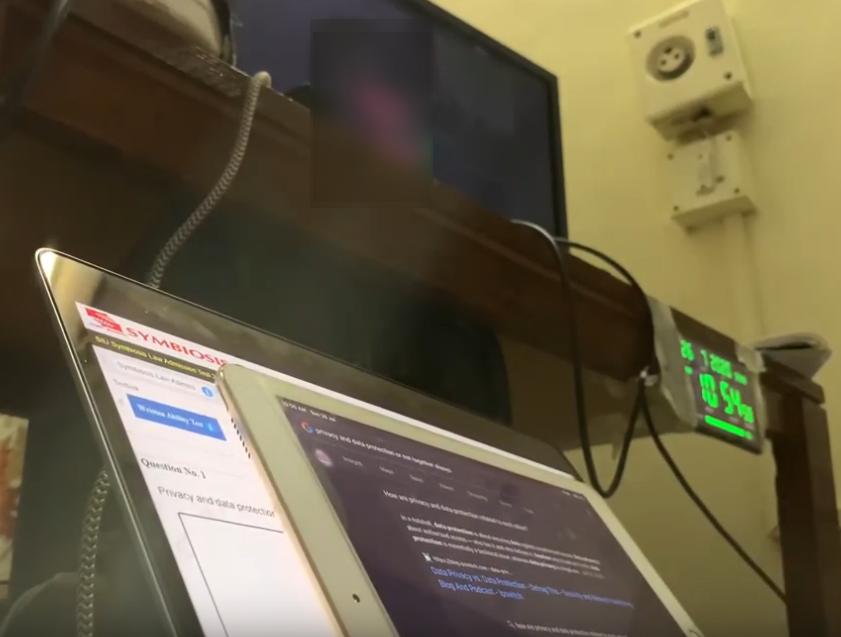
Reports and attempts have surfaced of how easy it had been to apparently circumvent some of the security measures in place for the home-proctored Symbiosis Law Admissions Test (SLAT), which was taken by around 20,000 aspirants this year for its five-year BA, BBA, LLB and LLB Honours programmes, according to an official with Symbiosis.
We have seen photos taken by at least four separate candidates of their laptops with open and readable SLAT questions over the previous three days of the test until today. This suggests that mobile phones were indeed accessible to candidates during the exam and even possible to operate without being immediately noticed by the proctoring system, by pretending to work out rough notes on scratch paper, for example.
Other candidates said that microphones were not enabled by the proctoring software, so it was possible to read questions out loud and get the help of someone sitting right next to the candidate, out of eye-shot of the webcam.
We have also heard reports of test takers sharing and discussing questions via chat with others.
None of those students apparently received any warnings by the proctoring software when they were taking the test, though that’s not to say they might not yet be outed.
And one particularly daring (or perhaps uncaring) candidate uploaded an entire video of his exam to YouTube.
We reached out to Symbiosis officials for comment. Declining to be identified, one said: “These points have already been anticipated.”
The YouTuber (see below) had already been identified and “he has been disqualified”, according to the official, with proctors having “been asked to be extra vigilant”.
They added that the SLAT’s technology provider (presumably TCS, although they declined to name them) had “a mechanism, artificial intelligence” (AI), that even students did not fully know the potential of, including “eye lid movement” tracking. “We get video of every candidate via proctor. Even batting an eyelid is captured. It is that comprehensive and sensitive.”
Such AI-enabled analysis would come in, in addition to “a backup investigative tool” after the exam had concluded (the last day of the SLAT took place today).
Only after such analysis would students find out whether their results have been accepted, or - if cheating is suspected - withheld.
During the Symbiosis-proctored LLM exam conducted earlier, there were no issues of cheating, said the official, probably in part because all those questions were subjective rather than just checking facts.
Furthermore, the Symbiosis official noted that “a candidate has about 60 seconds to click, allow the text to load, read, comprehend, remember / process a response” and that “diverting one’s attention for an internet search will be counterproductive” and “for most of the sections - like reading comprehension, logical / analytical / legal reasoning - an internet search will not be of any help”.
Those are fair points, though some candidates have clearly thought about (though perhaps not implemented) how to get around that with more sophisticated means and if given enough time and incentive, no system (including physical exams) will ever be 100% secure.
Does this raise bigger systemic issues?
Covid-19 is not easy for anybody, least of all for those hoping to hold or sit competitive national exams.
The SLAT is not alone in having pursued the home-proctored exam route. We had interviewed the LSAT-India in greater detail about this last week, which is relying on technology by multinational testing provider Pearson Vue.
The LSAT was confident in its integrity but that system had the advantage of only having been taken by only over 6,500 candidates and had been tested in the US before (where there is also likely to be stricter enforcement and sanctions for gaming the system).
However, even so, it is unclear whether such systems can stand up to Desi jugaad and competitive career pressures. This will also be of particular concern to NLU Delhi’s All India Law Entrance Test (AILET) exam, which has scheduled a home-proctored test also for around 20,000 candidates on 18 August (the even larger CLAT will go with centre-based online exams on 22 August, bringing with it other concerns).
Video evidence
The video uploaded on YouTube (screenshot above, video embedded below), with more than 3,700 views as of now, provides strong evidence of each of the above structural issues in this and potentially also other proctored exams.
Update 29 July 2020: The YouTuber has deleted his video and made a statement saying that since he had been busted, the exam is 100% secure. Read our full story and analysis here.
The video might be a proof of concept by an engineering student rather than an actual attempt to gain admission to a law school, but some of the potential very obvious issues in the video that make cheating a very real and easy possibility, include:
- The candidate is video recording the entire exam, apparently from a camera placed to the side of the laptop, so that it would not be captured by a webcam.
- The candidate is reading out loud many questions (which means that an expert test taker or family member or friend could easily help the candidate, much like ‘phone a friend’ on a quiz show). This also suggests that the proctoring solution employed does not require the microphone to be on.
- The candidate has access and is shown using a tablet device during the exam.
- A separate computer screen from the laptop displays what is apparently live webcam footage, possibly of the candidate, suggesting that
At the beginning of the video, the candidate has the LSAC’s LSAT-India landing page open (though there’s a warning that software needs to be downloaded.
Proctored technology sidebar (via Tata Consulting same as CLAT)
The YouTuber does not continue with the LSAT but instead then proceeds to take the Symbiosis test, running the so-called IBALauncher and iLEON apps that have to be installed on user’s system to effectively take over the computer and send webcam footage to the proctors.
System requirements for that app are a bit arcane, according to the Symbiosis-issued guide to its online test: Internet Explorer and Google Chrome are supported on versions 7 and 10 of Windows (and presumably also Windows 8, though it’s not explicitly mentioned), though if on Windows 7 you need to make sure you are on the right version, which is explained in much detail in the PDF guide. The open source Mozilla Firefox browser is only supported on Windows 7 using the very old and out-of-date version 56 from 2017). Those on Apple computers, much like for the LSAT-India, are out of luck completely but apparently all versions of open-source Linux-based OS Ubuntu can run the software (though no details are supplied about the browser to use).
Customer support and helpdesk itself seems to be handled via the Tata group company’s semi-separate TCS IOn digital learning.
Finally, the test itself seems to be software that seems to be the same that the Common Law Admission Test (CLAT) has used in its mock tests this year, hosted at the digialm.com domain, which also forwards to TCS IOn.
Cheating masterclass?
Separately, we have seen messages in a Telegram channel promising to explore tactics and tools to cheat on the SLAT, veering towards the more technical end of cheating (one of which would require fairly advanced computer programming competency to carry out).
Though there is no indication that the members of the channel or those that started it actually cheated or provided assistance to cheat, that channel had written in late May of this year:
Dear aspirants,
The goal of this channel is to explore all the tactics required to be able to cheat in the SLAT 2020 entrance which is to be conducted online.
Understand how cheating is possible in SLAT 2020:
There are two fundamental ways in which one can cheat.
● By becoming part of a small network of people who collectively provide the correct answer (according to each one of them) and the level of certainty to the cheat feed, all in real-time.
● By using freely available OCR (on screen reader - a software that detects the text on the screen) and then Google searches for immediate search results. The more sophisticated method is to use a python script (which runs on another computer) and feed your screen to a different monitor by using an HDMI or VGA cable.
How the latter method of cheating (mentioned above) works in the case of various types of questions:
●GK: Very possible
Reliability: Good
●Logical reasoning: Possible
Reliability: Good reliability if the question is a copy-paste one, which is usually the case.
●English: No luck!
All that’s possible is to look up some vocab related stuff but that is not worth the time.
Legal reasoning: One can look up some fact based stuff.
Maths: Not possible Questions in this section often tend not to be the exact copy of another question which pops up as the first search result.
Answering problem questions with YouTube help (badly)
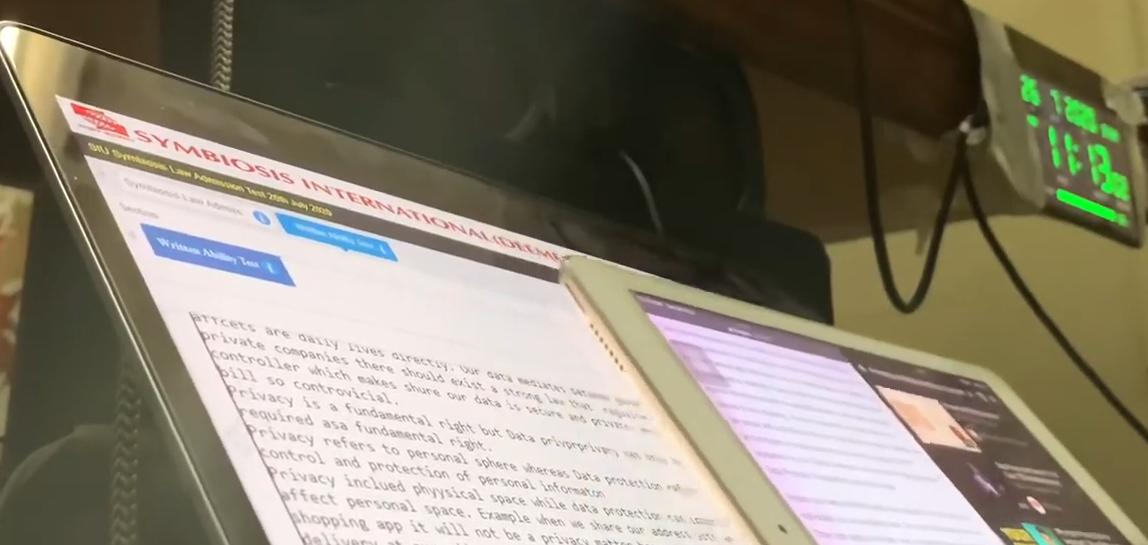
Regarding the somewhat cryptic long-answer question he attempts - “Privacy and data protection are not together always” - the YouTuber spends considerable time researching the subject, after placing a iPad-like tablet computer against his laptop screen.
He begins happily Googling information himself about data protection on his tablet, as well as watching YouTube videos on the subject (without even bothering to mute the sound).
After around five minutes of research, he begins answering the question on the laptop and the test software window’s textbox. “How are (sic) data is collected stored shared and used affects [text unreadable] directly. Our data mediates…,” the test taker transcribes from YouTube open on his tablet screen to the laptop that has the test window open. Eventually, after spending around 30 minutes on this question, the YouTuber has provided a long but fairly generic-seeming answer, which might or might not pass eventual muster as good enough to crack the exam.
And with the exam having a total time allotted of 75 minutes, this would scupper most serious candidate’s chances.
Proof of concept or actual cheating attempt? Either way, it will be a concern
While already apparently caught by Symbiosis, prima facie, the YouTuber seems to take few if any measures to hide his identity, and the example uploaded to YouTube would almost certainly be possible for the test convenors to disqualify, for several reasons:
- the YouTuber makes no attempt to hide their face recorded by webcam or their name (briefly visible during sign-in).
- each page of questions contains a unique grey text watermark of the tester’s ID, which is not obscured.
- it would be easy for the exam company to reconstruct the identity of the person from the video, just by virtue of the time stamps that each question is answered by, as well as camera footage and other details.
But until Symbiosis releases the final analysis of the proctoring recordings and other computer aided-conclusions, it is hard to say how widespread cheating was in SLAT.
But, it should be of serious concern to both institutions and students doing home-proctored tests.
Universities will be keen to not have to postpone their entire next academic year even further, since the CLAT physical exam approach in less than a month remains more risky from a health and organisational perspective, and subject to flare ups in Covid-19 hotspots.
Students will face a difficult choice: if cheating is possible without repercussion, even students that studied hard for a year may be tempted to get some additional assistance if it appears they can do so without significant risk and if they feel many other candidates are doing the same.
Update 29 July 2020: The YouTuber has deleted his video and made a statement saying that since he had been busted, the exam is 100% secure. Read our full story and analysis here.
{youtube}rufy8NX_Zd0{/youtube}
Comments
He did it openly to prove a point and also to claim whistleblower protection in case he is prosecuted.
1. "Giving" that exam
2. blow the lid "off"
Yours sincerely
Wren
1. NLS/NALSAR
2. NLS/NALSAR
3. NLUD
4. NLUJ
5. GNLU
6. NLIU
7. NUJS
8. RGNUL
9. NLUO
10. RMNLU
The rest don't matter
1. NLS/ NALSAR/ NLUD
2. NUJS/JGLS/NLUJ/ NLIU/GNLU
3. HNLU/ RGNUL/ RMLNLU/ NLUO/ NUALS
4. SLS Pune/CNLU/MNLU Mumbai/NUSRL/ MNLU Nagpur/NUSRL/ TNNLU/HPNLU
True more partners in law firms from NUJS and NLUJ or NLIU but the same true about DU or GLC or Symbiosis. Main reason is they started many years back.
I correct:
1. NLS/ NALSAR/ NLUD/NUJS
2. JGLS/NLUJ/ NLIU/GNLU
3. HNLU/ RGNUL/ RMLNLU/ NLUO/ NUALS
4. SLS Pune/CNLU/MNLU Mumbai/ NUSRL/ MNLU Nagpur/ TNNLU/HPNLU / ILS Pune
5. NLU Assam/Nirma/ DSNLU/ DNLU/ MNLU Aurangabad/ IPU USLLS/ GLC Mumbai/ BHU/ Jamia/ AMU / PU Chandigarh/ ULC Bangalore
6. BR Ambedkar NLU Sonipat, KIIT, Christ, SLS Noida, VIPS, Bennett, SOEL Chennai, DES Pune.
40+ law schools. All NLUs included. List for 5 year law only. For 3 year LLB, DU, BHU and Jindal are the best.