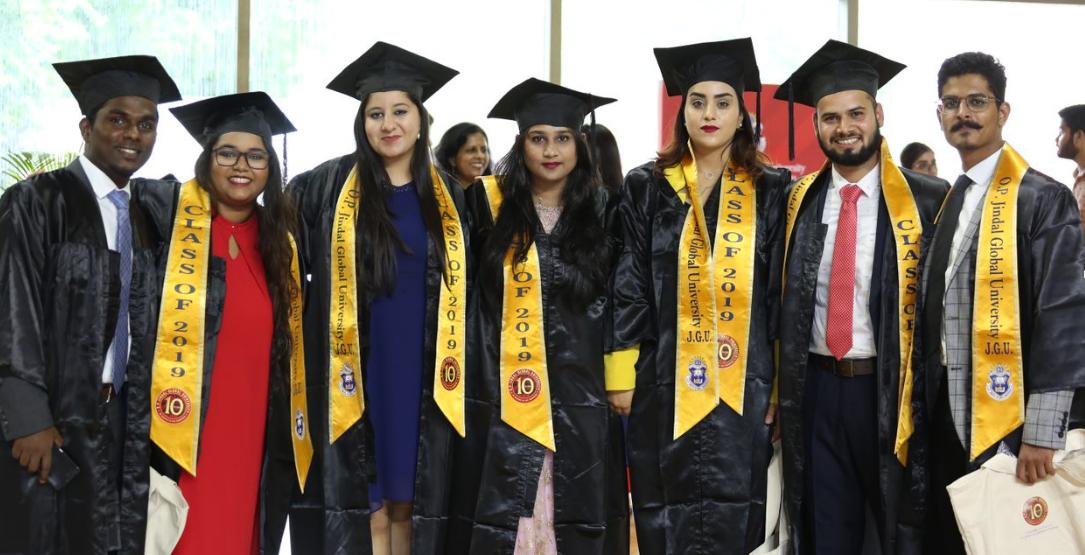
In a historic decision, the US Supreme Court recently ruled that the 1964 Civil Rights Act protects LGBTQI employees from discrimination based on sex. It was seen as a surprise decision, going against the tide, overturning the few backward steps issues around human rights have taken in recent times. That’s the power of law–it can spring hope, change and progress. For anyone interested in the world of law, the three-year B.A. (Hons.) Legal Studies programme can be the first step in the right direction.
“The law is the public conscience,” said one of the founders of modern political philosophy, Thomas Hobbes. According to Henry Ward Beecher, law is valuable not because it is law, but because there is right in it. In fact, law is meant to be the upholder of several rights the foundation of modern civilisation is based on. That’s why the study of law has intrigued and appealed to those who support and believe in the protection of rights for all.
In 2017, the Supreme Court of India passed its own historic judgment striking down the draconian Section 377, which criminalised sexual relations between persons of the same sex. Some of the best legal minds in the country came together in various capacities for the case. Jindal Global Law School (JGLS) alumnus Vamshi Rao was one of them, as he assisted a senior with the writ petition. “I felt lucky to have played a tiny part in this historic moment,” he says.
The three-Year B.A. (Hons.) Legal Studies programme can prepare young minds inclined to study law for their big moments. It sets the foundation for a sound legal training, and graduates can later decide to study further in order to practice law. Inviting admissions for the academic year 2020-21, it is the first-ever multidisciplinary undergraduate degree in legal studies in India. Designed to offer students exposure to the legal system, the programme will spark legal imagination and encourage students to express opinions on legal issues. It can be the perfect stepping stone to launch a range of careers in law and allied fields.
Fast-track your career path
While legal education in India has remained popular for decades, the path to law has been long. The traditional five-year B.A. LL.B. programme, which has held prevalence, can be a daunting prospect for some students who are interested in law, but are yet unsure about whether they want to practice or not. Alternatively, students have supplemented undergraduate degrees in other streams with a three-year LLB programme. Either way, it takes a minimum of five to six years or even more, to formally enter the field of law.
But the number one law school in the country has changed the game for legal education in India. Its new, three-year undergraduate programme prepares students for careers in legal and allied fields, without calling for the longer commitment to becoming a lawyer. The curriculum is especially designed for students to foray into the pre-legal and paralegal market, which is quickly booming across the globe. As the legal field gains major ground in modern times, the scope for a variety of new roles beyond the practice of law itself is opening up in a big way.
Some of the top American institutions like University of California, Berkeley and Northwestern University have been offering similar programmes to nurture future professionals in different areas of law and related fields. But it’s the first time in India that there is a three-year programme in legal studies with the advantage of multidisciplinary learning, which can open doors to many rewarding careers for students inclined towards law.
Leaders at the forefront with a background in law
Mahatma Gandhi and Nelson Mandela, two of the most revered leaders in modern history, had law degrees. John Grisham, one of the most prolific authors worldwide, was an attorney. He used his knowledge of law to spin legal tales that captured the imagination of millions of readers. From actors to artists, politicians, journalists, and entrepreneurs–there are many glowing examples of legally trained change-makers around the world. A more broad-based degree that combines law and liberal arts could be the gateway to interesting futures.
The B.A. (Hons.) Legal Studies programme at JGLS offers you the advantage of multidisciplinary studies as it includes liberal arts perspectives in the curriculum and allows you to pick cross-listed electives of your choice. The various schools at O.P. Jindal Global University (JGU) focusing on international affairs, business, government and public policy, liberal arts and humanities, and journalism and communication help you balance legal studies with your particular interest areas or career goals.
Let law take its own course
While you will not have the option to practice law at the end of the programme, that does not mean you won’t have a range of legal careers to look forward to. Paralegals, legal assistants and policy professionals are much sought after across industry sectors, particularly as the legal field continues to expand in the 21st century. As a paralegal, you could be working alongside some of the top lawyers and firms in the country. You could play your part in writing policies for companies, managing due diligence, conducting research, gathering evidence, and more.
At the end of the programme, if you choose to pursue further studies in the field, then your learning from the top law school in the country will hold you in good stead. You can apply for some of the best law school programmes being offered globally and build a career in corporate law, civil rights law, criminal law, and more.
In fact, you could continue your legal education at JGLS by enrolling for the three-year LL.B. programme. The additional degree will qualify you to take the All India Bar Exam and practice law. Graduates can also pursue certain post-graduate programmes that do not mandate a Bachelor’s degree in law, post-graduate diplomas in law and any other diploma or Master’s programmes beyond law.
For global perspectives and holistic growth
The B.A. (Hons.) Legal Studies programme has been designed to acquaint students with legal and political discourses, both national and international. The curriculum includes courses on International Law and Relations, and Cross Border Trade and Investment for a global perspective. JGU has strong collaborations with renowned universities and institutions around the world. These relationships are leveraged in many different ways to help students get a diverse worldview and understanding of best global practices in the field.
According to education experts, lateral thinking will be one of the most desirable attributes among future professionals. Through insights into subjects of social science along with legal studies, the programme fosters holistic growth. The wide-ranging learning opportunities help support all-round development and transformation of students.
Insider’s view of the legal system through experiential learning
Since its inception in 2009 as the first school of JGU—and India’s first global law school—JGLS has attracted experienced academics and practitioners from around the world. A global faculty that represents diverse legal systems and backgrounds has been a big leap for legal education anywhere in India. It’s earned JGLS a spot among the world’s top 150 law schools and as the country’s number one law school in the latest QS World University Subject Rankings, 2020.
In addition to world-class faculty in house, mentoring by distinguished legal personalities, who visit the campus for guest lectures, gives students a peek into real-world legal issues and cases. In fact, case studies are integral to learning at JGU. They offer industry insights into the legal system. JGLS has also signed MOUs and engaged in academic partnerships with reputed Indian and international law firms including White & Case, Cyril Amarchand Mangaldas, Shardul Amarchand Mangaldas, AZB & Partners, and Khaitan & Co. They offer a fertile training ground for students to gain hands-on experience through internships and more.
The demand for skilled, industry-experienced professionals with legal background is growing in different sectors within law and beyond. The B.A. (Hons.) Legal Studies programme at JGLS has been specially designed to meet that growing demand by nurturing experientially-trained candidates who can take on roles with corporate companies, media houses, NGOs, think tanks, and public policy organisations, or choose to pursue further studies in law.
Admission to BA Legal Studies Hons. 2020-23 batch is open till 15 November 2020. Please apply with your LSAT/ CLAT score at www.jgls.edu.in.
You can email to or call at 7027850388, 8930110758, 8930110817
Comments
Also, if one does BA + 3 year LLB afterwards at Jindal, is it cheaper than 5 year BALLB?
Thanks.
Yes it's cheaper than thier 5 year program which is like 8 lakhs per annum. But the best part is they have a placement system where all law students sit together for placements so it's a really good option.
Have given their test jsat law and waiting for results
[/quote]
The ones listed above + perhaps JD or LLB abroad + maybe UPSC, if you are smart enough to crack it. But if you cannot afford the fees then better to do a regular BA in Political Science from DU or a government college + a correspondence course like NLSIU MBL or diploma in human rights. After that you can do an LLB from JGLS or DU, depending on what you can afford.
[quote]It is not as if there is any masters version of this programme. [/quote]
In my view, a one year MA in Legal Studies will attract more students than a BA in Legal Studies, so you are right in pointing it out.
[quote]Do they have to change streams completely, like opting for an MBA or taking competitive exams? If so, why not just opt for a standard BA Hons. programme in other disciplines?
[/quote]
It's a question of finances. Simple as that.
1. Fall under under general quota and could not get into their college of choice due to tough competition
2. Don't wish to drop a year
3. Would rather do a BA at JGLS + 3 year LLB at JGLS/DU, rather than a 5 year LLB at a Z-grade college.
4. Can afford JGLS
5. Would like to spend a semester abroad