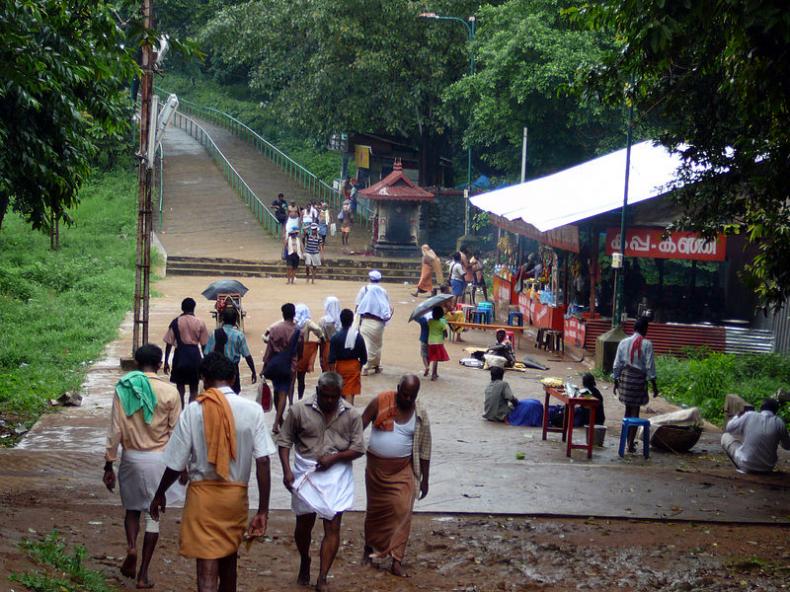
The afternoon hearing at Court No 4 of the Supreme Court on the entry of women to Sabarimala temple got interesting with senior counsel for the temple board, KK Venugopal, comparing the discrimination at Sabarimala with similar classification on the basis of gender in other areas of activity.
He referred to advertisement by armed forces which prefers men between the ages of 20 and 24 alone for recruitment under a particular category. Posing the question whether such a classification only on the ground of gender and age group is valid, he said, what is expected here is the quality of endurance, which only men of that age group possess.
He then referred to the army camp at Siachen, which requires highest degree of endurance, and said ordinary people can’t withstand the weather there.
He then asked whether we could call it discrimination if the Board of Control for Cricket in India (BCCI) spends money only on young people below 30 years of age, so as to train them for playing better cricket.
He then cited other instances like recruiting women nurses in hospitals only on the basis of sex, or recruiting male nurses in mental hospitals, to drive home his point that if in one the attributes of compassion or dedication are expected only from women nurses, in mental hospitals, only male nurses are expected to control patients who may be violent.
Venugopal then said these instances show that if the temple authorities believe that women devotees at Sabarimala are not expected to observe penance for 41 days, because they cannot perform the rituals associated with the puja, then it appears reasonable.
Justice Dipak Misra then asked whether a biological phenomenon like menstruation could be a condition precedent for worship at a temple.
To this, Venugopal cited Article 15 (2) (a) and (b) - dealing with prohibition of discrimination on grounds only of religion, race, caste, sex or place of birth or any of them - to suggest that the Constitution-framers deliberately omitted places of public worship from the list of access to public places given here, taking into account the religious diversity in the country.
Thus Article 15(2) (a) and (b) says no citizen shall, on grounds only of religion, race, caste, sex, place of birth or any of them, be subject to any disability, liability, restriction or condition with regard to access to shops, public restaurants, hotels and places of public entertainment; or the use of wells, tanks, bathing ghats, roads and places of public resort maintained wholly or partly out of State funds or dedicated to the use of the general public.
During the hearing, Justice Dipak Misra asked the counsel for information about the temple dedicated to the worship of Duryodhan in Kerala, and narrated the story behind the temple, which he partly remembered from reading a book.
The hearing will continue next Monday, 2 May.

Comments
But what you should do once pointed out is to see the facts for yourself.
Its not Mishra. Its 'Misra'.
Know your own facts first and then correct others.
Regards
It's Mumbai. Not bombay.
1. Sabarimala is a siddha abode sacred by its customs and rituals.
2. The sacred can be understood only if the supernatural basis of tantrik worship of the deities is understood.
3. Hindu supernatural abode is not a public place under the constitution of India. On the supernatural plane no constitution operates.
4. By placing wrong reasons Mr Venugopal is making the deity a laughing stock before the ignorant women.
5.Senior lawyer must make an effort to understand the socio-spiritual dimensions of the ancient enlightened society that existed in Kerala. Restriction or the ban order is a mistake committed earlier under same kind of ignorance meeting ignorance arguments.
6. Supreme Court has to ensure that the decision does justice to the sacred siddhapitha - the spiritual is understood by the Judges - including the Xian Judge on the bench. Without understanding the spiritual and explaining it, if the court intervenes in the matter of temples, it will be a sacrilege on the deity.
K. Chandra Hari
Please make legal arguments instead of saying things like law does not extend to supernatural places. Law is for people; not places. So if people are to visit or not visit places, the law governing the same will be implemented in such places also (even if it is supernatural etc etc.)
Questions that are getting discussed in the media are all funny. People lack even the basic knowledge of Hindu spirituality and temple worship. Life has a Physics and Hindu spiritual wisdom is the Physics of life. Let the court give an opportunity, the ignorance of those who seek worship during Mandala will be brought out.
In my submissions I have demanded a correction of the 05.04.1991 ban order issued by the honourable High Court of Kerala. I have stated menstruation as a sacred phenomenon and have not alleged any impurity out of the same to the women. Mr KK Venugopal is made to present such unscientific arguments and so he is getting rebuked by the court. If the issue is scientifically discussed by men who have the experience and knowledge of the spiritual process, all the questions by the Court can be answered satisfactorily.
Now the fight is between ignorance vs ignorance of the spiritual which has sought to make the SC its medium for manifestation. This is an opportunity for the Hindu spiritual doctrine to prove its truth and for that the abodes must be liberated from the Avidya to which they have fallen victims.
Court must look at the hereditary succession of caste oriented Pontiff (Tantri) position and such anomalies in the administration. All human beings must be made equal first and there must be a scientific assessment of the claims of Tantrik worship. Unless the court demonstrates that they have understood all the spiritual dimensions of the abode, they cannot decide it as a Town Hall.
I need not have represented to an anonymous comment. But I have did so only to convey that all the questions getting raised by the court and the media can be answered without any confusion before qualified men and women. Yes, I can't convince everyone. But if the people have the requisite minimum background and an open mind, I can make them realize that the Mandalavrta is an occasion where in women (10-50) abstained from pilgrimage due to some specific spiritual reason and during other occasions any women may visit Sabarimala. I want to reiterate that the reason for women's abstinence from pilgrimage is not menstruation or any impurity connected as Mr KK Venugopal has argued. Menstruation and women are most sacred as per the precepts. Men and Women make the unit of family and Society and the difference perceived in the context of tantrik worship is due to the fact that the male and female gender involve physiological difference that make them compliment each other. Please note - Men and Women are not duplicates spiritually. Had they been duplicates law could have decided the equality in tantrik worship.
K. Chandra Hari
Which brings us to the question of whether the temple is a public space. As someone who is agnostic, I would be more than happy if all temples were take out of the public sphere (no tax-breaks, and no benefits for being religious in nature, no reservations based on religion, etc.). However, that's not the world we live in, and there is more than enough evidence to suggest that temples like this one thrive through government benefits. The tax free trusts where tonnes of gold are recovered are evidence of this. So if you're going to attempt to claim benefits of being a public space, the rules of public spaces must apply to you as well. This is why there are laws regarding temple entry for Dalits, for example.
Lastly, on the competence of the judges, I would only say that, while the understanding of Hindu spirituality above may help them understand the issues involved, a belief in these ideas (or lack thereof) shouldn't impact their decision. This is a fundamental tenet of secularism in my view. The decision must be made on the basis of the constitution alone, and not some interpretation of Hindu spirituality that has no place in a decision of the Supreme Court which interprets the constitution
Why the women abstained during the two months of warrior vow by men and their pilgrimage?
Neither the petitioners nor the Amicus Curies or the parties at present involved with the case knows the fact. No effort has been made to understand the spiritual process out of which a geographical spot has emerged as sacred with supernatural associations.
Will the 50 crores Hindu women shall agree to disregard the sacred and the supernatural attached to the Siddha abode? How the petitioners can claim representation of the Hindu women folk when they are unaware of the spiritual dimensions and lacks clarity in respective of the objectives sought by them in the Mandala pilgrimage? When they don't have any grasp of the spiritual side what are the motives of the petitioners to seek entry? There are so many other peaks on the Western Ghats like the Potiyil Mala where anyone can go round the year? Why the women are not ready to trek on that Agasthya sacred route?
What makes Sabarimala special for the women petitioners? When they don't know the spiritual process and the articles of faith and initiation attached to it,how any cause can arise for fundamental rights?
[b]Let us be scientific in deciding whether there is a discrimination?
When does discrimination happen? When something useful or precious is denied. When something graceful is denied. Is there any such thing that the women feel as being denied to them at Sabarimala given the context of denial of its sacred and supernatural dimensions? [/b]
What is being denied to the women - tourist visit to the shrine? Is it scientific to think that a namesake visit to the structure can lead to any gain for the women?
How the court may assess the item - quantity & quality of the denial? Is there anything distributed at Sabarimala which is denied to the women?
What if on the other hand the spiritual process at the abode leaves the abstaining mothers with a gain?
Where lies the merit?
K. Chandra Hari
I'm not a highly spiritual or learned person. I have gone to Sabarimala only thrice. But i find the arguments put up by devaswom layer not very convincing.
As a common man and a hindu, what i understand is
1. Lord Ayyappa is a celibate and even his consort is waiting outside the temple. How can the women activist challenge these beliefs.
2. All the pilgrims visiting the shrine are following celibacy or brahmacharya for 41 days by abstaining from sex or sexual thoughts or masturbation. They focus their thoughts only on lord ayyappa and abstain from any influence of sexual thoughts like tv, films, close contact of females, even abstaining from their wife during menstruation.
3. The concept of "tatvamasi" means that all the pilgrims are Lord Ayyappan himself. Thats why all the pilgrims who have put mala are considered to be Lord Ayyappan and called Swami. So all the pilgrims are celibate and should not be distracted.
4. Now are women impure during menstruation? I dont have an answer to that because i understand that mentrual blood, child birth, are considered "Asshudhi". But on logical thought, sabarimala bans all women who may be sexually active so that the pilgrims who become Swami Ayyappan after putting mala are not distracted.
5. Women activist are saying they will take 41 days vratham and visit sabarimala. I doubt that they can do that. Men can avoid sexual thoughts, sexual acts and prevent release of semen/sperm consciously. Nightfalls during sleep cannot be compared as they are unconscious occurence.But women cannot prevent ovulation and menstruation, which is a normal reproductive cycle. It is medically recognised that during ovulation there are lots of harmones getting released by which there is sexual drive in women to conceive. This biological phenomenon cannot be controlled, moreover the male pilgrims who are normal human beings and not a real God, cannot control his normal sex drive when women come in close contact. All the vratham and brahmacharya will be lost if women are allowed by SC judgement.
6. The women activist are comparing this as bad tradition like Sati. I really dont understand why men like Rahul Easwar cannot tell them that Sati, Dowry death, female infanticide, child marriage, rape, forced polygamy, forced prostitution are atrocities against women. Going to Sabarimala is a choice, women can go to other temples, there is no life threatening force used by males.
7. The women are considering this as discrimination against them. Then reservation is an official discrimination, why do they fight for women reservation bill? Why do they want separate toilets, hostels, coaches, seats in buses, separate teams for men and women, let Sania mirza play against Nadal, let Mary Kom fight with Mike tyson.
Constitutional arguments:
Right to equality - Scrap all reservation policies as its discriminatory against the forward hindus. Stop the idea of womens reservation as it discriminates men. Stop discrimination of muslim women - no more polygamy, burqah, talaq. No more separate toilets, compartments, schools, colleges, hostels, sports team for men and women.
Right to visit public place - Declare all temples, mosques and churches are public places. Remove prohibition of entry to non-muslims at Kashi viswanath temple, Puri jagannath temple, Guruvayoor temple. May be we should fight for non-muslims visiting Mecca and Medina.
Regards
Shashi AG