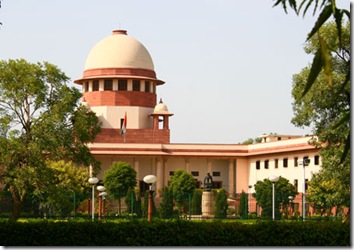
Exclusive: 71 advocates out of around 400 test takers have passed the June 2011 advocates-on-record (AOR) examination, making them part of the oligopoly of at least 1,000 advocates who can file petitions before the Supreme Court. However, the Delhi High Court has now taken up a writ challenging the AOR system and has approached the apex court for guidance.
According to the results uploaded on the Supreme Court website, 71 test takers passed the exam outright. The highest roll number of a candidate listed in the results is 396.
Advocates appearing for the exam must first take one year of continuous training from an existing advocate-on-record. Candidates are allowed five chances to pass the exam, except for those who fail all papers who will not be permitted to re-take the exam the next year.
Furthemore, 43 advocates may retake one or more papers of the test at the next exam under regulations 11(i) and (ii) to attempt to bring a single paper’s or the aggregate score up to pass level.
Advocates can retake only one paper that they failed under regulation 11(i) if they fail that paper with a grade above 40 per cent and pass all remaining papers with 60 per cent of total aggregate marks.
Under regulation 11(ii), those getting less than 60 per cent in aggregate without failing any single paper can also resit one papers where they scored less than 60 per cent to raise their score to the pass-level.
The AOR examination committee is headed by Justice Altamas Kabir, Justice DK Jain and Justice P Sathasivam.
Only AORs may file cases and may plead or instruct others to plead before the Supreme Court, including senior counsel.
Challenge to AOR supremacy
The PTI reported on 25 November that in hearing a writ, a Delhi High Court bench of Acting Chief Justice A K Sikri and Justice Rajiv Sahai Endlaw approached the Supreme Court to justify by 9 December why the AOR system should continue.
In the case Balraj Singh Malik Vs. Supreme Court of India through its Registrar General (WP(C) 8327/2011, the advocate petitioner Malik who is representing himself argued that the rules violated the fundamental right of other lawyers who had an equivalent qualification, according to PTI which reported that Malik said that a “large number of advocates are suffering professionally because of this rule giving the privilege only to advocates on record”.
The Supreme Court Bar Association (SCBA), AOR Association, Solicitor General and Attorney General of India have also been issued with notices.
Comments
Also, are AORs looked at as "inferior" advocates, since they seem to only "sign off" on stuff that others prepare?
Just like other advocates, AoR's charge a fee for representing a client in the Supreme Court and fees vary. While some AoR's also indulge in name-lending, this must be seen as indicative practice of all AoR's because in my experience that is actually not true.
Out of interest, does becoming an AOR give a boost to one's career or do you just end up doing mostly mechanical filings and 'name lending'?
Two follow-up questions for you, if I may.
1. I understand the fee range varies from one AoR to another, but I am just looking for averages here.
2. Following up to Kian's reply, what does an AoR designation do to one's career. Do AoRs typically end up doing mostly filings and collecting fees for it (not because they can't do filings, but with just 1600 AoRs, I am guessing there is a lot of filing to be done). Or, are there AoRs who are actually able to maintain their own robust practice drafting and pleading cases on behalf of their own clients, but at the same time file on behalf of others. If the latter is true for some AoRs, what percentage of practice would you say the two components are split at? For example, is it 50% own drafting and pleading + 50% filings for others in the capacity as an AoR?
Thank you.
So it basically depends on what the AoRs make of their careers. Many go on to become leading arguing counsels. At the same time, some end up being name lenders only.
[quote name="More"]Thank you for the reply. Very insightful response.
Two follow-up questions for you, if I may.
1. I understand the fee range varies from one AoR to another, but I am just looking for averages here.
2. Following up to Kian's reply, what does an AoR designation do to one's career. Do AoRs typically end up doing mostly filings and collecting fees for it (not because they can't do filings, but with just 1600 AoRs, I am guessing there is a lot of filing to be done). Or, are there AoRs who are actually able to maintain their own robust practice drafting and pleading cases on behalf of their own clients, but at the same time file on behalf of others. If the latter is true for some AoRs, what percentage of practice would you say the two components are split at? For example, is it 50% own drafting and pleading + 50% filings for others in the capacity as an AoR?
Thank you.[/quote]
very few or it is rare to find AOR arguing in matters than taking pass over or adjournment.( except few, which can be counted).
rumor running strong and seems to be true to some extent.
That said, there is another school of thought. The perception among some in Delhi bar is that once you qualify as an AoR, you've chosen to become a 'drafting counsel' (as opposed to an arguing counsel) and accordingly your chances of getting arguing work may be adversely affected as would your future chances of designation as a senior advocate, who undertakes mainly arguing work and little drafting work (i.e. opinions, settling SLPs etc). My personal opinion is that such perception is unfounded and misinformed and deserves to be ignored since there are many competent AoR's who are good arguing counsels in addition to being excellent draftsmen and fully conversant with the practice and procedure of the Supreme Court. Many AoR's also undertake only arguing work and do minimal filing. Nonetheless, rightly or wrongly, this perception does exist and to that extent, in the long term, becoming an AoR may not help if one intends to be exclusively an arguing counsel.
Name lending - many AoR's do indulge in name lending, which essentially means that the SLP (or writ petition or transfer petition etc) is drafted by a non-AoR (drafter's name is usually shown as 'drawn by ...' in the SLP and AoR's name is shown as 'filed by ...') but filed by an AoR without proper scrutiny by the AoR for compliance with Supreme Court practice. Once filed, such a case is almost entirely entrusted to the non-AoR who had originally drafted the petition. This practice of name-lending unfortunately does exist and there are certain advocates who are known to lend their name to a petition for a fee. While this practice must be condemned in strongest terms, this is clearly not indicative of the AoR practice in general and in my view, cannot be ground for doing away with the AoR system all together. The bar should ensure that such practices are checked and discouraged.