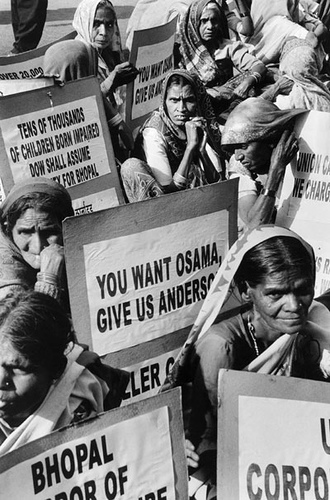
The former Indian chairman and six other directors, managers and staff of Union Carbide India Limited (UCIL) have been sentenced to two years imprisonment for causing death by negligence in the world’s biggest industrial gas leak disaster in Bhopal in 1984 that had killed up to tens of thousands.
The courts imposed the maximum possible sentence of two years of simple imprisonment along with a fine of Rs 1 lakh each on all the accused while UCIL’s current owners will have to pay Rs 5 lakhs in fine.
The court convicted eight former UCIL staff who were serving at the time of the disaster, including former UCIL chairman Keshub Mahindra, a managing director, vice president, works manager, production manager, plant superintendent and production assistant, of whom one died during the trial.
All have been granted bail on depositing Rs 25,000 as bail surety.
The verdict was delivered today by the chief judicial magistrate of the Bhopal District Court in the case after 26 years of protracted litigation since a leak of the noxious methyl isocyanate gas killed local residents on 2 December 1984.
All the accused were charged and convicted under Sections 304A (Causing death by negligence), compounded by Sections 336 (endangering life and safety), 337 (causing hurt) and 338 (causing grievous hurt) of the Indian Penal Code.
However, the maximum punishment under the above sections does not exceed two years, which has left commentators touting the judgement as “too little, too late”.
According to media reports the families of the victims and protesting activists will file an appeal in the Madhya High Court followed by an appeal in the Supreme Court for revision of sentence.
The global CEO and US-based chairman of Union Carbide, Warren Anderson has been declared proclaimed offender by the court after repeated attempts to extradite him for conviction failed.
The Bhopal disaster occurred at a pesticide plant owned and operated by Union Carbide (UCIL) in Bhopal, Madhya Pradesh. In 2001 another American company Dow Chemical acquired Union Carbide, which sold off its share holdings in the UCIL seven years back. (Click here for a chronology of events in the case.)
In December 2009, on the 25th anniversary of the disaster, legal experts from around the world met at NLIU Bhopal to discuss “Corporate Social Responsibility and Industrial Disasters” during a conference.
NLIU student and conference convenor Aditya Bhattacharya told Legally India: “Prof. David Lewis who is a Professor of Employment Law at Middlesex University (UK) created a niche in the minds of the participants by examining the employment and labour law perspectives while handling issues pertaining to mass tort litigation.”
Bhattacharya said that Lewis argued that India was incapable of handling issues pertaining to mass tort litigation and compensation mechanism but it was equally incapable in dealing with employment law issues. “India has a rich judicial background with respect to labour laws, however, [Bhopal gas tragedy victims] could never take advantage of it,” Bhattacharya summarised Lewis’ argument.
Professor Jeffrey Addicot of St Mary’s University School of Law San Antonio Texas had highlighted issues at the conference pertaining to mass tort litigation in India and abroad. “His emphasis was categorically on the solutions to the problem with respect to Industrial Disasters. At present, countries all over the world are playing blame game rather than coming out with effective solutions,” explained Bhattacharya.
Professor Madhava Menon traced the Bhopal gas disaster from the grassroots level but stated that over time Indian laws had become adept over all fronts to cater to industrial disasters. National Judicial Academy Bhopal professor Mohan Gopal on the other hand highlighted the conceptual problems that exist in the corporate social responsibility scenario, especially in India, emphasising the corporate commercial laws and the changes that are required for greater corporate social responsibility.
The Bhopal verdict could also revive the debate surrounding the civil nuclear liability bill and related issues of corporate liability.
Comments
It was supposed to be less about a national law school than about the points raised by various professors, which happened to be said in the city where the tragedy happened.
We found academics' comments interesting in this case.
Best regards,
Kian
I also can't understand why we worship Nani Palkhivala, who chose money over country and fought for UCC. This man has written articles saying that universal adult suffrage in India was a mistake, and he is considered to be a hero!! How ironic that one of the few noble people in the whole episode was a foreign lawyer, Marc Galanter. Perhaps the BCI xenophobes should take note?
Can anyone throw some light on who all were involved and why was UC let off without any sensible liability? Contrats this with the Obama's daily threats to BP.
the person to blame is justice pathak. his "prize" was a seat in the ICJ and krishan iyer slammed him for this
Is there no one influential who can bring justice to poor. What our government is doing.
I think it has quit a while we r talking it is the time to do something.
N i really urge youth of this country awake arise and do justice to your mother land.......