A group of lawyers analysed 884 judgments handed down by the Supreme Court in the 2014 calendar year and found that only 64, or 7 per cent, involved any substantive constitutional issues, and the apex court instead was mostly handling routine appeals from high courts.
Supreme Court advocate KV Dhananjay and a team of a dozen practising lawyers in Delhi and Bangalore sifted through the cases “with a view to find out how many of those judgments involved an interpretation of the Constitution of India or involved some challenge to any statute, regulation, law or executive action on the ground of it being inconsistent or repugnant to any constitutional provision”, explained their report.
They found that only 64 judgments involved a dispute over the interpretation of any constitutional provisions, or a challenge of any law on the basis of its inconsistency with the constitution, with several exceptions and notwithstanding a degree of unavoidable subjectivity (see below for full methodology and the list of cases).
Dhananjay commented: “One inescapable conclusion that a study of these 884 judgments does tells us is that the judges of the Supreme Court of India, as a class, are simply the most burdened of any class of judges anywhere in the world. They are increasingly carrying a tremendous burden with them and we must all be collectively grateful to them for their contribution to the cause of justice.”
Out of the 64 judges dealing with constitutional issues, exactly half (32) were written by a two-judge bench, 18 were penned by a three-judge bench, and 14 were handed down by a five-judge bench.
There was some correlation between seniority of judges and the number of constitutionally significant judgments they sat on, though this was not absolute.
The current Chief Justice of India (CJI) HL Dattu, and justices Anil R Dave and Sudhansu J Mukhopadhaya, for instance (the first, third and fourth-most senior judges currently in the supreme Court), had not authored any judgments with constitutional significance, according to the research data.
A relatively young member of the bench, former senior counsel Justice Rohinton Nariman, however, had already written three such judgments in 2014.
Justice AK Sikri was the sitting judge with the greatest number of such judgments – seven – while retired CJIs P Sathasivam and RM Lodha had each written nine judgments during the part of 2014 before their retirements.
In 2012, policy researcher Nick Robinson found that the number of constitution benches in the Supreme Court has steadily decreased since the 1960s, from hundreds per year, to around nine annually nowadays.
This lies in stark contrast to other constitutional apex courts all over the world.
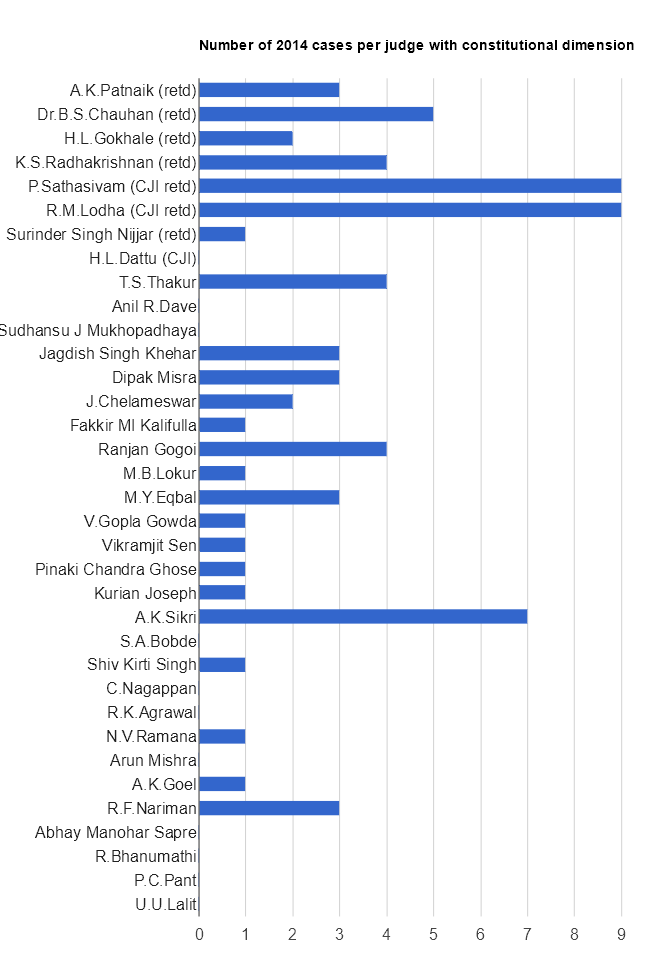
Source data: 2014 judgments with a constitutional dimension
| Sl.No. | Date: | Parties / Title | No. of Judges | Judges (The author name is in bold, followed by the other judges in the Bench) |
|---|---|---|---|---|
| 1 | 10-Jan-14 | Hardeep Singh v. State of Punjab | 5 | Dr.B.S.Chauhan * P.Sathasivam (CJI) * Ranjana Prakash Desai * Ranjan Gogoi * S.A.Bobde |
| 2 | 10-Jan-14 | R.Unnikrishnan v. V.K.Mahanudevan | 2 | T.S.Thakur * Vikramjit Sen |
| 3 | 16-Jan-14 | Kumari Hema Mishra v. State of Uttar Pradesh | 2 | K.S.Radhakrishnan * A.K.Sikri |
| 4 | 21-Jan-14 | Biswanath Bhattacharya v. Union of India | 2 | J.Chelameswar * H.L.Gokhale |
| 5 | 21-Jan-14 | Shatrughan Chauhan v. Union of India | 3 | P.Sathasivam (CJI) * Ranjan Gogoi * Shiva Kirti Singh |
| 6 | 07-Feb-14 | ABP Private Ltd. v. Union of India | 3 | P.Sathasivam (CJI) * Ranjan Gogoi * Shiva Kirti Singh |
| 7 | 11-Feb-14 | Suhas Pophale v. Oriental Insurance Co. Ltd | 2 | H.L.Gokhale * J.Chelameswar |
| 8 | 12-Feb-14 | Renu v. District And Sessions Judge | 3 | Dr.B.S.Chauhan * J.Chelameswar * M.Y.Eqbal |
| 9 | 18-Feb-14 | V.Sriharan v. Union of India | 3 | P.Sathasivam (CJI) * Ranjan Gogoi * Shiva Kirti Singh |
| 10 | 19-Feb-14 | Amarendra Kumar Mohapatra v. State of Orissa | 2 | T.S.Thakur * Vikramjit Sen |
| 11 | 19-Feb-14 | Shabnam Hashmi v. Union of India | 3 | Ranjan Gogoi * P.Sathasivam (CJI) * Shiva Kirti Singh |
| 12 | 25-Feb-14 | Common Cause v. Union of India | 3 | P.Sathasivam (CJI) * Ranjan Gogoi * Shiva Kirti Singh |
| 13 | 25-Feb-14 | Gohil Jesangbhai v. State of Gujarat | 2 | H.L.Gokhale * Surinder Singh Nijjar |
| 14 | 25-Feb-14 | Justice Ripusudan Dayal (Retired) v. State of Madhya Pradesh | 3 | P.Sathasivam (CJI) * Ranjan Gogoi * Shiva Kirti Singh |
| 15 | 06-Mar-14 | Union of India v. Major S.P.Sharma | 3 | M.Y.Eqbal * Dr.B.S.Chauhan * J.Chelameswar |
| 16 | 12-Mar-14 | Pravasi Bhalai Sanghatan v. Union of India | 3 | Dr.B.S.Chauhan * M.Y.Eqbal * A.K.Sikri |
| 17 | 26-Mar-14 | Justice Sunanda Bhandare Foundation v. Union of India | 3 | R.M.Lodha (CJI) * Sudhansu Jyoti Mukhopadhya * Dipak Misra |
| 18 | 27-Mar-14 | Sandeep Kumar Bafna v. State of Maharashtra | 2 | Vikramjit Sen * K.S.Radhakrishnan |
| 19 | 28-Mar-14 | Dr.Subramanian Swamy v. Raju Thru Juvenile Justice Board | 3 | Ranjan Gogoi * P.Sathasivam (CJI) * Shiva Kirti Singh |
| 20 | 28-Mar-14 | Usha Bharti v. State of Uttar Pradesh | 2 | Surinder Singh Nijjar * Fakkir Mohamed Ibrahim Kalifulla |
| 21 | 07-Apr-14 | Sudhesh Dogra v. Union of India | 3 | P.Sathasivam (CJI) * Ranjan Gogoi * N.V.Ramana |
| 22 | 15-Apr-14 | National Legal Services Authority v. Union of India | 2 | K.S.Radhakrishnan * A.K.Sikri |
| 23 | 17-Apr-14 | Association of Unified Tele Services Providers v. Union of India | 2 | K.S.Radhakrishnan * Vikramjit Sen |
| 24 | 23-Apr-14 | Common Cause v. Union of India | 3 | P.Sathasivam (CJI) * Ranjan Gogoi * N.V.Ramana |
| 25 | 24-Apr-14 | Mohammed Saeed Siddiqi v. State of U.P. | 3 | P.Sathasivam (CJI) * Ranjan Gogoi * N.V.Ramana |
| 26 | 24-Apr-14 | Vishal Goel v. State of Karnataka | 2 | A.K.Patnaik * Fakkir Mohamed Ibrahim Kalifulla |
| 27 | 25-Apr-14 | Security Association of India v. Union of India | 2 | Pinaki Chandra Ghose * Gyan Sudha Misra |
| 28 | 25-Apr-14 | Union of India v. Sriharan | 3 | P.Sathasivam (CJI) * Ranjan Gogoi * N.V. Ramana |
| 29 | 29-Apr-14 | K.Madhava Reddy v. Government of A.P. | 2 | T.S.Thakur * C.Nagappan |
| 30 | 06-May-14 | Dr.Subramanian Swamy v. Director, C.B.I | 5 | R.M.Lodha (CJI) * A.K. Patnaik * Sudhansu Jyoti Mukhopadhya * Dipak Misra* Fakkir Mohamed Ibrahim Kalifulla |
| 31 | 06-May-14 | Kone Elevator India v. State of Tamil Nadu | 5 | Dipak Misra * Fakkir Mohamed Ibrahim Kalifulla * R.M.Lodha (CJI) * A.K.Patnaik * Sudhanshu Jyoti Mukhopadhya |
| 32 | 06-May-14 | Pramati Educational And Cultural Trust v. Union of India | 5 | A.K.Patnaik * R.M.Lodha (CJI) * Sudhansu Jyoti Mukhopadhya * Dipak Misra* Fakkir Mohamed Ibrahim Kalifulla |
| 33 | 06-May-14 | Satya Pal Anand v. State of Madhya Pradesh | 2 | A.K.Sikri * Anil R Dave |
| 34 | 06-May-14 | State of Karnataka v. Associated Managements of Gov. Rec Primary Schools | 5 | A.K.Patnaik * R.M.Lodha (CJI) * Sudhansu Jyoti Mukhopadhya * Dipak Misra* Fakkir Mohamed Ibrahim Kalifulla |
| 35 | 06-May-14 | Subrata Roy Sahara V. Union of india | 2 | Jagdish Singh Khehar * K.S.Radhakrishnan |
| 36 | 06-May-14 | Union of India v. Hindustan Zinc | 2 | A.K.Sikri * Anil R Dave |
| 37 | 07-May-14 | Animal Welfare Board of India v. A.Nagaraja | 2 | K.S.Radhakrishnan * Pinaki Chandra Ghose |
| 38 | 07-May-14 | State of Tamil Nadu v. State of Kerala | 5 | R.M.Lodha (CJI) * H.L.Dattu * Chandramauli Kr Prasad * Madan B. Lokur * M.Y.Eqbal |
| 39 | 09-May-14 | Ahmedabad Municipal Corporation v. Ahmedabad Green Belt Khedut Mandal | 3 | Dr.B.S.Chauhan * J.Chelameswar * M.Y.Eqbal |
| 40 | 09-May-14 | Kishan Shankar v. Arun Dattatray Sawant | 2 | A.K.Sikri * Surinder Singh Nijjar |
| 41 | 22-May-14 | Union of India v. R.P.Singh | 2 | Dipak Misra * N.V.Ramana |
| 42 | 15-Jul-14 | Rohtas Bhankar v. Union of India | 5 | R.M.Lodha (CJI) * Jagdish Singh Khehar * J.Chelameswar * A.K.Sikri * R F Nariman |
| 43 | 23-Jul-14 | Dr.Subramanian Swamy v. Arun Shourie | 5 | R.M.Lodha (CJI) * Anil R Dave * Sudhansu Jyoti Mukhopadhya * Dipak Misra * S.K.Singh |
| 44 | 01-Aug-14 | U.C.Raman v. PTA Rahim | 2 | Shiva Kirti Singh * R.M.Lodha (CJI) |
| 45 | 06-Aug-14 | Manzoor Ali Khan v. Union of India | 2 | Adarsh Kumar Goel * T.S.Thakur |
| 46 | 07-Aug-14 | Nawal Kishore Sharma v. Union of India | 2 | M.Y.Eqbal * Ranjan Gogoi |
| 47 | 07-Aug-14 | Puducherry S.C. People Welfare Association v. Chief Secretary to Govt | 3 | R.M. Lodha (CJI) * Madan B. Lokur * Kurian Joseph |
| 48 | 25-Aug-14 | Manohar Lal Sharma v. The Principal Secretary | 3 | R.M.Lodha (CJI) * Madan B. Lokur * Kurian Joseph |
| 49 | 27-Aug-14 | Manoj Narula v. Union of India | 5 | Dipak Misra * Madan B.Lokur * Kurian Joseph * R.M. Lodha (CJI) * S.A.Bobde |
| 50 | 02-Sep-14 | Mohd Arif v. The Registrar, Supreme Court of India | 5 | J.Chelameswar * R.F.Nariman * R.M.Lodha (CJI) * Jagadish Singh Khekar * A.K. Sikri |
| 51 | 02-Sep-14 | State of U.P. v. Pawan Kumar Divedi | 5 | R.M.Lodha (CJI) * Jagdish Singh Khehar * J.Chelameswar * A.K. Sikri * R F Nariman |
| 52 | 04-Sep-14 | State of NCT of Delhi v. Sanjay | 2 | M.Y.Eqbal * Pinaki Chandra Ghose |
| 53 | 04-Sep-14 | U.P.Hindi Sahitya Sammelan v. State of U.P | 5 | R.M.Lodha (CJI) * Dipak Misra * Madan B. Lokur * Kurian Joseph * S.A Bobde |
| 54 | 15-Sep-14 | Commissioner of Income Tax v. Vatika Township Private Limited | 5 | A.K.Sikri * R.M.Lodha (CJI) * Jagdish Singh Khehar * J. Chelameswar * R F Nariman |
| 55 | 22-Sep-14 | Gulf Goans Hotels Co.Ltd v. Union of India | 2 | Ranjan Gogoi * M.Y.Eqbal |
| 56 | 25-Sep-14 | Madras Bar Association v. Union of India | 5 | Jagdish Singh Khehar * R F Nariman * R.M.Lodha (CJI) * J.Chelameswar * A.K.Sikri |
| 57 | 16-Oct-14 | Baharuni v. State of Gujarat | 2 | N.V.Ramana * Ranjana Prakash Desai |
| 58 | 19-Nov-14 | Rajkot District Co-operative Bank Ltd. V. State of Gujarat | 2 | V.Gopala Gowda * Adarsh Kumar Goel |
| 59 | 03-Dec-14 | Promoters And Builders Association of Pune v. State of Maharashtra | 2 | Ranjan Gogoi * R.K.Agrawal |
| 60 | 06-Dec-14 | Dr.Subramanian Swamy v. State of Tamil Nadu | 2 | Dr.B.S.Chauhan * S.A. Bobde |
| 61 | 11-Dec-14 | Chandana Dass v. State of West Bengal | 2 | T.S.Thakur * R.Banumathi |
| 62 | 17-Dec-14 | Assam Sanmilita Mahasangha v. Union of India | 2 | R.F.Nariman * Ranjan Gogoi |
| 63 | 18-Dec-14 | Additional District and Sessions Judge v. Registrar General, High Court of Madhya Pradesh | 2 | Jagdish Singh Khehar * J.Arun Mishra |
| 64 | 18-Dec-14 | K.K.Saksena v. International Commission on Irrigation And Drainage | 2 | A.K.Sikri * J.Chelameswar |
Methodology
The criteria for our tabulation – how many judgments touch upon the constitution of India and how many do not.
So, with much excitement, we looked at all the judgments delivered by the Supreme Court in the year 2014 from the perspective of:
- the cause of action raising a dispute over the interpretation of a provision of our Constitution;
- the cause of action involving a challenge to any provision of a statute, regulation, law or executive action on the ground of the same being inconsistent or repugnant to a provision of our Constitution.
This was an inherently unusual task for practicing advocates – to study a judgment for its own sake and not as a means to some end.
All the excitement apart, it did not take us much time to realize that we had set up ourselves for a very difficult and a time-consuming process. And, unless we first learnt to study a judgment for its own sake – a process that is almost alien to practicing advocates like us who generally look to judgments only as a means to an end – there was going to be an enormous frustration and fatigue at this planned exercise. Fortunately, I and my team must thank this massive exercise for creating in us, a rudimentary skill to study and analyze a judgment for its own sake.
Only 7% of the 2014 judgments involve a constitutional question.
64 judgments out of 884 lead to a percentage of 7.23 or 7%. So, it is fair to say that only 7% of the judgments delivered by the Supreme Court in the year 2014 involve a dispute over the interpretation of any provision of our Constitution or involve a challenge to any statute, regulation, law or executive action on the ground of it being inconsistent with our constitution – subject of course, to certain exceptions that we have stated below. We might continue this article into several future parts by writing about the synopsis of the 60 judgments in our tabulation.
Subjectivity, of course, is unavoidable – if we had to traverse beyond appearances.
Also, as is to be expected, an exercise such as this is not without substantial subjectivity if you must go beyond appearances. Say, an appeal is preferred before the Supreme Court on a dispute over a purely private property between private persons only. Say, while disposing it, the Supreme Court goes on to explain that it is not desirable for it to do a certain thing in that case given its limitation under Article 136 of the Constitution. Wait, now what is Article 136 of the Constitution? Well, it is the provision in our Constitution that empowers the Supreme Court to entertain an appeal over a decision of any other court or tribunal in India while not conferring a commensurate right upon the party eager for Supreme Court’s attention to insist that the Supreme Court should entertain his appeal. Should we take the judgment in this example as a judgment upon the interpretation of a constitutional provision – of Article 136? Well, we had a choice and we simply decided that we will not consider this and other similar cases as presenting a constitutional question.
Not all judgments that speak of a constitutional provision inherently involve a constitutional question.
Our reasoning went like this - after all, the private parties before the court below had merely brought forth a dispute over private property. And, any occasion for the Supreme Court to delve into its own powers under Article 136 of the Constitution, in our view, is not integrally connected to the very dispute itself though it became necessary for the Supreme Court to ponder over Article 136 in a case that by itself is no constitutional controversy at all.
Also, we then decided to adopt a similar approach with respect to the Supreme Court judgments in regard to the powers of the High Court under Article 227 (High Court’s power of superintendence over other courts or tribunals in its territory to correct any decision thereat that is contrary to the established law). There are a good number of cases that come before the Supreme Court every year complaining about improper or unfair exercise by the High Court of its supervisory power under Article 227 of the Constitution. Next, almost naturally, we took the same approach in regard to judgments of the Supreme Court that elaborate upon Article 142 – the power of the Supreme Court to do complete justice in a case before it even in the face of perceived technical obstacles. Our decision to exclude such judgments from our tabulation rests on a premise, a subjective one, that a discussion by the Supreme Court over the extent of power under Article 227 or under Article 142 is, for the purpose of our tabulation, not a discussion on the very cause of action itself.
There were good reasons to exclude some other judgments.
In some cases, we noted that the Supreme Court has expressed frustration at the High Courts and tribunals for not according the desired obedience to one or more published decisions of the Supreme Court. Whenever we did not detect an inherent constitutional controversy in such a decision, we have excluded it from our tabulation.
Also, there is too much disagreement over the ‘true meaning’ of several Supreme Court judgments on the law of ‘public employment’; we simply excluded judgments that explore the ‘settled meaning’ of previous decisions concerning ‘public employment’.
Finally, there are a large number of decisions of the Supreme Court given in respect of dispute over any incident or obstacle to public employment. Such cases are often brought before the High Courts on the ground of violation of Article 14 (equality before the law and obligation of the State to act fairly and not arbitrarily or capriciously) or Article 16 (equality in matters of public employment) or both. Almost always, the argument at the High Court is that the infraction by the employer is contrary to some ‘settled interpretation of the public employment law expounded by the Supreme Court’.
Unfortunately, however, we noticed that the various employment tribunals, High Courts across the country and the different Benches of the Supreme Court themselves do not seem to agree at all over the ‘true meaning’ of the numerous judgments already delivered by the Supreme Court so far on the law of ‘public employment’. Hence, we subjectively determined that judgments delivered by the Supreme Court ‘with respect to public employment’ by reiterating ‘established law’ will not be considered as a constitutional controversy even when the Supreme Court would elaborate on the already ‘settled’ meaning of Articles 14, 16 or 21 (constitutional right to not be deprived of personal liberties except in accordance with an established but a fair and reasonable procedure of law) with reference to its previous judgments. This caution did serve us well in terms of eradicating confusion altogether in our team while also lessening the number of judgments for the purpose of our tabulation.
[…]
We readily concede that our tabulation is highly subjective and may therefore, seem highly unsatisfactory to some or even to many. Besides, the Constitution of India is the most voluminous of all modern constitutions in the free world. And, its sheer volume is generally expected to occupy the attention of its constitutional courts to a greater degree and extent.
Also, if the reader is inclined to tabulate differently based on a different criteria, we invite him to do so and to share his exercise publicly with all of us.
We had to leave out two constitution Bench judgments. One judgment by a Bench of five judges did not even contain the word ‘constitution’ at all.
We understand that some readers might want to take a different approach such as finding out the number of times the word ‘constitution’ repeats itself in a given judgment and to identify all such judgments for the purpose of their tabulation. However, even they would not object to our leaving out a certain Constitution Bench decision from our tabulation for the universally agreeable reason that when the very word ‘constitution’ is nowhere contained in a judgment, that judgment cannot be included in a tabulation like ours.
The Constitution Bench decision by five judges of the Supreme Court in the case of Hindustan Petroleum Corporation Limited v. Dilbahar Singh delivered on 27-Aug-2014 is one of two Constitution Bench decisions that is left out of our tabulation. To start with, this judgment does not involve any constitutional question. And, the very word ‘constitution’ is nowhere to be found in this Constitution Bench judgment of the Supreme Court. The judgment is at:
http://judis.nic.in/supremecourt/imgs1.aspx?filename=41852
Another Constitution Bench decision by five judges of the Supreme Court in the case of Rajeev Dhawan v. Gulshan Kumar Mahajan delivered on 27-Aug-2014 is also excluded from our tabulation because we could not detect any constitutional question in this judgment. The fact of this judgment is that certain persons had allegedly committed contempt of the Supreme Court in connection with the Ram Mandir controversy at Ayodhya and a prominent advocate of the Supreme Court had brought the alleged contempt to the notice of the Supreme Court. At the time of the judgment in 2014, one alleged contemnor was more than 96 years old and the Supreme Court took a humanitarian approach to the question before it and closed the contempt case against the alleged contemnor and for that reason, against the rest as well. We could not discover any question of constitutional law in this judgment. So, it is excluded from our tabulation. The judgment is at:
http://judis.nic.in/supremecourt/imgs1.aspx?filename=41785
To those tempted to try alternate tabulations, we urge that they do so using advancements in search technology.
At first, in order to lessen our burden, some members in our team had suggested a study by excluding the judgments that do not feature the word ‘constitution’ even once in the body of the judgment. We employed advanced search algorithms to do so only to find a staggering number of the 2014 judgments that fit the bill. However, we had to abandon that approach as an aid once we realized that there is simply no substitute for studying a judgment in its entirety. Finally, we were left with a highly enriching experience and insight at the end of our work.
We invite criticism of our work.
We invite complete criticism of our tabulation and we further invite alternate tabulations that we could learn from in the interest of advancing our national jurisprudential analytics.
Comments
The headline is misleading. The body of your article nowhere expresses the conclusion put in your headline!
http://indianexpress.com/article/india/india-others/the-list-whos-who-how-much/
PRADIP KUMAR KHAITAN, HAIGREVE KHAITAN
BALANCE: Not mentioned
They are owners of Khaitan and Company, one of the oldest corporate law firms of repute in the country. The law firm has now expanded to cities outside Kolkata, where they started out. It employs over 300 lawyers. In the HSBC list, Pradip Kumar Khaitan and son Haigreve and their spouses Prabha and Tarulika are listed. No balance is shown for the accounts opened in 2004.
COMMENT:
Pradeep Khaitan said, “The Income Tax department has given us a clean chit since everything was documented and money sent to the HSBC account under the official remittance scheme. The account is in my name as well as other members of the family.”
1. The news was just published this morning - I doubt the MSM will keep silent on it for long, even if it is an MSM exclusive. Arnab will be all over this tonight, presumably.
Why am I silent?
Well, I just started reading into it, for one.
Second, all it says is that the Khaitans have an account in Switzerland, which prima facie is not illegal, nor is there any allegation of wrongdoing, right?
Anyway, not censoring, but looking into this properly and will report back...
The author name is to be in bold. It is not. Please correct it.
Terrific research, btw.