 Social media was abuzz this morning as Supreme Court justices J Chelameswar and Rohinton Fali Nariman read down section 66A of the Information Technology Act, though upheld section 69A that allows the central government to block entire websites.
Social media was abuzz in celebration this morning as Supreme Court justices J Chelameswar and Rohinton Fali Nariman read down section 66A of the Information Technology Act, though upheld section 69A that allows the central government to block entire websites.
Update: The judgment is out now (PDF):
Section 66A of the Information Technology Act, 2000 is struck down in its entirety being violative of Article 19(1)(a) and not saved under Article 19(2).
In respect of section 66A, the judgment also added:
92. In this case, it is the converse proposition which would really apply if the learned Additional Solicitor General’s argument is to be accepted. If Section 66A is otherwise invalid, it cannot be saved by an assurance from the learned Additional Solicitor General that it will be administered in a reasonable manner. Governments may come and Governments may go but Section 66A goes on forever. An assurance from the present Government even if carried out faithfully would not bind any successor Government. It must, therefore, be held that Section 66A must be judged on its own merits without any reference to how well it may be administered. …
95. It has been held by us that Section 66A purports to authorize the imposition of restrictions on the fundamental right contained in Article 19(1)(a) in language wide enough to cover restrictions both within and without the limits of constitutionally permissible legislative action. We have held following K.A.Abbas’ case (Supra) that the possibility of Section 66A being applied for purposes not sanctioned by the Constitution cannot be ruled out. It must, therefore, be held to be wholly unconstitutional and void. …
96. The present being a case of an Article 19(1)(a) violation, Romesh Thappar’s judgment would apply on all fours. In an Article 19(1)(g) challenge, there is no question of a law being applied for purposes not sanctioned by the Constitution for the simple reason that the eight subject matters of Article 19(2) are conspicuous by their absence in Article 19(6) which only speaks of reasonable restrictions in the interests of the general public. The present is a case where, as has been held above, Section 66A does not fall within any of the subject matters contained in Article 19(2) and the possibility of its being applied for purposes outside those subject matters is clear. We therefore hold that no part of Section 66A is severable and the provision as a whole must be declared unconstitutional.
Mint reported:
Quoting from the preamble to the Indian Constitution, the judgment emphasises the “paramount significance” of the “cardinal value” of the liberty of thought, expression and belief. The apex court held that Section 66A is “clearly vague” with every expression used in it being “nebulous in meaning”.
This would mean, that the intermediary liability exemption provision under section 79, which could apply to social media and other website operators, for example, would have to be read down in line with 66A’s unconstitutionality, according to the bench:
Section 79 is valid subject to Section 79(3)(b) being read down to mean that an intermediary upon receiving actual knowledge from a court order or on being notified by the appropriate government or its agency that unlawful acts relatable to Article 19(2) are going to be committed then fails to expeditiously remove or disable access to such material. Similarly, the Information Technology “Intermediary Guidelines” Rules, 2011 are valid subject to Rule 3 sub-rule (4) being read down in the same manner as indicated in the judgment.
The court upheld section 69A, saying:
109. It will be noticed that Section 69A unlike Section 66A is a narrowly drawn provision with several safeguards. First and foremost, blocking can only be resorted to where the Central Government is satisfied that it is necessary so to do. Secondly, such necessity is relatable only to some of the subjects set out in Article 19(2). Thirdly, reasons have to be recorded in writing in such blocking order so that they may be assailed in a writ petition under Article 226 of the Constitution.
The Indian Express has an interview with one of the petitioners, Faisal Farooqui, CEO of Mouthshut.
Section 66A: Annoying
Pranesh Prakash @pranesh_prakash
The Intermediary Liability Guidelines (aka the Internet Censorship Rules) have been read down SIGNIFICANTLY by SC. Great news!
#FoE
#Sec66A SC says this law can’t be considered as reasonable restriction on fundamental right to speech & expression.@IndianExpress
#Sec66A Discussion & advocacy, no matter how annoying, is allowed in democracy; this law affects right to know.@IndianExpress
Section 66A reads:
Any person who sends by any means of a computer resource any information that is grossly offensive or has a menacing character; or any information which he knows to be false, but for the purpose of causing annoyance, inconvenience, danger, obstruction, insult shall be punishable with imprisonment for a term which may extend to three years and with fine.
Section 69A: Indian firewall intact
Pranesh Prakash @pranesh_prakash
Unfortunately 69A (website blocking) has been upheld despite many issues, incl lack of transparency. Need to read full judgment to see why.
…tempered only slightly by Sec 69A being upheld. And 69A isn’t a disaster. Here’s more on it: http://copyright.lawmatters.in/2012/08/the-applicability-of-2009-it-act-rules.html …
According to the Internet Democracy Project:
Section 69A of the IT (Amendment) Act, 2008, allows the Central Government to block content where it believes that this content threatens the security of the State; the sovereignty, integrity or defence of India; friendly relations with foreign States; public order; or to prevent incitement for the commission of a cognisable offence relating to any of the above. A set of procedures and safeguards to which the Government has to adhere when doing so have been laid down in what have become known as the Blocking Rules.
Full judgment text below.
Petitioners & lawyers
The challenge to the validity of the IT Act provisions was raised by Shreya Singhal who had moved the apex court following the arrest of two women - Shaheen Dhada and Rinu Shrinivasan - for posting comments critical of the Mumbai bandh in the wake of the death of Shiv Sena supremo Bal Thackeray.
Singhal was represented by senior counsel Soli Sorabjee.
Thereafter NGOs Common Cause and People’s Union for Civil Liberties (PUCL) also filed writ petitions on the subject.
PUCL was represented by arguing counsel Sanjay Parikh and Karuna Nundy, and advocate Apar Gupta.
Prashant Bhushan was appearing for Common Cause, which challenged section 66A, section 69A and section 80 of the Act.
Senior counsel Sajan Poovayya made arguments for Rajya Sabha MP Rajeev Chandrasekhar, arguing against s66A of the Act.
Reviews website Mouthshut.com challenged section 66A and 74.
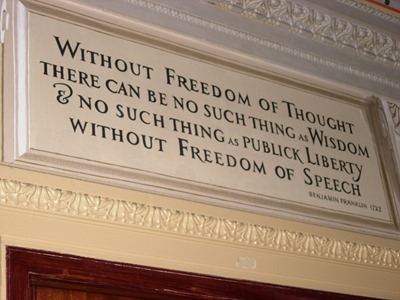
*Photo by* [*k\_donovan11*](http://en.wikipedia.org/wiki/File:Freedom_of_Thought_Ben_Franklin.jpg)
Comments
From my power to post freely on blogs,
With this new power I can have many fans,
If only I could solve the problem of Kian Ganz
To his seat he can be glued!!
Waah waah!
What story would you like us to [s]cover [/s]censor next? :)
Justice Suresh Kait seemingly wanted to impose Chinese Tyranny in India and methinks, and I bet, he is disappointed with the Supreme Court striking S.66A down.
http://www.sabhlokcity.com/2014/10/open-letter-to-justice-suresh-kait-please-explain-why-you-wish-to-impose-chinese-tyranny-in-india/