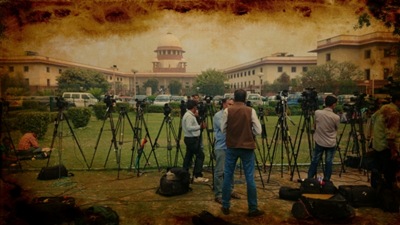
The Supreme Court sexual harassment committee has banned an advocate from the Supreme Court premises for six months for an incident of sexual harassment.
The Supreme Court Gender Sensitisation and Internal Complaints Committee (GSICC) submitted an inquiry report to the Chief Justice of India (CJI) P Sathasivam on 4 March, recommending that advocate CS Nagesh, against whom a complaint of sexual harassment was made, should be banned from the court premises for a year.
The Supreme Court Chief Justice of India (CJI) ordered that Nagesh should only be banned for six months from the apex court, since there was only one complaint ever made against him and it would allow him to “redeem himself” and “operate as a deterrent against him”:
“Having considered the Report of the GSICC dated 4th March, 2014, which unanimously accepted the Report of the Internal Sub-Committee dated 21st February, 2014, recommending debarring the entry of Mr.C.S. Nagesh, Advocate, into the Supreme Court precincts for a specified period extending upto a maximum period of one year and/or any other orders, as deemed fit, I am of the view that, in the first instance; six months’ bar on entry into the Supreme Court precincts would suffice, considering the fact that, except the instant case, no other incident of this nature relating to Mr. Nagesh has been reported.
This penalty, in my view, would not only allow him to redeem himself but also would operate as a deterrent against him.
GSICC
The Supreme court’s GSICC was set up in November 2013 to hear sexual harassment complaints against advocates and other court staff but not against judges. It is chaired by Justice Ranjana Desai and includes six other lawyers and members of civil society.
At its first meeting the GSICC constituted an internal sub-committee of senior advocates Indu Malhotra, L Nageshwar Rao and HAQ co-director Bharti Ali, which has apparently submitted the inquiry report against Nagesh.
Within two weeks of starting business, the GSICC had received two complaints.
The GSICC was set up after sexual harassment allegations by a former intern of former Supreme Court Justice AK Ganguly were reported. Ganguly, who denied the allegations, resigned from his retirement post as chairman of the West Bengal Human Rights Commission after an internal ad hoc committee, also including Desai, said there was a prima facie claim of sexual harassment made out against him.
In December a similar allegation of sexual harassment was made against former Supreme Court judge Swatanter Kumar, who has been National Green Tribunal chairman since his retirement.
Kumar has denied the allegations and launched legal defamation proceedings against his former intern and three media organisations for reporting on the allegation.
Comments
Also, if he challenges the order, will he be permitted to enter the court premises for his own hearing?
Looks like the SC has put the cart before the horse by suspending this advocate, because this action is not a judicial ruling (i.e. not a trial). Very similar to the blunder they did with the sexual harassment charge against A K Ganguly.
Further, instead of directions a general direction could have been issued to the BCI to frame regulations in line with Vishaka to protect advocates practising in courts from Sexual Harassment.
Interesting question though. As far as I know, the act is silent on the enrolment status of a lawyer who is elevated as a judge? Justice Ganguly retired. But he is still on the rolls of his State Bar Council. Can he be charged with misconduct?