Opinion: Most law firms and their websites are in ‘blatant violation’ of BCI advertising rules

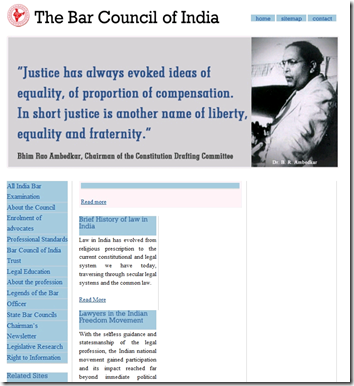
BCI website: Could do with some work
Either the Bar Council of India (BCI) should censure dozens of law firms for their singing and dancing websites, or it needs to be realistic and relax its strict advertising restrictions, argues Raghul Sudheesh.

It is a hotly contested matter today whether legal practitioners should be allowed to advertise their profession. While those who favour the proposition say that there is nothing wrong with displaying your achievements and employing creative ad agencies to boost your image in the media, many (including the custodian of legal practice in this country, the Bar Council of India) still believe that Law is a noble profession that must not be tainted by commercialisation.

The BCI regulations mandate that practitioners of law in India must not advertise or solicit either directly or indirectly through the media. There has been a recent amendment to these rules, wherein law firms are allowed to set up websites. However, these websites must only contain only “basic information about the names and number of lawyers in a law firm, the contact details and areas of practice”.

People
People

On visiting the websites of over 100 top law firms, I have found that unless the words ‘basic information’ is interpreted extremely liberally, several of the firms are in blatant violation of the law. The screen-shots of the violations are available with me.

Postcards
Postcards

Most law firms’ websites go beyond providing names and numbers of the lawyers, by including their CVs, complete with professionally-taken photographs. The websites mention the areas of practice of the firm, but go much further than that by using colourful wording to emphasise the skill, ability and efficiency of their lawyers in each area of law. Perhaps the forerunner in advertising its lawyers is top law firm ALMT, which apart from providing ‘basic’ information, has biographies of each of its partners, often running into hundreds of words. Lakshmi Kumaran & Sridharan has a searchable database of all its lawyers, and also showcases elaborate biographies and professional photographs of them.
Bombay boys
Bombay boys
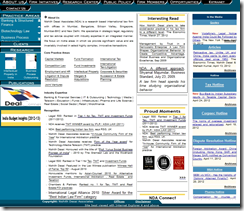
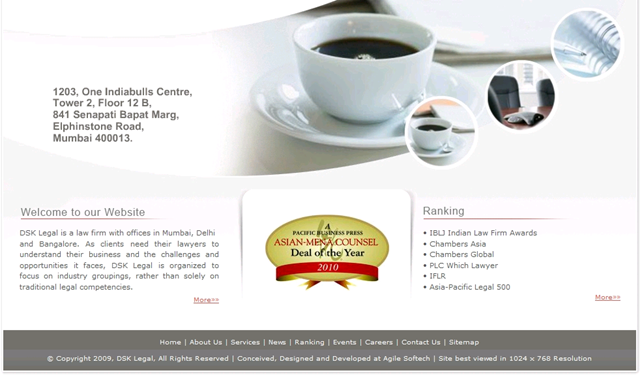
Many of the firms, like DSK Legal, Luthra & Luthra and OP Khaitan and Co. also devote prominent space in the home-page to displaying the various awards that they have won. On the website of Nishith Desai Associates, each listing in the ‘Areas of expertise’ column opens into a new tab, where a PDF called ‘Statement of Capabilites’ is displayed. It elaborates on the experience and achievements of the firm, using typical advertisement jargon such as ‘customised to meet client needs’, ‘ incorporate best global practices’, ‘we adopt a 360-degree approach’, etc. Out of the five-page PDF that is displayed for each area of law, only the last half of the last page is adherent to the law, as it mentions the names and contact details of the lawyers.
Interior design weekly

This is not limited to Nishith Desai alone. Firms like Fox Mandal and DSK Legal have downloadable PDF brochures available on the site, which squarely fall under the ambit of advertisements. The DSK Legal brochure uses phrases such as “when trouble arises, you will be glad to have us on your side”.

Fox Mandal, as well as some smaller firms such as Agnihotri & Jha, CL Gupta & Associates, Singhania & Partners among others, has also creatively added a ‘Client Testimonial’ section to its website. One of the Fox Mandal client statements is a glowing testimony that says that the firm must receive more awards for its excellent service. Singhania & Partners, strangely, also boasts of a ‘Gallery’ section which has pictures of its lawyers on office trips and vacations!

It's a rave
It's a rave

The BCI regulations mention how an advocate’s sign board or name plate must be of reasonable size. This rule is presumably so that lawyers do not use attractive signboards to solicit clients. However, websites, which can be considered to be online sign-boards, do not seem to show any semblance of austerity. There appears to be intense competition among law firms in creating aesthetically pleasing websites, as can be discerned from visiting the extremely well-designed websites for firms such as Fox Mandal, Luthra, J Sagar & Associates, H&B Law Offices, etc.


Pink
Pink
Most of the attractive websites also contain photographs of the interiors of the firm, as if to convey grandeur and professionalism. It is difficult to discern how any of this information regarding a law firm can be deemed to be ‘basic’. While Vaish Associates Advocates has a ten-minute video on its homepage, the website of Swamy Associates, a Chennai-based law firm, goes a step further from just looking nice, it even has catchy techno background music!

Flashy
Flashy
Most of the law firms attempt to absolve themselves of any liability by showing a disclaimer. All disclaimers read more-or-less the same, claiming that the information printed on the website is ‘merely for informational purpose’ and ‘is not intended to be a source of advertising’. Some law firms, like Luthra and Nishith Desai make the user say ‘I accept’ to the disclaimer before entering the website. It is quite ironic how once the user accepts the sombre-looking disclaimer, they are taken to a flashy website with colourful font, layout, language and photographs.
nic.in
nic.in

On opening the website of Anand & Anand, one can only view a high-resolution picture of its impressive head office. In order to open any of the other pages that contain information about the firm, the user has to register themselves with a user name and password. Perhaps the firm believes that complicating the process will make the information on the website seem less like an advertisement.

CC semblance
CC semblance

The website for Kochhar & Co. is not any different from the other heavily-advertised law firms, as it has client testimonials, lawyer biographies and a list of awards won. However, when one clicks on the ‘Practice Areas’ tab, the following message is displayed: Rules of the Bar Council of India preclude the Firm from providing information about its practice areas or expertise on the web. It appears as if the firm is selectively blind to the regulations. Some firms, big ones like DSK, as well as several others like CL Gupta, Daksh Associates, HK Legal, Global Juris, Advani & Co, Lexntech, etc. don’t have disclaimers.
Mmm, coffee
Mmm, coffee
The disclaimers universally declare that the websites are not for the purpose of solicitation. However, many of the websites include a feature where interested parties can schedule a meeting with the firm online. KPM & Associates devotes a prominent portion of its website homepage to a box labelled ‘Arrange A Session’. It invites the user to enter their name and contact details, and choose a time for the meeting, one of the options being ‘Immediately’. In its bid to reach out to as many people as possible, an IPR firm called Krishna & Saurastri asks visitors to leave their contact details behind to receive a free DVD on patent law (solely informational, of course). A picture of the DVD is prominently displayed on the site, and not surprisingly, the DVD cover includes the name of the firm.

Minimalist
Minimalist
However, it is unfair to pin down all law firms for flouting BCI regulations. Firms like King & Partridge and Dua Associates have websites, but they adhere to the BCI standards by providing only what information is strictly necessary. Mundkur Law Partners has an especially solemn website, which doesn’t contain any information, but only politely invites visitors to email them with queries.

The website of Mulla & Mulla & Craigie Blunt & Caroe also contains only a plain message on its website that it is not allowed to advertise. The message states: “While we may not be in agreement with this view, what we hold in high esteem, is to maintain discipline by following the Bar Council’s mandate”.

Arty
Arty

Also, some of the biggest firms like Amarchand & Mangaldas, AZB & Partners and Desai & Diwanji go on to prove that internet advertising isn’t a pre-requisite for success; they do not have websites at all.

In light of all the above discussion, there are some pressing questions that need be answered. By making visitors sign a disclaimer, are the law firms admitting to advertising on the sly? Can extravagant website designs, fancy wording and displays of accolades and testimonials be considered solicitation or influence on the consumer?

Either the Bar Council of India must open its eyes to this trend and clamp down on those who flout the regulations (who could make up nearly every note-worthy firm, apart from dozens of upcoming ones) or recognise the changing nature of the ‘noble’ legal profession and relax the rules against advertising.

A version of this article was first published on strippedlaw.blogspot.in by Raghul Sudheesh, who would like to thank Arpita Seth (NLIU, Bhopal) and Spadika Jayaraj (NLSIU, Bangalore) for their research on this post.

Read more on:

Comments

RB 27 Apr 2012, 18:55
+1 -0
Well written. And certainly the BCI must take a stand, either way. You may also add Trilegal, Wadia Ghandy and TTA to the list of big firms that don't have websites.
KoolKat 27 Apr 2012, 18:55
+4 -0
And what about foreign law firms advertising India practices? There are in excess of a 100 foreign law firms with "India practices" - and most of these firms have ZERO Indian qualified lawyers.

While some of the rhetoric around the 'noble' legal profession is disconcerting, everyone who advises on Indian law is part of the justice system. Most seem to think that advertising is antithetical to a noble legal profession. That is wrong and harmful nonsense. The Bar Council needs to change these advertising restrictions to ensure that there is more transparency in the market. The folks who stand to gain the most from such transparency are students and litigating lawyers. That is what the Bar Council doesn't seem to understand.
KoolKat 27 Apr 2012, 19:02
+27 -0
And please. To make amarchand and azb sound like saints is ridiculous. Who have been the biggest beneficiaries of these advertising restrictions? It's Equity Partners at Firms like Amarchand and AZB. One of the reasons they've done so well is because of the information asymmetry in the Indian legal market.
Spot on 28 Apr 2012, 02:44
+5 -0
Totally agree. It is only the big law firms and established lawyers who benefit from restrictions on advertising. They have been established for many years - how are upcoming firms and lawyers supposed to compete if they are not even permitted to highlight their capabilities.

This is an archaic law and a vestige of our "victorian hangover" which bigger firms and lawyers today are using for their own advantage.
xyz 4 May 2012, 10:57
+1 -0
Presumably you also support the entry of foreign law firms and requirements relating to legal practise restrictions and registrations?

I would suppose these are also archaic.
skeptical 28 Apr 2012, 03:17
+6 -0
The continuation of the ban on advertising is simply a method to continue the monopoly of the establishment, and ensure that there is lack of information and knowledge about firms which have the same capabilities but not the brand value and connection of the established ones (readers should read Prashant Narang's excellent Regulatory Barriers to Litigation in India in the Asian Journal of Law & Economics.

Frankly, this argument is a bit annoying. Instead of an analysis of the pros and cons of the issue, it seems more a diatribe on "snazzy" designs, which the author seems to find particularly offensive.

Recent (and past) experience should teach the BCI that a "noble" profession status is not achieved by banning trivialities such as advertising, but by the actual "nobility" of its constituents and also by how heavily it is willing to come down on moral turpitude and corruption. Sadly, that does not align with anyone's political positions.
Oh My My! 28 Apr 2012, 04:35
+9 -0
Raghul, We all know this. But we appreciate your time and effort in collating and presenting the obvious!
Naan 28 Apr 2012, 04:50
+3 -0
[...] What about big firms including the biggest, paying huge amounts of money to sponsor events? Is that in compliance with the rules of a noble profession? [...]
Aditya 28 Apr 2012, 05:19
+0 -0
A Premiere law firm like Khaitan & Co too has a very minimal website, which just shows the names of the contact persons for each offices. This very well goes on to show, that when you are confident about your quality, you don't need any advertisement.
skeptical 28 Apr 2012, 08:06
+13 -0
Dear Aditya

Thats a fairly naive assessment - (i) Khaitan has over a 100 years of existence, and therefore immense contacts and institutional relationships; (ii) Khaitan has one of the strongest PR presences and ensures that every single one of their deals get reported (thats an advertisment gimmick); (iii) they regularly pay to be listed in international directories and publications; and (iv) actively lobby to be included in peer review journals.

They dont need direct advertisement. More skillful but younger firms do. It has nothing to do with confidence in quality.

And by the way, if you talk of the quality of some of the Khaitan offices, example, Kolkata, people will laugh at you.
anon 28 Apr 2012, 10:52
+0 -0
[quote name="skeptical"]Dear Aditya

Thats a fairly naive assessment - (i) Khaitan has over a 100 years of existence, and therefore immense contacts and institutional relationships; (ii) Khaitan has one of the strongest PR presences and ensures that every single one of their deals get reported (thats an advertisment gimmick); (iii) they regularly pay to be listed in international directories and publications; and (iv) actively lobby to be included in peer review journals.

They dont need direct advertisement. More skillful but younger firms do. It has nothing to do with confidence in quality.

And by the way, if you talk of the quality of some of the Khaitan offices, example, Kolkata, people will laugh at you.[/quote]

Agree!
LegallyRight 28 Apr 2012, 05:49
+0 -0
Dear Kian/Raghul,

Nice information. May i add that when you have done so much to point out the names of big firms, why were JSA, Poovayya, Dr. Kainth and Associates, Singhania and others ommitted?

LegalllyRight
friend 28 Apr 2012, 08:17
+2 -0
Kian forgot to mention one of his favourite firm's Naik Naik & Co..their firm is snazzy and lavender.
lawyer 28 Apr 2012, 08:46
+2 -0
FYI Raghu,

Its Crawford Bayley and not Crawford Bailey and please enlighten me about its website, if at all it exists.
kianganz 28 Apr 2012, 11:31
+0 -0
Dear lawyer - thanks for pointing out. You appear to be correct and CB does not have a webpage at all, except for a placeholder at crawfordbayley.com stating that there is no webpage. We have removed the firm's name from the article.

Best wishes,
Kian
Legally speaking 28 Apr 2012, 11:14
+3 -0
Why dont the disclaimers save the sites from a violation of Rule 36? If someone enters my office on their own volition, and then I tell them about my practice, it is certainly not a violation of Rule 36. The same logic should apply for the disclaimers and therefore websites with a disclaimer should save the websites from a violation of Rule 36. The author should address this point.
But then, sir. 29 Apr 2012, 16:19
+3 -0
Because the disclaimer is a flimsy veil, considering the nature of the internet. When you hop around on law firm websites given the time and effort it takes to do so, it's not the same as visiting their offices. It can be considered more akin to looking them up in a phone-book. In such a scenario, having jazzy designs, testimonials, etc will count as solicitation.

Having a flashy website can also be considered equal to a law firm setting up a stall at a carnival. You can put up a sign saying that you don't intend to solicit, but what you are doing is essentially that.
Madman 28 Apr 2012, 11:22
+3 -0
A website is not exactly advertisement, now is it?

If someone actively goes to find out about something by typing the name of the law firm into Google, and then hits their webpage where he finds more information, is that advertisement?

What is the difference between a brochure lying in an office and a webpage exactly?

I think the BCI does not understand the interwebs.
Legally speaking 28 Apr 2012, 13:35
+10 -0
Also - many of these so called "doodh mein dhula hua" law firms, pay through their nose to legal magazines for getting articles and profiles published. That is advertising in its most slavish form. Also, as someone already pointed out, they pay hard cash for getting ranked in legal journals and not to mention so called "awards". They pay hard cash for attending so called business development conferences outside the country. Surely, that is much worse than a website.

[...] ".... on to prove that internet advertising isn’t a pre-requisite for success; they do not have websites at al"... They do not have websites and neither do they want others to have websites so they can maintain their hegemony. This is precisely why they resist foreign firms from also coming in.

Imagine a young lawyer, with the best of degrees, and 8 years of experience starting off on his own. How should he let people know about his practice? By this logic, sending a brochure or brief description of his work over email would also violate Rule 36. Instead of subscribing to such an archaic view, the author would do well to read down Rule 36 and conclude that the disclaimer saves the website from falling foul. Alas, there is no attempt to even analyse this aspect in any detail.

Anyone who has worked with one of the big firms knows exactly how these things work. Big firms have "business development officers" - what do you think they do? The author could do well to gain some more practical insight and experience in the field before going on to make such harsh statements. His inexperience in practice shines through this article. If youngsters also go on to support the views of big firms, how will anything change?? The author would do better to study whether Rule 36 is constitutionally correct or the scope of someone filing a writ challenging this archaic rule.
Hello 29 Apr 2012, 16:08
+1 -0
S&R? Alliance Legal?
Hold on 29 Apr 2012, 16:22
+1 -0
But the author isn't strictly arguing for the BCI Regulations. What is being pointed out is that some websites may be violating these rules. It's not meant to be a critique or an analysis. Just a glimpse into the truth. I think.
Jal 29 Apr 2012, 05:50
+0 -0
Mulla and Mulla is one firm that abides by the rules in this respect
Sudipto Sircar 29 Apr 2012, 09:33
+0 -0
There seem to be a few above who wish that the BCI remove the restrictions on advertising. While trying to remain neutral to the debate, would just like to point out that this is some of the nonsense well be seeing if its allowed.

http://www.youtube.com/watch?v=tCZ3tY-_Ljo&feature=related

http://www.youtube.com/watch?v=9hEykO_gwHw&feature=endscreen

http://www.youtube.com/watch?v=xSKe42bxMZ0

http://www.youtube.com/watch?v=o8j9GHiKFF0&feature=endscreen&NR=1
Just a thought! 30 Apr 2012, 03:21
+5 -0
But then isn't Legally India also an conspirator in violating the BCI rules by highlighting deals et. al. in the garb of legal journalism?
illegal 30 Apr 2012, 05:01
+0 -0
these are extremes...and there can be well established rules on what can be done and what cannot.. have you ever been to the lower courts and have a horde of lawyers descend on you? they are no better than these ...
aaa 30 Apr 2012, 15:41
+0 -0
You moron, those commercials are spoofs. Besides, the real menace is "fixing". Some top law firms do it. What aout that? Shouldn't that be banned?
Jam 29 Apr 2012, 17:41
+0 -0
Please mention lexygen if it's considered a law firm
krk 30 Apr 2012, 08:50
+3 -0
I thought Raghul was with B & B. How come LI has hired him? Seems like there is an inside understanding between the two competitors.
kianganz 30 Apr 2012, 09:01
+3 -0
Raghul's article was originally published on the strippedlaw blog and we thought it was interesting research so we asked to republish it.

For the avoidance of doubt, no, Raghul has not joined LI and there is nothing nefarious going on :)

Best regards
Kian
Anon 30 Apr 2012, 13:52
+3 -0
It's about time BCI amends this draconian legislation to allow firms to publish their websites in line with international standards. What is wrong if a firms highlights it's achievements? They have worked hard to achieve them or highlight their capability statement. It helping a client to make a choice of that firm is the right fit. Just because the "older" firms have had first mover advantage and established institutional relationships, does not mean that the newer firms are less capable! I strongly believe that a firm should be allowed to showcase it strength in a dignified manner and give itself the opportunity to grow!
Blah Blah 30 Apr 2012, 20:08
+0 -0
You realize that the first 3 youtube videos there are spoofs right? Not real commercials.

In any case, if lawyers want to make fools of themselves in their advertising why stop them?
Sammith 1 May 2012, 17:32
+1 -0
Its time India grows up to the modern times. Noble profession, ours may be, but with everyone searching the internet for information, its not in any way wrong that these people are providing extensive information. Also, there's nothing wrong with advertising!
Nikhil 3 May 2012, 04:52
+0 -0
Agreed, 100%
Nikhil 3 May 2012, 04:51
+0 -0
Really? what decade are you living in? And you really think more information is harmfully than less information? Sheesh.
White & Black Stripes 8 May 2012, 11:29
+2 -0
"Law is a noble profession that must not be tainted by commercialization"

Since when did advertising become moral terpitude? If building a website is immoral or against the notions of nobility (whatever they may be); then what does the BCI have to say about the Websites of the Holy See, or of various hospitals and medical research institutions (a profession which is WAY more 'noble' than Law for sure) - it is high time that Internet is supposed to ease the access to information that people have, not to take them further away from the firms or organizations which are best suited to cater to their needs.
anand 18 May 2012, 10:24
+0 -0
Hi,
nice article and nice research and good work.
all the best.
thanks and
regards.
anand.a
Advocate 8 May 2013, 04:31
+0 -0
True, some big size law firm does not have their website is like 'dhongi sadhu baba' that never solicits for work in reality they are the one advertise the most also their 'paid' article appearing as if they have written a fantastic informative news that keeps popping up on internet, in fact there should be a control on funny and shady legal journals giving awards to law firms and lawyers on payments that too keep popping up. its not the law firms website that needs to be monitored its the funny legal news journal or legal news website. I wonder why these big size law firms jump like yo yo ball to publish outdated article as if it is a latest news to the world. this is where the control should be and not the start-up law firms trying to get work and everyone knows including the statement published in this article that law firms / lawyers don't ever get work thru their website.
suniel samant 21 May 2013, 12:24
+0 -0
Undoubtedly Bar counsel has enacted the rule for the "Legal Firms" but it is also equally important to consider "who is your lawyer" a legal firm consists of several lawyer of different domain, The responsibility Matrix differs, hence on indecent of loosing a case, a firm is acquiring a bad reputation, instead of putting all restrictions it should also be looked upon that , how many cases being won by a law firm, in connection with the client testimonials. Law firm is a individual entity irrespective of lawyers, as such a success failure ratio should also be reflected when the law firm is indirectly advertising regarding their services.