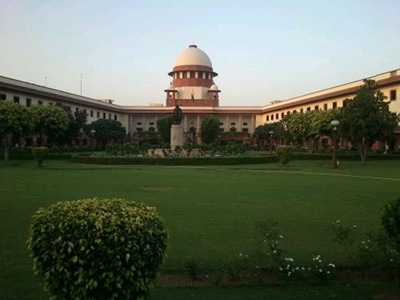
Those who are accusing the Supreme Court of washing its hands of the allegation that a former apex court judge sexually harassed a former intern (“SJ”), have it wrong: in fact, the institution performed a skilful balancing act over several dark weeks that couldn’t have gone any other way.
Reading between the lines, the parts of the judicial inquiry’s report that went public yesterday were damning about retired Justice Asok Kumar Ganguly.
The inquiry of justices RM Lodha, HL Dattu and Ranjana Prakash Desai wouldn’t have taken lightly the decision to write what they did in their official report.
It might not seem like much, but it is highly significant for two ‘brother’ and one ‘sister’ judge to write that they were “of the considered view” that SJ’s written and oral statements “prima facie discloses an act of unwelcome behaviour (unwelcome verbal/non-verbal conduct of sexual nature)” by Ganguly at a room in Delhi’s Le Meridien hotel on Christmas Eve of 2012.
Likewise, Chief Justice of India (CJI) P Sathasivam wouldn’t have taken it lightly to republish that passage in his public statement yesterday, unless that popular legal term ‘prima facie’ (‘on the face of it’) meant more than just “her word against his” in the context of #InternJudge, which has become the affairs’ coyly appropriate hashtag on Twitter.
Sources with knowledge of the inquiry strongly corroborate that SJ’s testimony, witness’ affidavits and the inquiry’s report reference more than just hearsay, with some hints published in a Times of India report yesterday morning.
And despite Sathasivam adding that “no further follow up action is required by this Court” (arguing that Ganguly was already retired at the time of the incident and SJ was not an official apex court intern), the full statement leaves the door wide open.
The police have several already-opened files, and politicians have long begun, perhaps gleefully, sharpening knives in West Bengal, where it is an open secret that the Trinamool Congress has little love lost for Ganguly.
Much ado without anything?
Those who say that at the end of the day, the apex court has achieved absolutely nothing in its inquiry, except for delaying the inevitable political fallout and police investigation, which had been stalled by the court’s administrative procedure, are missing the point and the dynamics.
The Supreme Court as a creature of the constitution is beset from all sides by the tyrannies of power, the commercial interests of the selfish and the inequities faced by the weak.
Behind nearly every action of the apex court, lies the institution’s insecurity that its role as protector of the constitution is precarious and could become compromised. The risk of judges losing their independence and freedom to act is real and should be feared, considering that in recent years they have been the only real counterweight to the excesses and corruption of India’s political and wealthy.
(Exhibit one: The judiciary’s limp-spined conduct during the 1976 Emergency, which Ganguly himself slammed in a rightfully celebrated judgment; exhibit two: the heated battle for what the judicial appointments commission (JAC) will eventually look like.)
Shortage of sticks, too many apples
The judiciary knows as much as anyone that unchecked corruption could destroy the institution from the inside, and even a powerful Chief Justice with a long term and a strong anti-graft agenda, such as SH Kapadia, could only do so much to rein in errant judges in junior benches.
Short of the carrot of elevation to higher benches, which is already a politicised and flawed process, the only stick available to beat bad judges with is the judicial transfer, which is less akin to problem solving than shunting problems from state to state.
Impeachment as an effective check on judicial impropriety is mostly unrealistic, despite former Calcutta high court Justice Soumitra Sen’s resignation in its face. And compared to its aggression over others in public office, the media has traditionally been over-cautious in reporting on the judiciary, partially muzzled by India’s near-draconian contempt rules (witness the silence around the Mysore sex scandal).
Allowing outsiders – i.e., non-judges – too much sway over the judiciary is anathema to many judges, and rightly so because of outsiders’ potential to be corrupted and indirectly used to bully and intimidate judges.
On a scale of judicial impropriety, sexual harassment is an apple to judicial corruption’s orange, but the concerns at play should be similar. Sexual harassment goes to the heart of the public’s trust in the judiciary, its decisions and law making powers.
And though arguments in favour are strong, as outlined in an amicus brief by senior advocates Indira Jaising and Anand Grover, creating an independent panel in line with the Supreme Court’s own Vishaka guidelines is nearly as worrying for judges who fear that false charges could be used to bully them, just as an omnipotent Lokpal or JAC could be influenced politically.
Clumsy but firm
Re-considering #InternJudge, it is clear that only judges could have sat in preliminary judgement of it, or at least have had the first chance to do so.
Despite their clumsy arrangement, the words used by the inquiry (“considered view”, “prima facie”, “unwelcome”, “verbal”, “non-verbal”, “sexual nature”) cover nearly all important bases within the framework of realpolitik they operate in.
Sure, the CJI could be accused of sleight of hand to get out of taking any action: “as decided by the Full Court in its Meeting dated 5th December, 2013, it is made clear that the representations made against former Judges of this Court are not entertainable by the administration of the Supreme Court”, he wrote.
However, careful reading of SJ’s original 11 November interview with Legally India, suggests that some form of alleged impropriety could also have pre-dated his retirement in February 2012: SJ had claimed that three other interns were also harassed by the same judge, though “perhaps” not as overtly as what she had faced.
It is not known whether any tangible evidence of other alleged incidents than SJ’s was presented to the committee, but in any case, other considerations must have outweighed the need for deeper investigation by the committee.
First, the judges were able to present a strong and united front, by not directly throwing a brother judge under a bus as could have been caused by outright damnation or an investigation and verdict beyond reasonable doubt, while allowing the institution to be seen as impartial, despite having sat in judgment over one of their own.
Second, it allows the bench to wrap up its part in the story, which has for too long already cast a shadow over other former judges over whom aspersions were cast because of the allegation, as Ganguly remained un-named for several weeks as the “recently retired” former judge in question.
Third, with the court out of the picture, this has essentially become a story about the chairperson of a public authority.
Beneath the robes
This should not be used as a chance for another media frenzy as in L’Affaire Tejpal, nor, no matter what the outcome, should it be an opportunity to question or unravel Ganguly’s judicial output, which should rightly continue to stand as some of the finest and most important jurisprudence of the Supreme Court of India.
There are horror stories about judges, senior counsel and powerful individuals in all countries; alleged failings of personal character must simply serve as an unfortunate but unsurprising reminder of everyone’s potential for error, including those who are larger than life. But if the institution rises to acknowledge the inevitable existence of the (all-too-)human underneath the robes, this should cement rather than diminish the respect the institution needs right now in India.
A police complaint or other action might now proceed and SJ or others might choose to cooperate with such an inquiry that could take years out of their lives and is therefore a decision only they can make.
While the road ahead is dark and full of peril, one hugely important milestone has already been reached, which years of sensitisation workshops, sexual harassment committees and guidelines have failed to pass: the message is out that sexual harassment needs to be taken seriously, by everyone, whether they like it or not.
Comments
It is an of-quoted proverb - [i]Law Without Politics is Blind, Politics Without Law is Deaf[/i]. With all due respect (and you have not said anything incorrect [i]per se[/i]), you perhaps fail to miss the more important point.
The Supreme Court is more than just the Apex Court with wide powers. In the Indian experience, it has emerged as the guardian of the nation, its conscience keeper, and the one institution that provides hope in a country that is poorly managed and full of various social evils and injustices. Assuming you haven't done so already, you will do well to read commentaries that speak of the judiciary's conduct (both judicial and political) in the pre-Emergency cases which led to Kesavananda Bharati. Or about the dynamic approach of the same Court in the Bhagwati-Iyer era.
In such context, many would disagree with your analysis and would feel rightly disappointed by the way this matter has been handled. For example, see http://in.news.yahoo.com/extremely-disappointed-handling-ex-justice-ganguly-case-sibal-100840056.html
Also note that judges are not supposed to perform "balancing acts", unless it involves Federal issues, or it is aimed to resolve a clash of statutes, or a clash of individual rights with the greater good.
Best.
I think it's great and necessary in a democracy that people like you have and are calling for even higher standards of the judiciary.
By the same token, I also think it's great for people fighting for veganism, 100% green energy, abolishing armies, or utopias.
I just think that fulfilment of some of these is unrealistic in the actual and messy world we live in, and there are real forces, some of which are reasonable, at work that will temper any of those lofty aims and goals.
Expecting the Supreme Court to have come out guns blazing in this case is, I would argue, unrealistic, considering the natures of the institution and the individuals.
I also think that they were probably hasty in constituting the inquiry, either not having read some of the news reports properly and assumed that it was a sitting judge who was accused, or not having read their own administrative rules properly.
Howveer, implicitly by 'washing its hands' of the matter, they have acknowledged two important things:
1. They will not actively sweep it under the carpet.
2. They have established that they might not necessarily be the appropriate authority to look over such cases even amongst their ranks, giving hope for a stronger Vishaka mechanism going forward.
And in any case, nothing is stopping the rest of the legal and political system from taking over at this point where the SC left off...
Your assertion that judges of the highest court "hastily" read a news report and misunderstood it (or your assumption that they did not know their own administrative rules) is just, wellllll, [s]preposterous[/s] a bit much :)
After finding a [i]prima facie[/i] case that fit the definition of sexual harassment as framed in the Vishakha guidelines, the Court should have sent the message that it will not hesitate to fill a void (i.e. jurisdiction over retired judges for sexual harassment) because of technicalities. The judicial side of the SC has to take over at this point where the administrative side of the SC has left off.
You are entitled to differ, but it was perhaps not necessary to label my view as utopia, or imagine that the judges are dumb, because it fits your conclusions. I do get your view - only disappointed that it does not befit the fine traditions of the SC to shirk justice, which has a tendency to remind us of its "dark hours". The SC is a hallowed institution from which equity, justice, good conscience and high standards can be expected. If, for some reason, the SC feels it should not "blaze guns", the SC can easily state the reasons and explain its decision to us.
The standards which the Court sets for babus and netas should be equally applicable to it also.
Anything else is unnecessary hyperbole.
I read that in Samuel Jackson's voice! :)
http://www.youtube.com/watch?v=YcOWkFBGJPI
Is the Supreme Court meant to save its errant brother judges or to serve the values embedded in our Constitution?
1. [i][b]To highlight "a cognitive vacuum that feminism fails to fill", which she felt does not offer a frame to fit in her experiences[/b][/i]- The ensued debate after the publication very clearly brought out this vacuum. It is not always the traditional; report, investigate and prosecute, framework that fits all. This established model is thrust on the victim and is not always the choice but for lack of alternatives. The intern chose to deal with it beyond the archetype and later happenings proved her arguments of lack of options accurate.
2. [i][b]"I felt I had a responsibility to ensure that other young girls were not put in a similar situation"[/b][/i] - This objective is completely achieved not only specific to one particular Judge or judiciary but would say is capable of empowering many in unequal power equations.
3. [i][b]"When dealing with sexual violence, can we allow ourselves to embrace feelings beyond or besides anger, and to accept the complexity of emotions that we face when dealing with any traumatic experience?"[/b][/i] - The post was a search, though she has undergone more that what she initially seems to have intended by writing, for modes for venting out, cautioning and opening up a debate. By her responses to later development as gathered by interviews and news paper reports, she remained dignified and at peace with herself. Moments of frustration and sufferings of course, but then that is natural, it was not her chosen path.
Seemingly as an unintended consequence of the post, it could remind SC about its own long forgotten judgment.
Now shall we leave the intern to herself and let her choose her course, show some gratitude for what she has done for the society at her own expense and wish her well.