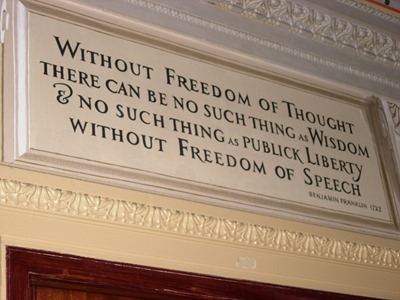
A high stakes case was part-argued today by government and nine petitioners on the constitutional validity of certain sections of the Information Technology Act 2000.
A judgment by the Supreme Court on the controversial law could either provide a boost to freedom of speech activists or a fillip to government censorship of and control over content published on the internet.
The central government today told the Supreme Court that some provisions of IT Act were incorporated to act against those posting objectionable material on social media and websites.
To back its plea, the government placed before a bench of Justice J Chelameswar and Justice SA Bobde some content it deemed objectionable, which it said had prompted the incorporation of sections 66A, 69 and 80 of the Act in order to provide recourse against those publishing such content.
Submitting the material in a sealed cover, additional solicitor general Tushar Mehta said: “These are the objectionable materials which compelled us to make the provisions.”
The challenge to the validity of the IT Act provisions was raised by Shreya Singhal who had moved the apex court following the arrest of two women - Shaheen Dhada and Rinu Shrinivasan - for posting comments critical of the Mumbai bandh in the wake of the death of Shiv Sena supremo Bal Thackeray.
Thereafter NGOs Common Cause and People’s Union for Civil Liberties (PUCL) also impleaded themselves in the matter.
PUCL is represented by arguing counsel Sanjay Parikh, and advocates Apar Gupta and Karuna Nundy.
Prashant Bhushan is appearing for Common Cause, which is challenging section 66A, section 69A and section 80 of the Act.
Senior counsel Sajan Poovayya is making arguments for Rajya Sabha MP Rajeev Chandrasekhar, who is arguing against s66A of the Act.
Reviews website Mouthshut.com is challenging section 66A and 74.
Three of the petitions linked to below
Chelamneswar asks: Is IPC inadequate to deal with objectionable content?
In the course of the hearing, Justice Chelameswar said: “We want to examine whether the IPC (Indian Penal Code) was found inadequate to deals with defamation and objectionable materials. Or is it some special kind of legislation to deal with a special kind of situation. It requires a detailed examination.”
Senior counsel Soli Sorabjee, appearing for Singhal, told the court that section 66A is unconstitutional as it violates the constitution’s article 19(1)(a) guaranteeing fundamental right of freedom of speech and expression.
He also argued that section 66A also suffers from vagueness because expressions used in it would give different meaning based on the understanding of the person invoking the provisions in his complaint.
Bhushan also said that expression used in section 66A were vague and are grossly abused by those in power and cited instances to back up his plea.
The hearing will continue tomorrow.
Controversial sections: 66A, 69A, 80
In her plea, Singhal had challenged the constitutional validity of section 66A that provides for proceeding against people posting annoying and inconvenient comments on social networking sites like Facebook and Twitter and other electronic media.
She said that the “phraseology of the aforesaid section is so wide and vague and incapable of being judged on objective standards, that it is susceptible to wanton abuse”.
The section reads: “Any person who sends by any means of a computer resource any information that is grossly offensive or has a menacing character; or any information which he knows to be false, but for the purpose of causing annoyance, inconvenience, danger, obstruction, insult shall be punishable with imprisonment for a term which may extend to three years and with fine.”
Notice on Singhal’s plea was issued to the central as well as Maharashtra, West Bengal, Puducherry and Delhi governments 30 November 2012.
The validity of section 66A has also been challenged by the self-exiled Bangla writer Taslima Nasrin.
Section 69A concerns the central government’s power to block websites.
Section 80 gives a local police inspector the power to seize materials in a criminal investigation or when an FIR is filed. Bhushan argued that before 2008, only more senior police officers were allowed to seize, but this was diluted in the 2008 amendment to the Act, which now allows every local police station to define crimes as cybercrimes and use the Act to intimidate people.
Photo by k_donovan11

Read 3 petitions
- PUCL’s Supreme Court petition vs IT Act
- Mouthshut’s Supreme Court petition
- Shreya Singhal’s petition
Click here for Legally India’s previous coverage on the IT Act
Comments