
Writing a great legal article is truly amazing. Not only it will be published in a good, well-known website or blog, thereby increasing your brand value and visibility, but also be read by many people who are in need of that information. It may help litigants, researchers, other lawyers or a reporter to understand the state of the law.
However, the best part is perhaps that you learn to think systematically and strategically when you write article after article. It is a fantastic exercise for a lawyer to write about practical legal problems continuously. It keeps your knowledge sharpened, arguments ready and reputation strong.
I learned about the importance of blogging about law simply by observing my friend and classmate Deepak Raju who later became my flatmate as we both went to work in Mumbai (although for different law firms). Deepak developed a keen interest in arbitration law early in his law school day after doing some arbitration moots. This happens to many people, but they usually lose steam later on. To keep his interest and engagement alive, Deepak began a blog called Lex Arbitri and even cobbled together a team with a few other law students to keep the blog regularly updated. He made sure to stay abreast of new developments in the area of arbitration law so he could regularly update his blog with the relevant information, news, judgments, and happenings. He kept this up for a couple of years till he graduated. By this time, he was well known for his knowledge of arbitration law in our small circle.
However, the best validation of his arbitration prowess came much later after he was recruited. He was working in a financial regulations team, mostly handling SEBI matters. This was quite far from arbitration work. However, very soon, people from the arbitration team in his office began to call him up for his opinion and inputs on various arbitration related questions. Those who worked in big law firms will know how rare this is. It is also a clear sign of massive respect.
Deepak quit this law firm within a year and went on to study at Cambridge. Now he is a successful practitioner of International Trade Law in Geneva, and I imagine a lot of his work involves arbitration.
I told you this story to give an idea of how long-term blogging can be extremely beneficial for law students and lawyers alike. If you think it’s only for law students, just take a look at the legal careers of the pioneers of legal blogging in India who frequently wrote on blogs like Spicy IP, Indian Corporate Law Blog, Law and Other Things blog, etc. Of course, tons of other blogs have been started and closed down too.
Anyway, if you are by now convinced that regular blogging is a great idea, you may want to know next how to write amazing legal articles that will be read by tons of people, get you many clients and lots of attention of the right kind.
I must acknowledge that I wrote the first version of this article for our Ace Your Internship Program as well as for students of the business law diploma course. Also, a lot of this content is borrowed from the writing manual followed by interns at iPleaders (created by yours truly), and we use this material to quickly train them. Those who take this training seriously, usually return from the internship with significant enhancement of ability to research and write, dozens of articles published in iPleaders blog, and a lot more practical knowledge of law than what they ever had. You can see what some of the former interns said about this transformation over here, it should give you an idea about the effectiveness of this step by step guide.
Before you begin to write an article/blog post
Before writing any article, first decide who is going to read this article and how they are going to benefit from it. Is it something that people are already looking an answer for? Will they google this topic? Are they in trouble and want an answer so that they are googling? What can you tell them through your article, what information can you share with them that will help them? How can you make it simple so that those who are not very smart can also understand what you are writing very quickly? Can you include tables, formats, bullet point lists? Will that make it easier to read the article?
-
Length: Aim for at least 1500 words (excluding footnotes and citations). More is fine. This is because Google gives more importance to long form articles in search result as opposed to very short articles. However, make sure to break down your article in many small paras with multiple headings and subheadings.
-
Language: Simplest possible language, must be very easy to read. Use simple sentences instead of complex sentences and easy words instead of difficult words. Only in school and college people get rewarded for using a difficult language, everywhere else, in real life, using difficult, complicated language results in being penalized and ridiculed. Please write in as simple language as possible.
What makes your article valuable is quality of information and insights, how rare or useful the information or insight you are providing is, how easy it is to understand and read, and how nicely the content is flowing from one issue to another. Provide bullet points and tables everywhere possible. That will make your article stand out and valuable. Provide formats, samples, examples and practical advice wherever possible. Do not just write about sections and case laws.
-
Always ask people: Whenever you don’t know the practical issues involved in a topic, ask someone. Call up lawyers who specialize in that subject and ask. Call up your teachers and ask. Ask people intelligent questions and learn real life practical insights and then write those in a lucid, simple language. Asking the right people is probably the quickest way to learn the real stuff, but it is also the most undermined legal research technique. Let it be your secret weapon. Cultivate a bunch of people you can call for information, insights and inside scoop. This is a big asset for a legal blogger.
-
Method: First create a structure, give your article a skeleton. Identify one or two important questions you will answer in the article. Around this structure develop a body. Information should be crisp and to the point so that the reader gets what he wants at one glance. Beating around the bushes frustrates the reader and he will switch to something better. Use Google docs for the writing instead of microsoft word, it helps to get other people to edit or comment on your article later, and there is no possibility of accidentally deleting the content.
-
Headings and subheadings: The entire article must be broken down according to headings and subheadings. The headings and subheadings should be complete and not partial or indicative. For example if you are writing an article of habeas corpus, and you have to write a subheading for a paragraph where you are writing which courts you can go to for getting this writ issued, the heading or subheading should be:
“Which courts may issue the writ of Habeas Corpus” And not “Which courts can issue this writ” or “Courts” or “courts with writ jurisdiction” etc.
If the focus is on habeas corpus then try and ensure that it is directly mentioned in most of the headings and sub-headings.
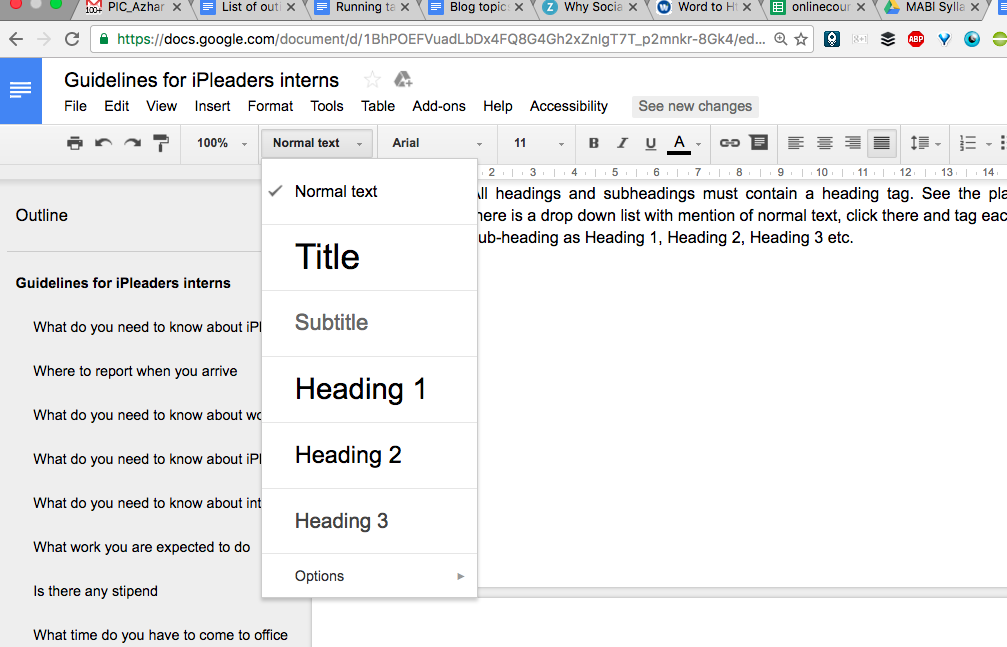
All headings and subheadings must contain a heading tag. See the place where there is a drop down list with mention of normal text, click there and tag each heading and sub-heading as Heading 1, Heading 2, Heading 3 etc.
Google reads the text written in heading and sub-headings and decides which article should be shown on the top of search results. Keyword rich headings and subheadings are always better for this purpose.
-
Do not write lengthy introductions and conclusions: no one cares. Just get to the point quickly. Imagine that you have to write an article on licenses required for hydropower generation. Now many law students will start this article by writing what is electricity, what types of electricities are used in India, what is the percentage of hydropower use in India and pros and cons of hydropower and ramble on before coming to the point of if licenses are required and what licenses are required and how to get them. That is crazy. Never write an introduction that is longer than 4-5 sentences. Same goes for the conclusion. One exception is if you have a great story to tell in the introduction which will hook the reader’s attention, go ahead. Only tell relevant stories.
-
Bullet points: more you write in bullet points and numbered lists, better your article will be received. It is a bad thing to write huge chunky paragraphs. Try to break things down in bullet points and numbered lists as far as possible.
For example, this is an old article, with accurate and good information on a famous website: http://www.indiainfoline.com/article/research-articles-personal-finance/cheque-dishonoured-a-step-by-step-guide-for-legal-recourse-113111500895_1.html
Still, the article mentioned below, new and from a not so famous website, ranks high above and gets 10 times more traffic because it is written with so many bulleted and numbered lists, and gives a step by step approach. It even includes a table: http://lawrato.com/indian-kanoon/cheque-bounce-law/dos-donts-in-case-of-a-cheque-bounce-16 This is the kind of article you want to write if you want to get a big audience and be appreciated. Break down chunky information into bullet points and numbered lists in your article. Provide steps wherever possible.
-
Grammar: Your work reflects your image. It is necessary that grammar is absolutely correct. Publish or submit for publication only after writing check for spelling, grammar and language errors. You can use free online tools for this purpose. If you can afford it, for about INR 5000, you can buy a good software for this as well.
-
Title: The document should be saved with an easy to understand, direct title. Many people are taught to write creative, convoluted, witty titles. These are counterproductive as you lose out google traffic due to this. Try to keep the title similar to how the reader will think of it or type in google when they search for it. Fancy titles are not helpful for the reader. Write a simple title, maybe in form of a question that the article answers.
-
Headings: The headings and subheading should be linked with Styles -> Heading 1 and Heading 2 of google document. Google search always prefer documents with the linked style instead of normal text.
-
Scannability: Most readers skim through the article to see if it is worth a read. So add more subheadings, bullet points and paragraph breaks.
-
Explain the technical terms: General public is not familiar with technical legal terms. If is is absolutely necessary to use big legal jargons then simplify them for readers who come from non-legal background.
-
Citation style: References should be cited properly through a hyperlink. Wherever possible, use hyperlink instead of footnotes.
-
Make it exhaustive, answer FAQs: Try to answer all the frequently asked questions about the topic. The article should be able to answer all kinds of secondary questions that may be raised in the mind of the reader.
How to research for these articles
The biggest mistake that everyone who started to write articles have made is to research, research and research until they know “enough”. It is never enough. They waste time aimlessly researching and don’t begin to write. You strategy should be to write everything that you research immediately. If you have researched for 10 minutes, write for at least 10 minutes (basically write down what you found out in your research) before you research more. Here is a step by step process.
Step 1: Deciding what is your research question and recognize what does not fall in the scope
Decide the exact question you are going to answer in your article. There cannot be more than 2 questions you answer in one blog post. If there are more relevant questions, no problem, write another article to address the same later. Note it and focus on the current article only.
Let’s say you want to write about how to file a consumer complaint. The target group is clear: people who faced a deficiency of product or deficiency of services as a customer may want to know more about how to file a consumer complaint. Great! This is the only question you will answer now. There may be more material available on how to make an appeal from the decision of a consumer court, but you are not going to read, research or bother about that. You are going to solely focus now on one and only question.
Step 2: Identify your headings and subheadings
Identify what are the smaller questions that you need to answer in order to answer the bigger question. For this, you may have to read up a bit. Don’t read everything, don’t read into great details. Read just enough, maybe scan through material just to understand what are the smaller questions you have to answer in order to answer the bigger question.
For instance, to answer the bigger question how to file a consumer case, you have to answer these questions first (just list down all questions that come to your mind):
- Who can file a consumer case and who are not eligible
- Can a business file a consumer complaint?
- What documents you need to be able to file a consumer case
- Can you file it yourself or do you need a lawyer?
- Is it a good idea to argue your case yourself in consumer court?
- Do I need to pay a court fee in order to file a case?
- What information should go into a consumer complaint?
- What evidence will be useful for me to collect and what do I need to provide to the court?
- Can I draft my own consumer complaint?
- Before hearing in the consumer court do I need to go through some other process?
- How to decide which is the right court (having jurisdiction over the matter) to file the consumer case?
- On what grounds can the court reject my application?
- How much time can it take to decide my case?
- How much compensation can I get?
And so on. Of course, there can be more questions. Think of a question or two more by yourself.
These questions will eventually become the headings and subheadings.
Step 3: Make the skeleton structure
Write down all the headings and Subheadings as a skeleton structure. It should look like something like this:
How to file a Consumer Complaint
In what kind of matters can I file consumer complaint?
Can I file a consumer complaint on behalf of a business?
Which court is right for me to file the complaint?
Which consumer court will have territorial jurisdiction?
Which consumer court has financial jurisdiction?
What all do I need to file the consumer complaint?
What documents do I need to produce?
What kind of evidence do I need to produce?
Can I file and fight my consumer case myself?
Can you file it yourself or do you need a lawyer?
Is it a good idea to argue your case yourself in consumer court?
Can I draft my own consumer complaint?
What is the process involved in a consumer case?
Before hearing in the consumer court do I need to go through some other process?
What are the different stages? How long will each stage take?
How can I assess if I have a good case?
What are the important factors?
On what grounds can the court reject my application?
Potentially how much compensation can I get?
Step 4: Populating the skeleton
Now that your skeleton is ready, you can start filling up the blanks with answers to these specific questions. All your research will now be directed to answer these limited questions. Remember that there can be more questions added to any skeleton with unlimited possibilities. It is possible to write a book on any topic, even on how to file a consumer case. However, your job here is to just write enough to cover 1500-2000 words. If you want to write more and answer important questions, do so in another article. When you are done with answering all these questions, you are done with your article.
Caution: Please do not start to write or aimlessly research till you have your skeleton structure in place. This will save time and make you a structured thinker.
Step 5: Review and edit
Many people skip this critical step. They never become amazing writers. First run your article through spell-check and grammar check. There are excellent softwares. If you can’t afford one please get a friend or a mentor to do so. Ask them what is good about the article and what is it’s weakness. Add, remove, edit content with the objective of polishing your article. Do not overdo it though, ship it quickly. Not more than 24 hours after finishing in any case.
Other important points:
-
Sources: Easy sources are news articles and blogs but since the aim is to publish them it would be better that the work is original and informative, use bare-acts and judgments (if applicable) for proper information and articles as references. Also ask lawyers about the topics. Call them up and ask.
-
Improve before submitting: Take pride in your work, try to find out ways to improve your work with tables, graphs, charts or anything at your disposal so that your article is superior and more helpful than anything else available on the internet.
-
Primary and secondary research sources: Start by researching from secondary sources for the broad overview. The secondary sources are articles, journals, blogs etc. Verify your research with primary sources like case laws, and bare provisions etc.
-
Answer a few very important questions in your article, and provide a lot of valuable information that will help the readers.
All the best! Hope you have a great time writing some amazing articles. Feel free to reach out to me if you have problems on my twitter @law_ninja. Feel free to ask me as many questions as you want, I will surely reply! You can also add me on linkedin and message me over there. I reply quickly!
It is one thing to read about how to write an article, another to actually do so. Make sure you attempt to write an article in next 24 hours! If you are not able to, maybe you need to do a structured program with us. Take a look at our flagship course here.
Comments
Maybe he needs to go read on the topic.
For the avoidance of doubt, Ramanuj and I used to work together on the bar exam preparation course Barhacker, but I haven't been involved in that for a while now...
In any case, as far as content marketing goes, it's been quite successful, which I think is what Ramanuj was writing about in this article.
Anyway, from what I understand Mr. Laughable has nothing to say about the article except that it is very long, perhaps because he didn't read it. I however feel the need to address the comment on iPleaders blog.
We started that blog 10 years back as 4th year law students. Sure, we have learnt a lot and grown a lot along the way. We opened our platform to all sorts of law students to give them an opportunity to publish their work. It may be a crime to many of you, but we are proud of it. Many of those authors are now established and well known lawyers, scholars and published authors. Just for instance, Rahul Bajaj, who got Rhodes scholarship this year published his first blogposts in iPleaders blog when he was a first year law.student. We have also been able to grow the quality of articles as we could hire a team of editors. You will see that only very high quality articles get published these days.
Let me clear one misconception though, we never had anyone do any SEO for iPleaders blog. Until today, we just don't have the resources to do so as a bootstraped company. The traffic has however grown due to legions of loyal readers, and currently stand at 5 lakh unique visitors per month.
Anyway, thanks for your constructive criticism.
@Kian, would love to know how many people read the article, if you don't mind sharing the same! I just don't know how to figure out which article on legallyindia becomes popular and which don't, unlike in other platforms where I actually get to see how many people read my post and how many people shared!
I am happy to know that "only very high quality articles get published these days." By your own admission, high quality articles were not published earlier.
I am not saying everyone who writes on your blog writes poor articles. Please do not challenge me on the quality of articles put on iPleaders - I have plenty to share. After all, there is not a single high-quality academic portal anywhere in the world that publishes blogs with such frequency. It will be useful for all of us to know what your review standards are and who does the review (I am sure you will not accept that it is you who reviews the submissions).
If you have written this to market yourself or your e-courses, I have no problem at all. As I said, you have been successful in marketing your business. Therefore I said, if you are talking about writing "popular" articles, I find you credible. But a piece on writing "effective" articles, not so may be. Again, I am not saying you are a bad writer (anyway you have been quick to cite your publications). All I am saying is that if you could not micro manage your own blog and if you encourage publication of poor-quality articles by law students (for reasons known to us all), then you have something to reflect upon.
Finally, I am not using derogatory remarks against you so there is no harm in remaining anonymous. This is just a feedback (I wasn't even sure if Kian would carry my comments).
I must point out that I do not own any business or share interest in any business that directly competes with Ramanuj's online course business. So, people, I am not another disgruntled competitor.
Probably, they are the ones who pass their exams using those key books instead of reading the whole book.
No wonder why some lawyers are only doing copy paste work at notary?
I personally believe that learning begins with the willingness to learn and Ipleaders is the perfect platform to learn. Ramanuj Sir is indeed a very good mentor and after my experience with IPleaders I have witnessed the change within myself.
As far as this article is concerned, it provides an insight into the reality and relevance. People who show the willingness to learn and grow intellectually they will definitely benefit from it.
I have read the whole article which you shared on Legally India. It was worth reading. Keep up the good work.
With regards
Akash Gupta
Vinod Joseph
Although to be honest, I get the point being made here. Ramanuj Sir writes for all people. What it does is create a bit of a spasm with regards to different professions. It is always going to be lawyers first. Then the barrier between civil/corporate and criminal and then the entrepreneurial. And that is what makes their articles seem out of tune, even though they seem to be revised quite well.
Also, that course requires that a student write a blog per month which are then published on Ipleaders blog. [...]
[...] I am yet to see my diploma certificate more than a year later after passing.
[...]
I am disappointed that you published only the good bits. It is a problem because of a lot of students buying into the course which is not worth their money. Certificates are hardly of any consequence.
But if you would like to I can produce copies of discussion in Ipleaders WhatsApp group regarding delayed certification and terrible content.
I think it's only fair that feedback be passed back to Ramanuj, since your comments are anonymous and otherwise very hard for them to take action about...